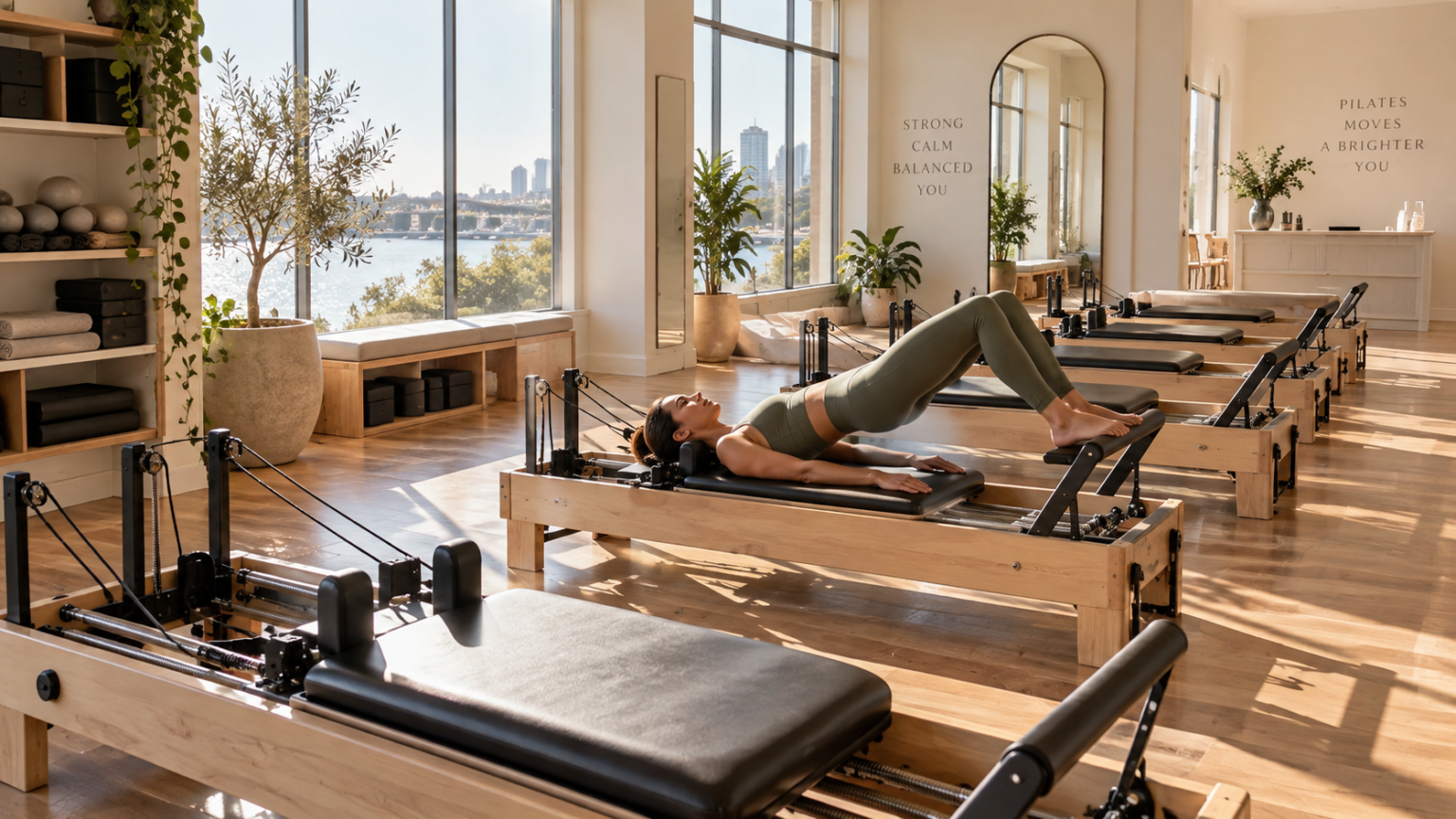
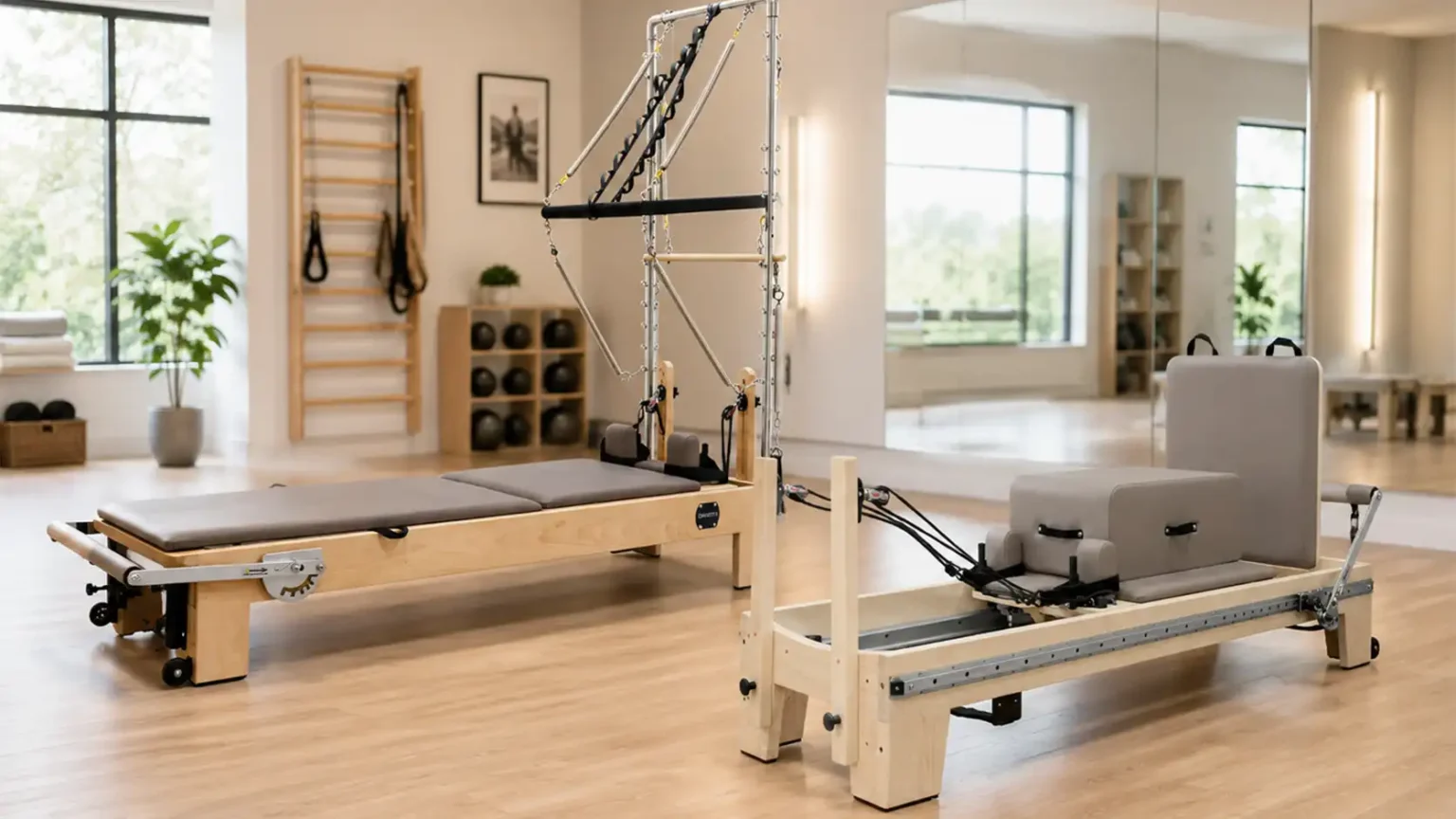
A Pilates reformer appears deceptively simple from the outside: a padded carriage on a frame, a set of springs, a footbar, and some ropes and pulleys. This first impression is misleading. The reformer is, from a manufacturing perspective, one of the most structurally complex and tolerance-sensitive products in the fitness equipment category — combining precision woodworking or aluminum fabrication, spring engineering to defined tension tolerances, rope and pulley systems calibrated for smooth resistance delivery, and an upholstered carriage system designed to glide silently and consistently across hundreds of thousands of use cycles.
Understanding the Pilates reformer structural design from a manufacturer’s perspective matters for any brand or buyer developing, sourcing, or evaluating commercial Pilates equipment. The difference between a reformer that studio operators trust as a clinical tool and one that generates complaints about spring tension inconsistency, carriage binding, or frame creaking is almost entirely attributable to specific engineering and material decisions made during the design and production process. This guide examines those decisions, from frame material selection through spring engineering to carriage wheel specification, with the technical specificity that sourcing and product development decisions require.
Frame Design: The Foundation of Reformer Structural Integrity
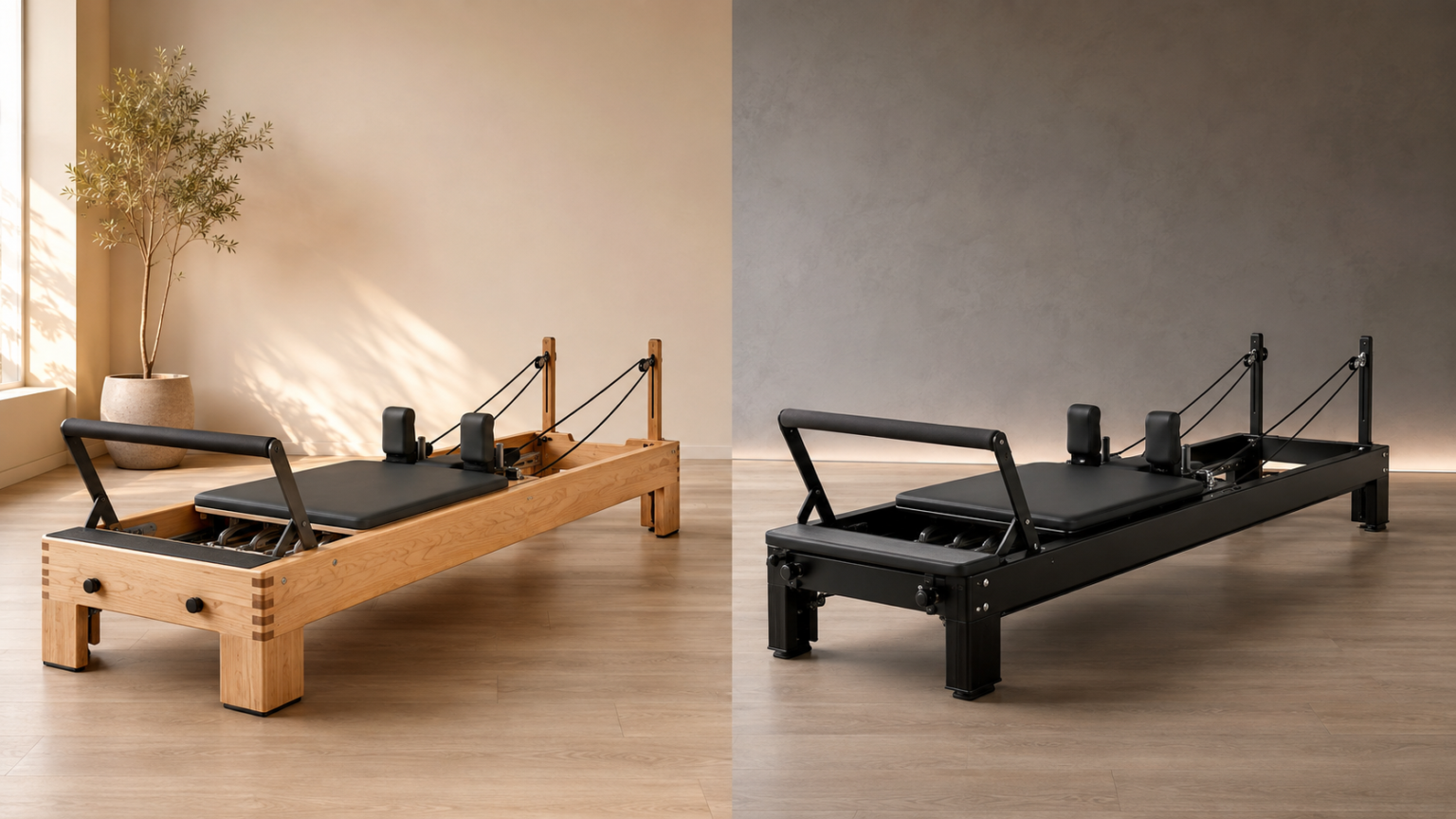
The reformer frame is the structural backbone from which every other component’s performance is derived. Frame rigidity determines carriage rail alignment stability over time; frame joint design determines whether the apparatus creaks and flexes under load or remains silent and stable; frame material determines the product’s visual character, weight, corrosion resistance, and manufacturing cost.
Wood Frames: Traditional Craft and Modern Engineering
Solid wood frames — primarily hardwoods including maple, oak, beech, and cherry — represent the traditional Pilates apparatus aesthetic and remain the dominant frame material for premium commercial reformers. High-quality manufacturers prioritize hardwoods such as oak and maple for the frame, chosen for their natural strength and resistance to wear. These woods undergo rigorous drying and curing processes to eliminate moisture, preventing warping over time.
The engineering challenge in wood frame design is dimensional stability: wood moves with changes in ambient humidity and temperature, and joints designed without adequate movement accommodation will develop gaps, squeaks, or stress cracks over time in the variable humidity environments of commercial studios and clinical facilities. Premium wood reformer manufacturers address this through several techniques: selecting kiln-dried lumber with moisture content below 8% before fabrication; using mortise-and-tenon or dovetail joinery for structural corners rather than butt-and-screw connections; applying glue and mechanical fastening in combination for primary structural joints; and finishing with penetrating oil or catalyzed lacquer systems that slow (though do not eliminate) moisture exchange with the environment.
Wood species selection has meaningful implications for both structural performance and aesthetic character. Maple — dense, tight-grained, and naturally resistant to surface marking — is the premium choice for high-traffic commercial reformers. Its hardness (Janka rating approximately 1,450 lbf) provides excellent dent resistance when equipment is handled by studio staff and clients. Oak offers similar structural properties with a more pronounced grain character that some studio operators prefer for its aesthetic warmth. Beech — widely used in European apparatus manufacturing — offers excellent machinability and dimensional stability with a tighter, more uniform grain than oak or maple.
Aluminum Frames: Commercial Durability and Precision Engineering
Aluminum alloy frames — primarily 6061-T6 extrusions — represent the engineering-forward approach to reformer construction, prioritizing dimensional precision, corrosion resistance, and long-term structural stability over the warm aesthetic of solid wood. Aluminum is lightweight, corrosion-resistant, and highly durable, maintaining structural integrity over time.
The primary engineering advantage of aluminum over wood is dimensional stability: aluminum extrusions do not move with humidity or temperature changes within normal studio operating ranges, meaning that rail alignment, carriage clearance, and footbar positioning remain consistent across years of operation without adjustment. For commercial Pilates studios where equipment alignment precision directly affects the quality of client sessions and the credibility of the instructor’s cueing, this dimensional consistency is a genuine clinical benefit.
Aluminum frame design for reformers typically uses hollow extruded sections in the 40×80mm to 60×120mm range for the main side rails, with welded or bolted end-cap structures connecting the head and foot ends of the frame. Critical design considerations include: the tolerance between the carriage wheel width and the rail inner dimension (directly affects carriage movement smoothness), the surface finish of the rail interior (anodized or powder-coated for smooth wheel contact), and the structural connection between the main rail and the cross-members that support the spring bar and footbar attachment points.
Frame Dimension Standards
Commercial Pilates reformers have evolved around a reasonably standardized set of frame dimensions that reflect the ergonomic requirements of the exercise repertoire and the user population. Typical commercial reformer dimensions are:
- External length: 2,200–2,500mm (varies with model and optional extensions)
- External width: 550–650mm
- Platform height (frame top to floor): 300–380mm (studio reformers) or 400–450mm (elevated tower models)
- Carriage travel length (maximum range of motion): 900–1,000mm
- Usable carriage platform dimensions: approximately 600×600mm
Brands developing proprietary reformer designs should confirm that their dimensional specifications are consistent with the standard footbar and shoulder rest mounting positions used by major spring and accessory suppliers, as departing significantly from these standards can make it difficult for studios to source replacement components from the open market — a potential commercial disadvantage versus brands whose accessories are interchangeable with industry-standard components.
The Spring System: The Heart of Reformer Resistance Engineering
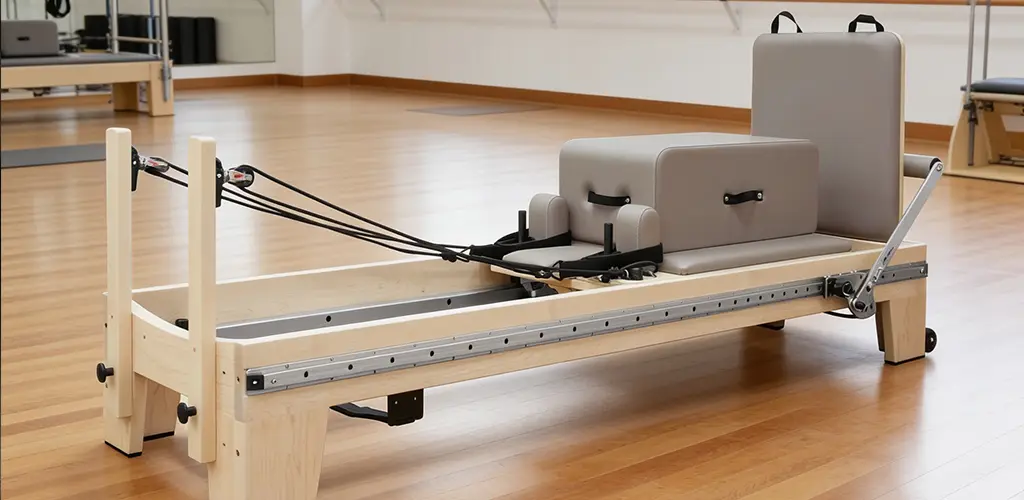
The spring system is functionally the most critical subsystem in a Pilates reformer. Springs determine the resistance profile experienced by the user throughout each exercise, and their consistency — both within a single reformer and across units in a studio fleet — directly affects the reproducibility of exercise protocols and the instructor’s ability to prescribe precise resistance levels for different client populations.
Spring Material and Construction
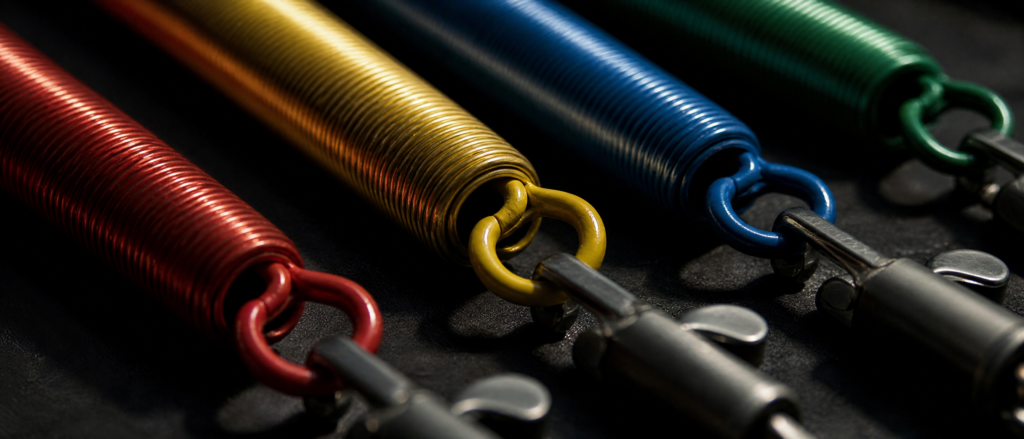
Springs are made from German or Korean imported piano wire, coiled and heat-treated to achieve uniform tension. Each spring is individually tested to meet load-bearing standards. Piano wire — high-carbon steel with carbon content typically 0.7–1.0% — is the preferred material for Pilates reformer springs because its high tensile strength and consistent elastic modulus allow precise spring rate engineering across a wide load range. The wire diameter, coil diameter, number of active coils, and overall spring free length are the four engineering parameters that determine the spring’s force constant (measured in Newtons per meter or lbs per inch).
Commercial Pilates reformers typically use four to five springs of defined resistance categories — commonly designated as full, half, quarter spring equivalents or numerically as “heavy,” “medium,” and “light” — that can be attached in various combinations to produce the range of resistance profiles required for different exercises and client strength levels. Different materials — carbon steel, stainless steel, or coated alloys — each bring unique characteristics in terms of strength, flexibility, and corrosion resistance. Stainless steel springs (304 or 316 grade) are preferred for clinical and high-humidity environments; carbon steel springs with nylon or PVC coating offer a cost-effective alternative with good corrosion protection for typical studio environments.
Spring Tension Calibration and Consistency
Spring tension calibration — ensuring that springs rated at the same resistance level actually produce the same force throughout their range of motion — is one of the most technically demanding quality control requirements in reformer manufacturing. Inconsistent or low-quality springs can lead to uneven resistance and reduced equipment lifespan. Reliable spring performance is particularly important in studios where multiple instructors and clients adjust equipment throughout the day.
The acceptable tolerance for spring tension consistency in commercial Pilates apparatus is typically ±5–8% of the rated tension at the standard testing extension (usually 50% of the spring’s maximum operating extension). Springs outside this tolerance range produce a perceptibly uneven resistance profile — experienced instructors and advanced practitioners can detect tension inconsistency across a spring set and may attribute it to equipment quality rather than exercise variation, which creates commercial complaints that damage the brand’s reputation with the professional Pilates community.
For OEM buyers sourcing commercial reformers, spring calibration verification should be a standard component of the pre-shipment inspection protocol: measuring the tension of each spring in each reformer at a defined extension against the specification, and flagging units where springs fall outside the acceptable tolerance band. This is a simple test with a calibrated spring scale or force gauge, but it is frequently omitted from standard OQC procedures unless explicitly specified by the buyer.
Spring Attachment and Hook Design
The spring attachment mechanism — how each spring hooks to the spring bar on the carriage and to the anchor point on the frame — is a detail that significantly affects both functional performance and safety. Commercial reformers require secure spring attachment that resists accidental disengagement during use while allowing deliberate adjustment by instructors without special tools. The hook geometry must maintain secure engagement across the full range of spring extension without stress concentration at the hook bend that could lead to metal fatigue failure over thousands of use cycles.
Spring hook design should include a safety feature — either a locking tab, a closed hook configuration, or a captive attachment point — that prevents the spring from disengaging accidentally if the hook opening is accidentally engaged against the attachment bar during use. Spring disengagement during a loaded exercise creates a sudden and significant change in resistance that can cause client injury, particularly for users with balance or neurological conditions. This safety dimension makes spring attachment design a liability-relevant specification area for clinical and rehabilitation market buyers.
| Spring Specification Parameter | Commercial Studio Standard | Clinical / Rehabilitation Standard | Home Use Standard |
|---|---|---|---|
| Wire material | Piano wire (high-carbon) or coated carbon steel | 304 stainless steel or nylon-coated piano wire | Carbon steel with PVC or nylon coating |
| Tension calibration tolerance | ±5–8% at test extension | ±3–5% at test extension | ±8–12% acceptable |
| Corrosion resistance | Nylon or vinyl coating | Stainless steel or medical-grade coating | Standard coating acceptable |
| Hook design | Secure engagement with safety locking feature | Captive attachment, tool-free adjustment | Standard hook; secondary safety acceptable |
| Cycle fatigue life | Minimum 500,000 extension cycles | Minimum 750,000 extension cycles | Minimum 100,000 extension cycles |
The Carriage System: Engineering Smooth, Silent Movement
The carriage — the padded platform that the practitioner’s body contacts and that moves along the reformer rails during exercise — is the most mechanically active component in the system. Carriage quality determines the character of the reformer’s movement: whether it feels smooth, precise, and effortlessly controllable, or jerky, resistant, and inconsistent.
Carriage Wheel Design and Material
The carriage rides on wheels that roll along the interior surface of the reformer frame rails. Silent wheels are a key component ensuring smooth operation and overall performance. Commercial Pilates reformers use precision wheels — typically polyurethane or nylon composite — whose diameter, width, and bearing specification determine both rolling smoothness and noise level.
Polyurethane wheels provide better vibration damping (producing a quieter, more cushioned carriage feel) while nylon or Delrin composite wheels offer lower rolling resistance and greater durability against surface wear. Premium commercial reformers typically use polyurethane or nylon wheels with sealed stainless steel or chrome steel bearings — sealed to prevent contamination from dust and humidity in studio environments. Unsealed bearings in studio reformers develop corrosion and contamination-related roughness within 12–18 months of use, creating the characteristic grinding or catching sensation that generates client complaints.
The fit between the wheel outer diameter and the rail inner surface determines carriage play — the amount of lateral movement in the carriage perpendicular to its direction of travel. Some carriage play is acceptable and normal; excessive play creates a side-to-side wobble that feels imprecise and can destabilize practitioners during balance-sensitive exercises. Commercial reformer manufacturing should maintain carriage lateral play within a defined specification (typically 1–2mm maximum lateral displacement under normal loading) and should include this measurement in the pre-shipment inspection protocol.
Carriage Platform and Upholstery Specification
The carriage platform — the structural surface on which the practitioner lies, kneels, and sits during exercise — must support the full body weight of the user plus any additional loads from spring resistance and movement momentum. Commercial reformer carriage platforms are typically constructed from marine-grade plywood (9–12mm thickness, void-free) or MDF (medium-density fiberboard), covered with high-density foam (typically 50mm thick at 35–45 kg/m³ density) and upholstered in vinyl, leatherette, or genuine leather.
Foam density is a critical specification for commercial use: foam at the lower end of this density range (35 kg/m³) will compress and develop permanent deformation within 12–18 months under daily commercial use, creating an uneven carriage surface that affects exercise technique and client comfort. Foam at 45 kg/m³ or above maintains its dimensional integrity through years of heavy commercial use. For OEM buyers specifying commercial reformer carriage upholstery, foam density should be explicitly specified in the product brief, with a verification protocol at sample approval that includes foam density measurement (using a simple water displacement test on a sample core cut from the approved foam batch).
Footbar Design and Adjustability Engineering
The footbar — the horizontal bar at the foot end of the reformer against which practitioners push in the majority of core reformer exercises — is a structurally and ergonomically critical component whose design quality significantly affects both exercise performance and user safety.
Footbar Height Adjustment Mechanisms
Commercial reformer footbars require multiple height positions to accommodate the diverse exercise repertoire and the range of user leg lengths and exercise protocols in studio use. Footbar adjustment mechanisms range from simple pin-and-hole systems (where the footbar is manually repositioned to a different hole in the side brackets) to lever-operated gas-assist systems (where a single hand lever releases a spring-loaded or gas-assisted mechanism and the footbar repositions to the desired height under user control without requiring lifting the bar).
The quality criterion for footbar adjustment mechanisms is a combination of secure locking engagement (the footbar must not move under the full pushing force applied during footwork exercises — typically 30–80 kg of applied load), smooth and intuitive operation (instructors adjust footbar position multiple times during each session; mechanism stiffness or complexity creates operational friction that accumulates into a meaningful disruption of session flow), and durability under high-cycle operation (a busy commercial studio may cycle the footbar position 200+ times per day across a fleet of 12 reformers).
Footbar Diameter and Surface Material
Commercial reformer footbars typically use 32mm–38mm diameter steel tubing — large enough to provide a stable push surface for the heel and ball of the foot in footwork positions, and small enough to allow secure grip when the footbar is used in hand positions during standing exercises. Surface treatment must be simultaneously grip-friendly (not slippery under sweaty foot contact) and comfortable for skin contact (not abrasive or thermally uncomfortable when the bar is in an air-conditioned studio environment).
Standard commercial footbar finishes include rubber-wrapped steel, stainless steel with textured surface, and chrome-plated steel with knurling. Rubber wrapping provides excellent grip and thermal comfort but requires replacement as the rubber degrades with cleaning chemical exposure over time. Stainless steel or chrome with surface texture provides durability and hygiene advantages but requires more careful surface engineering to achieve adequate grip — particularly important for reformer practitioners working barefoot.
Rope, Strap, and Pulley System Engineering
The rope and strap system — through which the practitioner’s arms and legs apply resistance to the spring system via the carriage — must deliver smooth, consistent resistance across the full range of motion of each exercise without fraying, stretching, or creating binding resistance at the pulleys. Rope and pulley systems, hook straps, and risers play a vital role in ensuring smooth operation, user safety, and overall performance.
Commercial reformer ropes are typically constructed from nylon or polyester braid — materials that resist fraying, maintain consistent elongation characteristics across temperature changes, and withstand the abrasion of daily pulley cycling. Rope diameter (typically 8–10mm for commercial apparatus) determines the mechanical advantage at the pulley system and the tactile feel of the handhold.
Pulley design — wheel diameter, bearing quality, and frame attachment rigidity — determines how smoothly resistance transfers from the rope to the spring system throughout the range of motion. Small-diameter pulleys create sharper friction angles that increase rope wear and mechanical resistance; larger-diameter pulleys reduce friction angle and extend rope life. Commercial reformers should use pulleys of at least 60mm diameter with sealed bearings for low-friction, long-service performance. Our complete Axispila Pilates reformer range incorporates these engineering standards across all commercial product configurations.
Quality Testing Protocol for Commercial Pilates Reformers
Before any commercial Pilates reformer is approved for production and shipping, a defined quality testing protocol should verify the performance of each structural system against specification. The following testing framework reflects the minimum quality verification standard for commercial apparatus:
- Frame dimensional verification: Measure carriage travel length, frame squareness (diagonal measurement), rail parallelism (rail gap consistency across the full travel length), and footbar positioning at each adjustment position against specification.
- Spring tension calibration: Measure the tension of each spring at 50% of maximum operating extension using a calibrated force gauge. Verify that all springs of the same designated resistance category fall within the specified tolerance band (±5–8% commercial standard).
- Carriage movement test: Load the carriage to 120 kg static load and operate through the full travel range 50 times. Verify smooth operation, no lateral play exceeding specification, no noise or binding at any point in the travel range.
- Structural load test: Hydraulic presses simulate up to 300 kg of weight to ensure structural integrity. Apply rated maximum user load plus 50% safety factor to the carriage in the fully extended position, the fully retracted position, and the midpoint of travel. Hold for 5 minutes at each position and verify no visible deformation or joint movement.
- Footbar engagement test: Apply the maximum rated footwork force (typically 80–120 kg) to the footbar at each height position and verify no movement or disengagement of the adjustment mechanism.
- Pulley and rope cycling test: Cycle the rope system through 1,000 complete travel cycles and inspect for rope fraying, pulley bearing noise, or resistance change.
- Upholstery inspection: Verify foam density against specification (water displacement test on sample core), stitching integrity at all seams, and cover adhesion to the foam substrate.
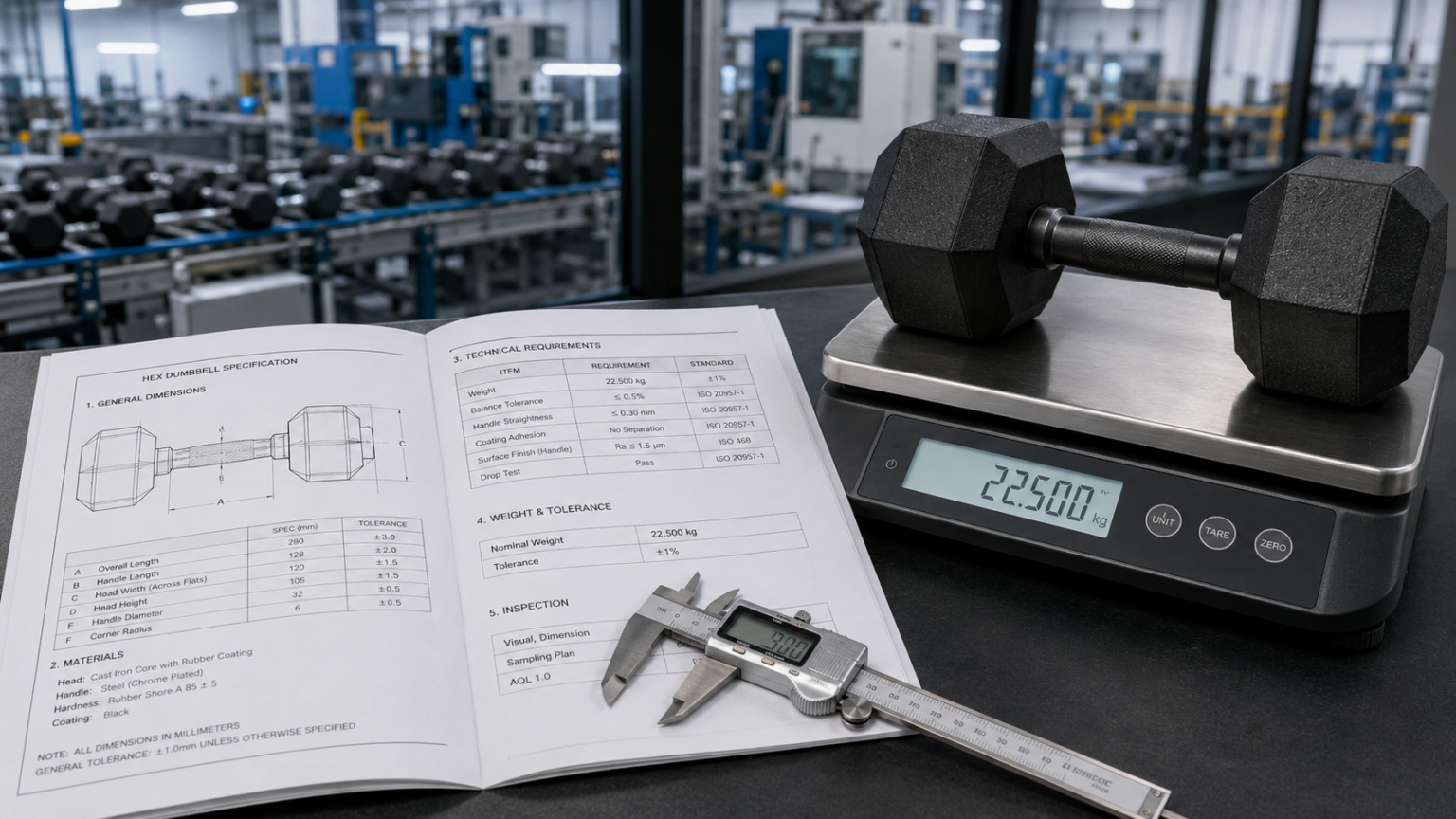
This testing protocol should be documented and completed for each unit or for a defined AQL sample from each production batch, with results recorded and retained as part of the production quality record. For OEM buyers requesting commercial Pilates reformers under a private label program, including this testing protocol in the production agreement — and requiring test records to accompany each shipment — provides the quality assurance documentation that studio operator and clinical buyers increasingly require from their equipment suppliers. Our OEM/ODM services for Pilates apparatus include structured quality documentation for all these test parameters.
Frequently Asked Questions
What is the difference between aluminum and wood frame Pilates reformers?
Aluminum frames offer superior dimensional stability (no movement with humidity changes), corrosion resistance, and precision manufacturing tolerances. Wood frames offer traditional aesthetic warmth, natural vibration damping, and a tactile quality associated with handcrafted apparatus. For commercial studios prioritizing rail alignment consistency over years of use, aluminum is the engineering-superior choice. For studios where aesthetic and brand positioning are primary considerations, premium hardwood frames from manufacturers using proper wood preparation and joinery techniques provide excellent long-term performance alongside superior visual character.
How many springs does a commercial Pilates reformer use and what do they do?
Commercial reformers typically use 4–5 springs of varying resistance levels — commonly designated as heavy, medium, and light or full, half, and quarter spring equivalents. Springs are attached in different combinations to the carriage spring bar to produce the range of resistance profiles required for different exercises. More springs = more resistance; fewer springs = lighter resistance. The combination flexibility allows a single reformer to support exercises ranging from very light (appropriate for post-surgical rehabilitation) to very heavy (appropriate for advanced strength training protocols).
What foam density should a commercial Pilates reformer carriage use?
Commercial reformer carriage foam should be specified at a minimum density of 40–45 kg/m³ (2.5–2.8 lb/ft³) for daily multi-user commercial use. Foam below 35 kg/m³ will develop permanent compression deformation within 12–18 months of commercial use, creating an uneven surface that affects exercise technique. Foam density should be explicitly specified in OEM production agreements and verified at sample approval through a simple density measurement, not assumed from visual inspection of the finished pad.
What is the typical warranty structure for commercial Pilates reformers?
Commercial Pilates reformers typically carry tiered warranty coverage reflecting the different durability expectations of each component system: lifetime or 5+ year structural warranty on the main frame; 1–2 years on springs and mechanical components; and 90 days to 1 year on upholstery, ropes, and straps. This tiered structure reflects the genuine durability hierarchy of the components — frames last the life of the product; springs and mechanism components have defined cycle lives; upholstery and consumables wear faster under daily commercial use. Always request the specific warranty terms for each component category, not a single blanket warranty statement.
How do I verify spring tension consistency in a Pilates reformer before purchase?
Request a spring tension calibration record from the manufacturer for your specific units, confirming that each spring of each designated resistance category has been individually measured and verified within the specified tolerance band. For studio operators evaluating reformers before a purchase decision, a simple field test involves loading each spring of the same designated resistance category onto a luggage scale or hanging spring scale and comparing the measured force at a consistent extension point. Springs within the same category should not vary by more than 5–10% from each other — if they do, tension inconsistency will be perceptible to instructors and advanced practitioners during use.
Conclusion
The Pilates reformer structural design encompasses engineering decisions at every level — from frame material selection and joint design through spring wire specification and tension calibration to carriage wheel bearing choice and footbar adjustment mechanism durability. Each of these decisions has a measurable impact on the reformer’s functional performance in commercial use, and the commercial distinction between apparatus that earns the trust of professional Pilates instructors and apparatus that generates chronic complaints is almost entirely explainable by the quality of these engineering and specification choices.
For brands developing or sourcing commercial Pilates apparatus, this engineering depth is also a purchasing criterion framework: the questions to ask of any OEM manufacturer, and the specifications to include in any production agreement, flow directly from the system-level understanding this article provides. If you are developing a commercial Pilates reformer program or evaluating manufacturing options for an existing Pilates product line, our Axispila engineering team is available to discuss specifications, prototyping, and production partnership for the full range of commercial Pilates apparatus.