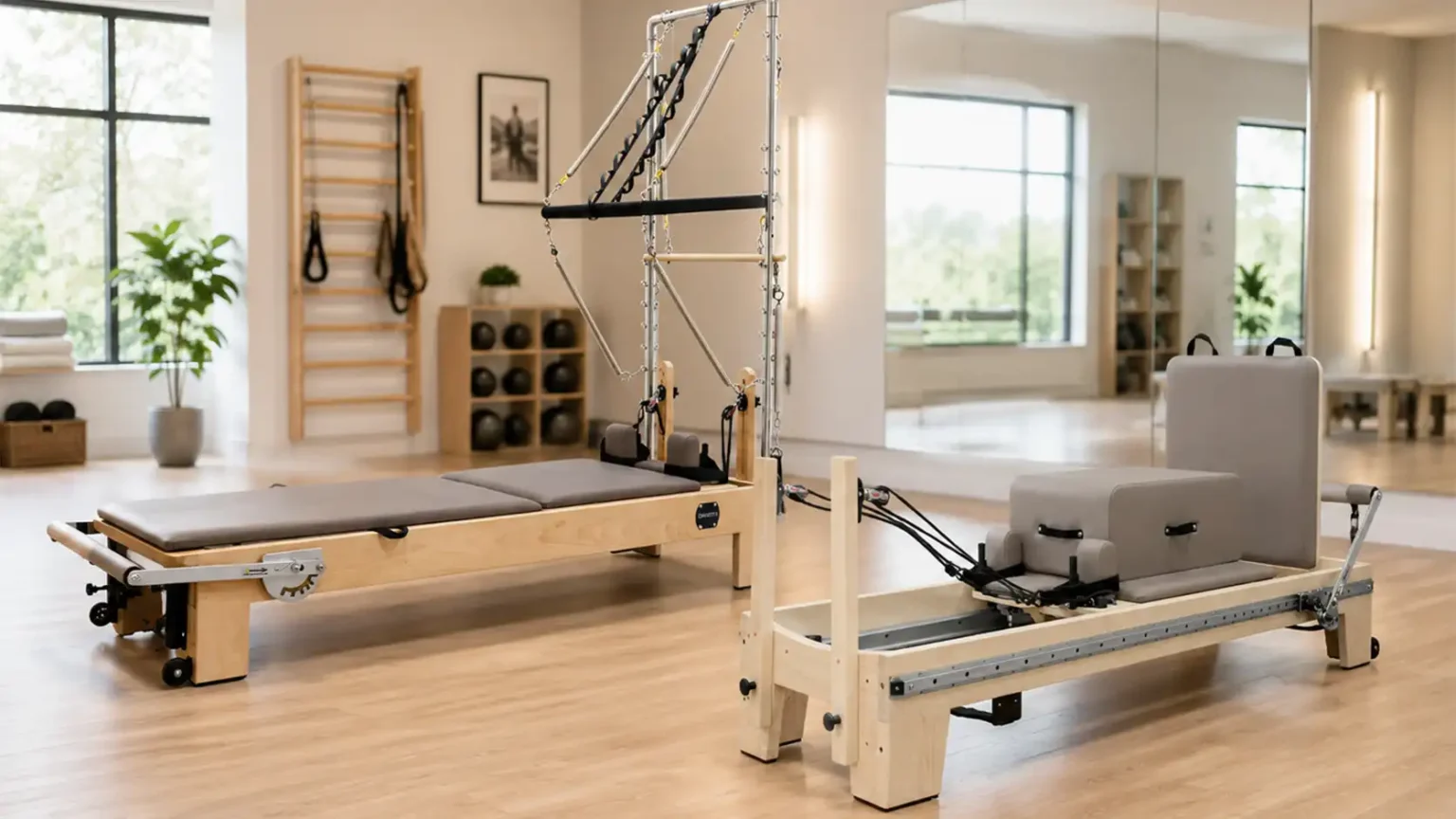
The Pilates Cadillac — formally known as the Trapeze Table — occupies a unique position in the Pilates apparatus ecosystem. A staple of nearly every Pilates facility, the Cadillac offers over 200 exercises for everyone from post-rehab clients to advanced athletes. No other single piece of Pilates apparatus approaches this exercise range: a well-equipped Cadillac can deliver everything from the most gentle spring-assisted supine movements for acute rehabilitation clients to advanced aerial acrobatics for elite movement practitioners. This versatility makes it one of the most demanding pieces of fitness equipment to engineer for commercial durability — it must simultaneously support delicate assisted rehabilitation work and tolerate the mechanical demands of vigorous athletic Pilates training, multiple times daily, across a 10–15 year commercial lifespan.
Understanding the Pilates Cadillac structural design — from the four-post canopy frame and table base through the spring system, attachment bars, and sliding crossbar mechanism — provides manufacturers, OEM buyers, and studio operators with the technical foundation to evaluate commercial apparatus quality, specify appropriate components, and understand why genuine commercial-grade Cadillacs cost significantly more than consumer-grade alternatives. This article provides that structural breakdown from a manufacturer’s perspective.
Origins and Functional Philosophy
The Cadillac machine was developed by Joseph Pilates himself during the early twentieth century. The original design was reportedly built using hospital bed springs attached to the frames of patient beds. The name “Cadillac” was coined by Joseph Pilates’ students — a playful nod to the luxury American automobile — because if the Reformer was the standard model, this apparatus was the top-of-the-line version.
This origin story is significant for understanding the Cadillac’s engineering philosophy. Unlike the Reformer — which was designed from the outset as a purpose-built exercise machine — the Cadillac emerged from the improvised combination of a hospital platform (for client positioning), springs (for resistance), and an overhead frame (for suspension and traction). The modern commercial Cadillac preserves this three-element structure: a fixed table platform, an overhead canopy frame, and a spring system — but each element is now engineered to commercial standards that the improvised original could not achieve.
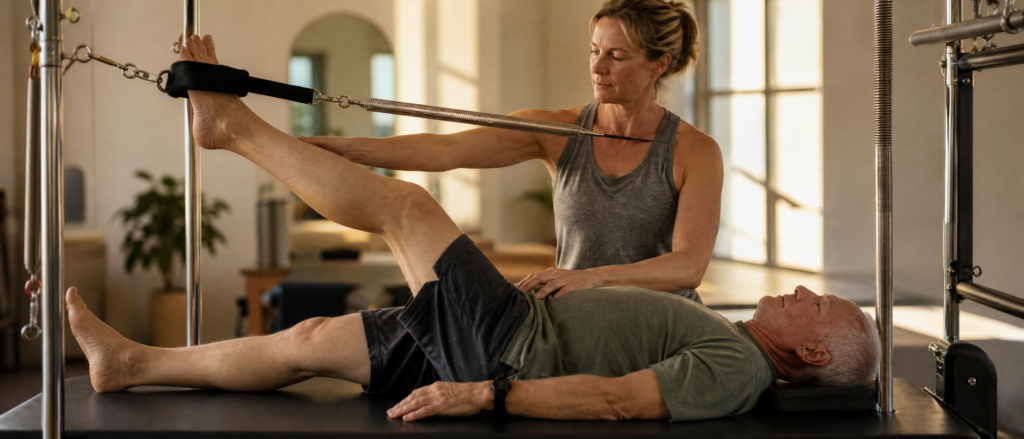
The functional philosophy of the Cadillac is decompression and multidirectional resistance — the overhead frame enables exercises that work against gravity, provide spinal traction, support suspended movement, and allow the instructor to access the client from all sides without obstruction. This multidirectional functionality is the source of the 200+ exercise repertoire and is also the structural demand that defines commercial durability requirements: the frame must be stable under loading from every direction, including upward suspension forces that ground-based fitness equipment is never required to resist.
The Table Platform: Foundation and Ergonomic Design
The table platform is the horizontal padded surface on which most Cadillac exercises begin — the equivalent of the reformer’s carriage, except fixed rather than sliding. Its height, width, length, and surface characteristics directly affect user accessibility, instructor access, and exercise safety.
Table Dimensions and Height Options
The Balanced Body Trapeze Table base is 81 inches (206cm) long by 29 inches (74cm) wide and 25.5 inches (65cm) high. The frame is available in 14-inch (36cm) and 18-inch (46cm) heights. These dimensions reflect the ergonomic requirements of the full exercise repertoire: length must accommodate the full body length of tall practitioners in extended positions; width must allow the instructor to stand alongside the table and provide hands-on guidance; and height must allow safe mounting and dismounting for a wide range of client mobility levels.
The 14-inch versus 18-inch table height distinction reflects different user population priorities. Lower tables (14 inches) are preferred for rehabilitation settings where clients with mobility limitations need minimal step height for safe access. Higher tables (18 inches) provide better ergonomic working height for instructors during assisted exercises and are preferred for training environments where most clients have normal mobility. Commercial Cadillacs should offer height options to serve both populations; single-height products typically make a fixed design choice that inevitably sub-optimizes for one context.
Table Frame and Base Construction
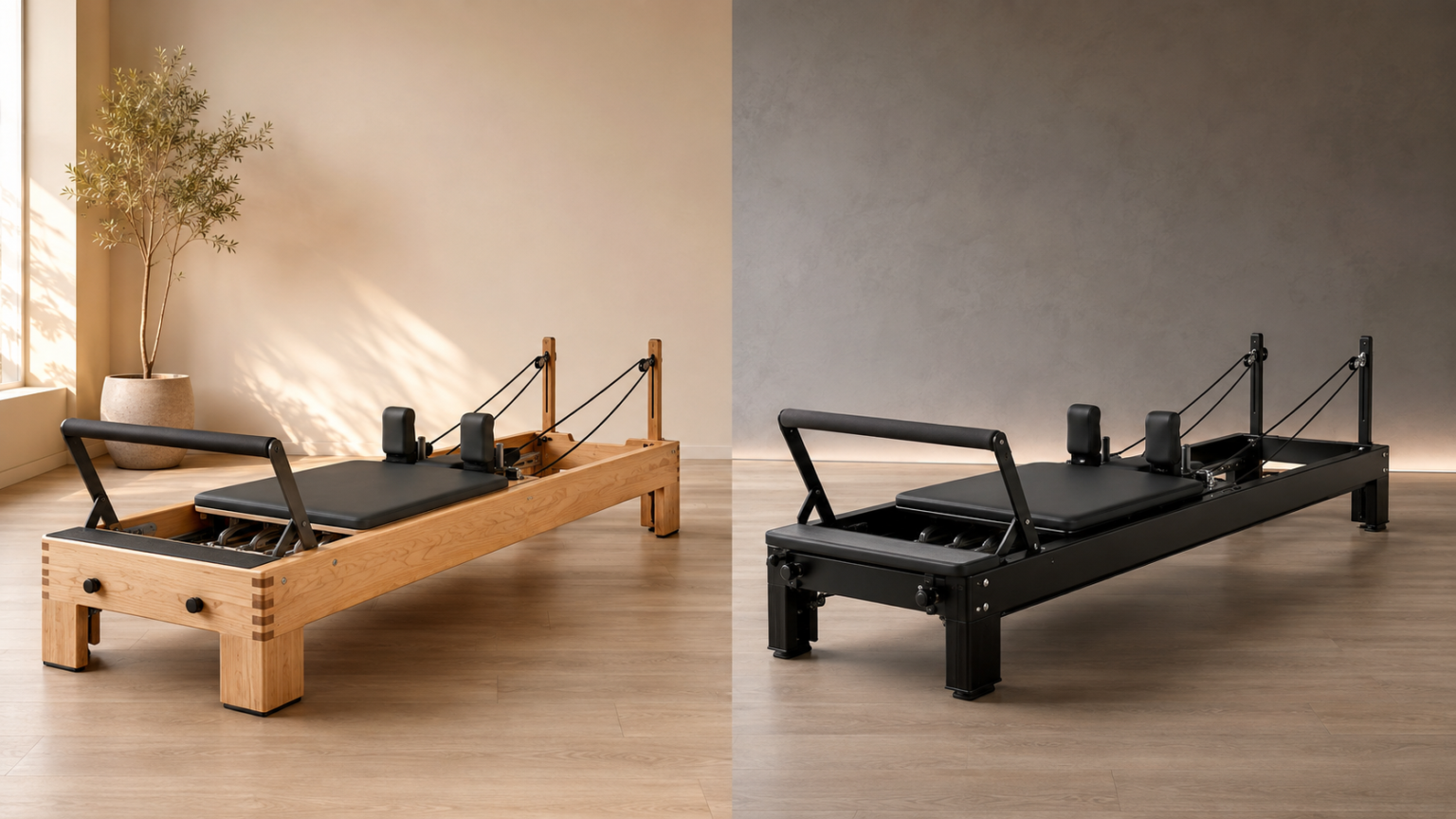
The table base — the structural platform that supports the user’s weight and provides the anchoring points for the canopy posts — is the most structurally loaded element in the entire apparatus. The stainless-steel frame sits on a solid, stable maple wood base handcrafted with lapped and fitted joints for maximum strength and durability. The combination of materials is deliberate: the wood base provides the dimensional stability and visual warmth appropriate for studio environments, while the stainless steel frame elements provide corrosion resistance and the mechanical strength required for the attachment points that connect the canopy posts to the base.
For all-wood base construction — common in premium commercial Cadillacs — the joint design at the base corners is the most structurally critical specification. The wider base compared to traditional Cadillacs can accommodate a broad range of body types. Mortise-and-tenon or bolted metal-insert joints at the table leg-to-rail connections must resist the rocking forces generated when clients shift weight laterally during side-lying exercises, and the downward bending forces from clients sitting at the table edge during seated exercises. Tables with glued butt joints at these locations will develop movement and squeaking under commercial use within months; proper mechanical joint design maintains rigidity across years.
Platform Upholstery and Foam Specification
The padded surface of the Cadillac table functions as a treatment table as much as an exercise surface — clients perform supine, prone, side-lying, and seated exercises that place the body in contact with the platform surface for extended periods. Upholstery specification must therefore address both durability under high-contact use and comfort during prolonged exercise sessions.
Commercial Cadillac table foam should be specified at 40–50kg/m³ density for daily multi-user operation — the same specification recommended for commercial reformer carriage pads. Foam at 35kg/m³ or below will develop significant permanent deformation within 12–18 months of daily commercial use, creating an uneven surface that affects body alignment and exercise efficacy. Private Pilates warrants wearable parts including foot straps, handles, and vinyl for 90 days — reflecting the reality that upholstery is the highest-wear component in commercial apparatus and should be designed for accessible replacement rather than assumed to be permanent.
Vinyl upholstery is the standard commercial choice for Cadillac surfaces — it is impermeable to sweat, easily cleaned with standard studio cleaning solutions, and available in custom colors. Premium vinyl upholstery is available in up to 35 custom colors for boutique studios where visual identity extends to apparatus color choice. Genuine leather is occasionally specified for ultra-premium installations; it requires more careful maintenance and is significantly more expensive but provides a distinctive tactile and visual quality that some high-end studios specify as a brand differentiator.
The Canopy Frame: Engineering for Suspension and Safety
The canopy frame — four vertical posts connected by horizontal crossbars — is the defining structural feature that distinguishes the Cadillac from all other Pilates apparatus. Its engineering requirements are unique in the fitness equipment category because the loading is fundamentally different from ground-based equipment: suspension exercises place the canopy under upward tension from body weight, spring loading applies bending forces to the horizontal crossbars, and dynamic movement generates vibration and impact loads that must be absorbed without structural resonance or fastener loosening.
Canopy Post Material: Stainless Steel vs. Chrome-Plated vs. Aluminum
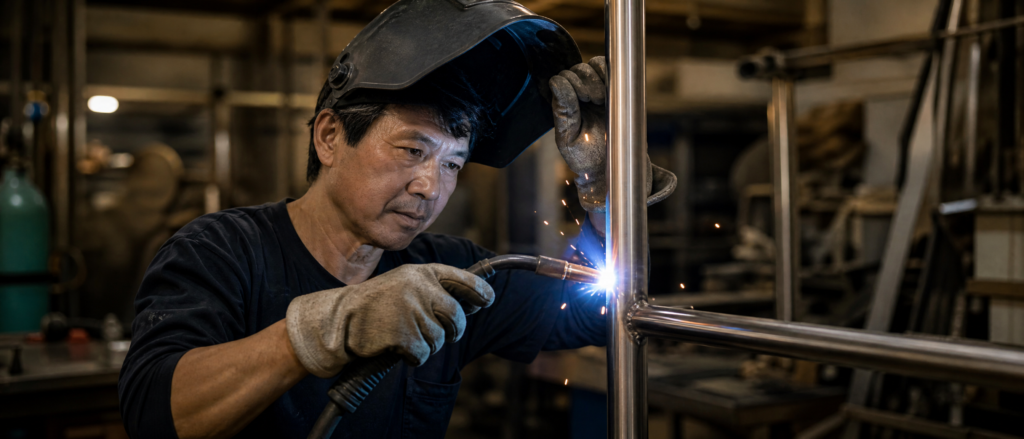
Stainless steel frames are significantly superior to painted or chrome-plated frames from other manufacturers, which can rust if scratched or chipped. This is the most commercially consequential material selection decision in Cadillac design. In commercial studio environments where apparatus is cleaned daily with cleaning agents, the corrosion resistance of the canopy material determines whether the apparatus maintains its visual presentation over years of use or becomes an eyesore requiring replacement on a 3–5 year cycle.
304 stainless steel — the standard alloy for commercial Pilates apparatus — provides excellent corrosion resistance in normal studio environments (neither marine nor highly industrial) without the maintenance requirements of chrome plating or the finish limitations of painted steel. 316 stainless steel offers superior corrosion resistance for coastal or high-humidity environments at modestly higher material cost. Aluminum alloy posts — used in some lightweight or travel Cadillac designs — provide good corrosion resistance and weight reduction but require careful load analysis to verify adequate structural stiffness under suspension loading.
Post Diameter and Wall Thickness
Commercial Cadillac posts typically use 38–51mm outer diameter steel tubing with wall thickness of 2–3mm for standard commercial applications, increasing to 3–4mm wall thickness for premium commercial apparatus designed for heavy rehabilitation use. The post diameter affects both structural stiffness (larger diameter = more resistant to lateral bending under suspension loads) and visual proportion — posts that appear too thin relative to the table base create a visual instability impression even when the structural performance is adequate.
Canopy post height determines the clearance available for suspension exercises — hanging from the trapeze bar, standing pole work, and aerial movements all require adequate overhead clearance above the table surface. Commercial Cadillacs typically provide approximately 155–165cm of clearance from the table surface to the lowest overhead bar position, accommodating practitioners up to approximately 195cm in height in most suspension exercises. Installations in studios with lower ceilings should verify clearance requirements against the exercise repertoire intended to be delivered before purchasing apparatus.
Horizontal Crossbars and the Sliding System
The horizontal crossbars — which run along the length of the canopy at the top and provide the attachment points for springs, bars, and accessories — must accommodate the full range of spring and accessory positioning required by the 200+ exercise repertoire. Commercial Cadillacs achieve this through either fixed-position attachment rails (where springs hook to defined positions along the bar) or sliding crossbar systems (where the crossbar itself slides along the upright posts to infinitely adjust its height).
Sliding cross bars feature self-lubricating, greaseless bearings for ease of movement. The Slide System makes repositioning the push-through bar a fast, quiet, and one-person job that will not interrupt session flow. This sliding system design — where crossbar repositioning can be accomplished in seconds during a session by a single instructor without tools — is a significant functional differentiator between professional commercial Cadillacs and budget alternatives where crossbar repositioning requires significant effort or tooling. In a busy commercial studio where the Cadillac is used for consecutive sessions by different clients with different exercise requirements, session transition efficiency is a genuine commercial consideration.
The Spring System: Resistance Architecture
The Cadillac spring system is more complex than the reformer’s spring configuration — the overhead attachment rail positions, the variety of spring lengths and resistance ratings required for different exercise categories, and the carabiner and strap attachment system all contribute to a spring architecture that demands careful specification for commercial durability.
Spring Categories and Configuration
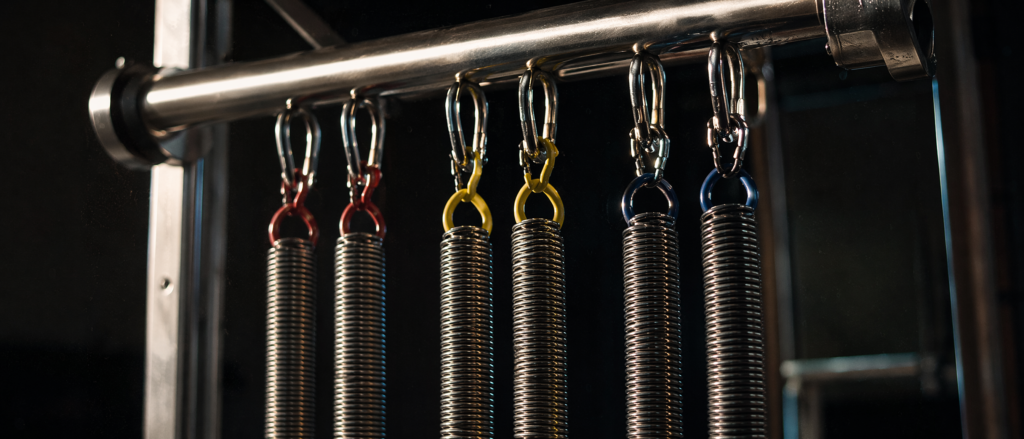
Commercial Cadillacs typically include 8–12 springs in 4–5 resistance and length categories. A professional Cadillac Table comes with 10 commercial grade springs: 2 red (heavy), 2 green (medium), 2 yellow (soft), 2 long green (medium), and 2 long yellow (soft). The distinction between standard-length and long springs reflects different exercise categories: standard springs are used for arm springs and leg springs in supine and seated positions; long springs are used for standing exercises and exercises requiring the spring attachment point at a distance from the client’s body.
The Cadillac spring calibration standard follows the same ±5–10% tolerance recommended for reformer springs — but the clinical population served by Cadillac exercises often includes more medically compromised clients (acute rehabilitation, neurological conditions, spinal pathology) for whom spring tension inconsistency has greater safety implications than in a healthy-adult commercial gym context. For Cadillac apparatus designated for clinical rehabilitation use, specifying ±5% tension tolerance (rather than the ±8–10% acceptable for standard commercial reformer use) provides an additional safety margin appropriate for the population.
Attachment Hardware: Carabiners, S-Hooks, and Safety
The hardware connecting springs to the frame rail and to the exercise attachment (fuzzy loop, strap, or bar) is a critical safety component that is frequently underspecified in budget apparatus. Carabiners used for spring attachment must be rated for the combined spring force plus dynamic loading factor — for body-weight suspension exercises, the carabiner at the trapeze bar must be rated for the full user body weight (typically 120–150kg for safety factor coverage) under dynamic loading conditions.
Standard climbing carabiners — which some lower-cost Cadillac manufacturers use as a cost reduction — are rated for static rope climbing loads that involve slow, controlled force application. Pilates exercises involve more sudden force application when clients push through spring resistance: the dynamic loading factor (typically 1.5–2× static load for exercise equipment) must be accounted for in carabiner selection. For commercial apparatus, specifying carabiners rated to EN362 or ANSI Z359.12 industrial standards — rather than consumer climbing grades — provides the appropriate safety margin for commercial studio use.
| Component | Commercial Standard | Key Specification | Durability Driver |
|---|---|---|---|
| Canopy posts | 304 stainless steel | 38–51mm OD, 2–3mm wall | Corrosion resistance, lateral stiffness |
| Table base | Maple hardwood or stainless steel | Lapped/fitted joints, steel inserts at post attachment | Joint rigidity, moisture resistance |
| Sliding crossbars | Stainless steel with self-lubricating bearings | Greaseless bearings, single-person adjustable | Session efficiency, bearing longevity |
| Springs (standard) | Piano wire or 304 SS, nylon/vinyl coated | ±5–8% tension tolerance, 500,000+ cycle life | Calibration consistency, fatigue life |
| Carabiners | EN362 or ANSI Z359.12 rated | Rated for dynamic loading + safety factor | Safety under suspension loads |
| Platform foam | High-density polyurethane | 40–50 kg/m³, 50mm depth | Shape retention under daily use |
| Upholstery vinyl | Commercial vinyl with antimicrobial treatment | Medical-grade cleaner compatible | Seam integrity, chemical resistance |
Attachment Bars: The Push-Through Bar and Roll-Down Bar
Two specialized attachment bars define the Cadillac’s functional identity and cannot be found on any other piece of Pilates apparatus: the push-through bar and the roll-down bar. Both bars must be engineered for the specific force profiles of their intended exercises — force profiles that differ significantly from the more familiar spring and carriage loading of the reformer.
The Push-Through Bar: Design and Adjustment Mechanism
The push-through bar is a horizontal bar attached to the overhead frame by a vertical post, positioned to hang at approximately chest height above the platform when the client is supine. Its defining characteristic is that it pushes — the client extends the bar upward against spring resistance, working the shoulder girdle and core against a resistance that would otherwise pull the bar back down. This loading direction (downward spring tension against upward manual push) is biomechanically unusual and creates specific force demands on the bar’s mounting: the attachment must resist both upward force (from the spring pulling down) and the eccentric loading of a practitioner pushing asymmetrically through one side.
The aluminum push-through bar adjusts to three vertical positions using the innovative Slide System, making repositioning a fast, quiet, one-person operation that will not interrupt the session flow. The pivot height adjustment — which changes the effective spring attachment height relative to the client — is the most frequently operated adjustment on the Cadillac, used multiple times per session for different exercises and different client heights. This adjustment mechanism must operate smoothly and reliably across hundreds of thousands of cycles without developing play or friction that impedes single-handed operation.
The Roll-Down Bar and Safety Bar Design
The roll-down bar — a padded horizontal bar attached by straps to the overhead frame at approximately waist height — is used for standing and seated roll-down exercises that use the spring-loaded bar for spinal flexion work. The bar must support the client’s full body weight in some exercise configurations, requiring structural ratings equivalent to the suspension hardware specifications described above for spring attachment carabiners.
A safety bar — fixed horizontally across the base of the canopy frame — prevents clients from inadvertently rolling off the end of the table during supine exercises and provides a foot stabilization point for certain exercise configurations. Its structural specification is straightforward (adequate to resist foot-pushing forces during exercise), but its placement and padding quality are critical ergonomic details: a safety bar positioned incorrectly or inadequately padded creates contact discomfort that instructors work around by repositioning clients — defeating its safety function.
Durability Testing for Commercial Cadillac Apparatus
Commercial-grade durability for the Pilates Cadillac must address the full spectrum of loading modes that occur in professional studio use — modes that span from delicate assisted rehabilitation work to vigorous suspension exercises. A commercial durability testing protocol should cover:
- Canopy frame lateral load test: Apply horizontal force equivalent to 1.5× the maximum body weight (typically 150–180kg horizontal force) to the top of the canopy frame in the most unfavorable direction (perpendicular to the long axis of the table) and verify no structural deflection, joint movement, or post-connection loosening.
- Suspension load test: Hang a static load of 200kg from the central overhead bar attachment point for 30 minutes; verify no bar deformation, bearing movement, or post settlement.
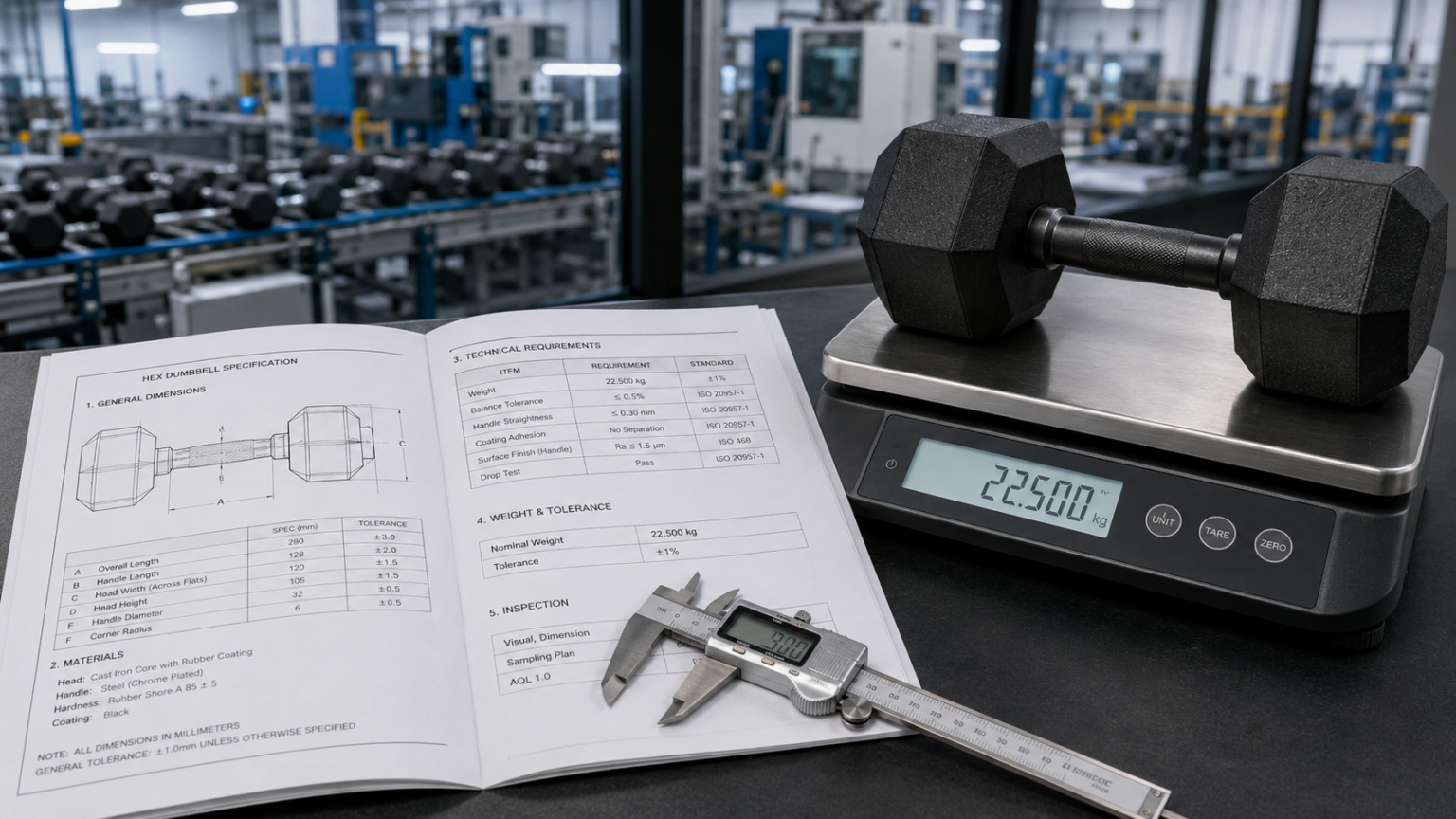
- Push-through bar cycle test: Cycle the push-through bar through its full range of motion 5,000 times under rated spring load; verify no play development, mechanism wear, or surface coating delamination.
- Table base joint test: Apply 150kg static load to the table corner (simulating a client sitting at the edge) and 80kg asymmetric loading (simulating side-lying exercises) while inspecting for joint movement or creak development.
- Spring cycle fatigue test: As specified for reformer springs — minimum 500,000 extension cycles for commercial-grade springs, with tension verification at 100,000-cycle intervals.
PilatesEquip offers a 4-year warranty on their Cadillac equipment, reflecting confidence in the durability and quality of their products. Leading commercial Cadillac manufacturers offer structural warranty periods ranging from 4 years to limited lifetime on the main frame — a significant warranty commitment that reflects the engineering quality required to sustain commercial use across the advertised warranty period. Our Axispila Cadillac Trapeze Table is engineered to these commercial durability standards, available for OEM customization through our OEM/ODM program.
OEM Manufacturing Complexity and Lead Time Considerations
The Pilates Cadillac is among the most manufacturing-intensive products in the commercial fitness equipment category — combining precision woodworking or metalworking for the base, structural steel fabrication for the canopy, precision spring manufacture, hardware sourcing from certified suppliers, and complex final assembly and testing. Understanding this complexity is essential for OEM buyers planning production timelines and cost structures.
Production lead times for commercial Cadillac apparatus are typically 70–100 days from confirmed order to shipping-ready units — longer than reformers (70–90 days) due to the additional canopy fabrication and assembly complexity. Custom frame finishes, proprietary upholstery colors, or branded hardware add 10–20 days. Brands sourcing Cadillac apparatus for studio opening projects should plan accordingly: a studio opening in April requires Cadillac orders confirmed before the end of January, accounting for production, OQC inspection, and ocean freight transit.
The height of the canopy creates specific shipping logistics challenges: a fully assembled commercial Cadillac in its canopy-erected configuration would exceed standard container height limits. Cadillacs are shipped disassembled — base packaged separately from canopy posts and crossbars — and require on-site assembly, for which professional installation guidance and a defined assembly sequence are essential. Brands delivering Cadillac apparatus to studio operators should include comprehensive English-language assembly documentation, assembly hardware kits, and ideally video installation guides as standard components of the product package.
Frequently Asked Questions
What is the difference between a Pilates Cadillac and a Trapeze Table?
They are the same apparatus — “Cadillac” is the colloquial name coined by Joseph Pilates’ students (comparing the top-of-the-line apparatus to the luxury car), while “Trapeze Table” is the formal name used in Joseph Pilates’ own writings and by many professional equipment manufacturers. Some manufacturers use both terms interchangeably; others use one consistently for branding reasons. The distinction does not represent a product difference — the same apparatus is described by both names.
Why is stainless steel preferred over chrome-plated steel for Cadillac canopy frames?
Stainless steel provides corrosion resistance throughout the material — not just at the surface. Chrome-plated steel is only corrosion-resistant while the chrome layer is intact; scratches, chips, or mechanical wear that expose the underlying steel create rust nucleation sites that spread progressively under commercial cleaning conditions. In studio environments cleaned daily with quaternary ammonium or other commercial cleaners, chrome-plated canopy posts typically begin showing corrosion within 3–5 years, while properly specified 304 stainless maintains its appearance indefinitely under normal use.
How many springs does a commercial Cadillac include and what are they for?
Commercial Cadillacs typically include 8–12 springs in 4–5 categories: heavy (red), medium (green), light/soft (yellow), long medium (green), and long light (yellow). Standard-length springs are used for arm, leg, and core exercises in supine and seated positions; long springs serve exercises requiring attachment at a greater distance. The color-coding is an industry-standard visual convention that allows instructors to configure resistance quickly during session transitions without measuring or testing individual springs.
What foam density should a commercial Cadillac table surface use?
A minimum of 40–45 kg/m³ (2.5–2.8 lb/ft³) at 50mm depth is recommended for commercial Cadillac table surfaces used in daily multi-user studio operation. Lower density foam (35 kg/m³ or below) will develop permanent compression deformation within 12–18 months of commercial use, creating surface irregularities that affect body alignment during exercises where precise positioning is clinically relevant. Foam density should be specified and verified at sample approval, not assumed from visual inspection of the finished upholstery.
What is the typical warranty for a commercial Pilates Cadillac?
Commercial Cadillac warranties are typically structured in tiers: the main frame and structural components receive the longest warranty (ranging from 4 years to limited lifetime among leading commercial manufacturers); springs and mechanical components receive 1–2 year coverage; and wearable parts (upholstery, straps, fuzzy loops, vinyl) receive 90-day to 1-year coverage reflecting their higher wear rate in commercial use. Always review warranty terms by component category and confirm what the warranty process involves before purchasing.
Conclusion
The Pilates Cadillac structural design represents the highest level of engineering complexity in the commercial Pilates apparatus category — combining architectural-scale steel fabrication, precision spring engineering, clinical safety hardware specification, and fine woodworking in a product that must perform reliably across a 10–15 year commercial lifespan in demanding daily multi-user use. Understanding these structural dimensions enables studio operators, buyers, and OEM developers to evaluate commercial Cadillac quality with technical precision rather than relying on brand reputation or visual impression alone.
For brands developing or sourcing commercial Pilates apparatus — including Cadillac trapeze tables — the engineering depth required to meet genuine commercial durability standards is significant. Our Axispila engineering team is available to discuss OEM manufacturing specifications and production partnership options for commercial Cadillac programs aligned with your studio distribution and clinical market requirements.