Sample approval is the single most consequential decision point in a fitness equipment OEM production cycle. It is the moment at which you, as the brand or buyer, formally confirm that the manufacturer’s interpretation of your specifications is correct — and that production can proceed to full volume based on the approved unit. A thorough, structured sample review protects you from discovering problems after thousands of units have been produced. A rushed or superficial approval guarantees that those problems will not be caught until they are already too expensive to fix.
The challenge is that fitness equipment sample approval covers a wide range of quality dimensions simultaneously: dimensional accuracy, material specification compliance, surface finish consistency, structural integrity, functional performance, branding and labeling accuracy, and packaging suitability. Most buyers review what is visible and obvious — cosmetic finish, logo placement, overall appearance — and miss the technical details that determine whether the product will perform reliably and safely in its intended environment. This guide walks through every category of sample review that brands should conduct before releasing a production order, with specific tests and documentation requirements at each stage.
Why Sample Approval Is Not the Same as Visual Acceptance
The most common sample approval failure mode is treating the process as a visual acceptance exercise: does it look like what we ordered? This question, while necessary, is insufficient. A fitness equipment sample can appear entirely correct — correct color, correct shape, correct branding — while failing on weight accuracy, steel gauge, rubber compound hardness, coating adhesion, or structural load capacity. These failures do not show up in photographs or casual handling; they require deliberate testing against measurable criteria.
There is also the temporal dimension of sample quality: some fitness equipment defects only become apparent over time or under repeated use conditions. Rubber coatings that appear well-adhered at sample stage may delaminate after repeated thermal cycling. Chrome finishes that look perfect in factory lighting may show plating voids under UV exposure. Powder-coated frames that feel solid at rest may develop stress cracking at weld joints after load cycling. A sample review that only evaluates the product at the moment of receipt is inherently incomplete.
A professional sample review should therefore combine immediate physical inspection (dimensional measurement, weight verification, surface examination) with functional testing (load application, mechanism cycling, drop testing where applicable) and documentation review (material certifications, test records, branding asset confirmation). All three components are necessary for a fully informed approval decision.
Category 1: Dimensional Accuracy and Weight Verification
For fitness equipment — particularly free weights — dimensional accuracy and weight accuracy are product performance criteria, not simply aesthetic ones. A dumbbell that is 5% heavier than its marked weight creates a false training stimulus. A barbell sleeve that is 0.3mm oversize will not accept competition-standard collars. A rack upright with 11-gauge steel specified at 3.05mm wall thickness that is actually 2.8mm has a structural capacity below what the product specification represents.
Weight Verification for Free Weights
Every sample of every weight denomination should be weighed on a calibrated scale. For standard rubber or cast iron dumbbells, a tolerance of ±2–3% is commercially acceptable in most markets. Calibrated competition plates should be verified to ±0.25% or better. Record the actual measured weight against the marked weight and against the tolerance stated in your product specification. If the sample falls outside tolerance, determine before approving whether the deviation is a sample-level variation or a systematic production calibration issue — these have different implications for your acceptance decision.
As noted in Ankaforce’s OEM manufacturing guide for fitness brands, in-production quality checks should include weight accuracy within ±2% tolerance as a minimum checkpoint — and this standard must first be established and confirmed at the sample approval stage, not assumed.
Dimensional Measurement for Structural Equipment
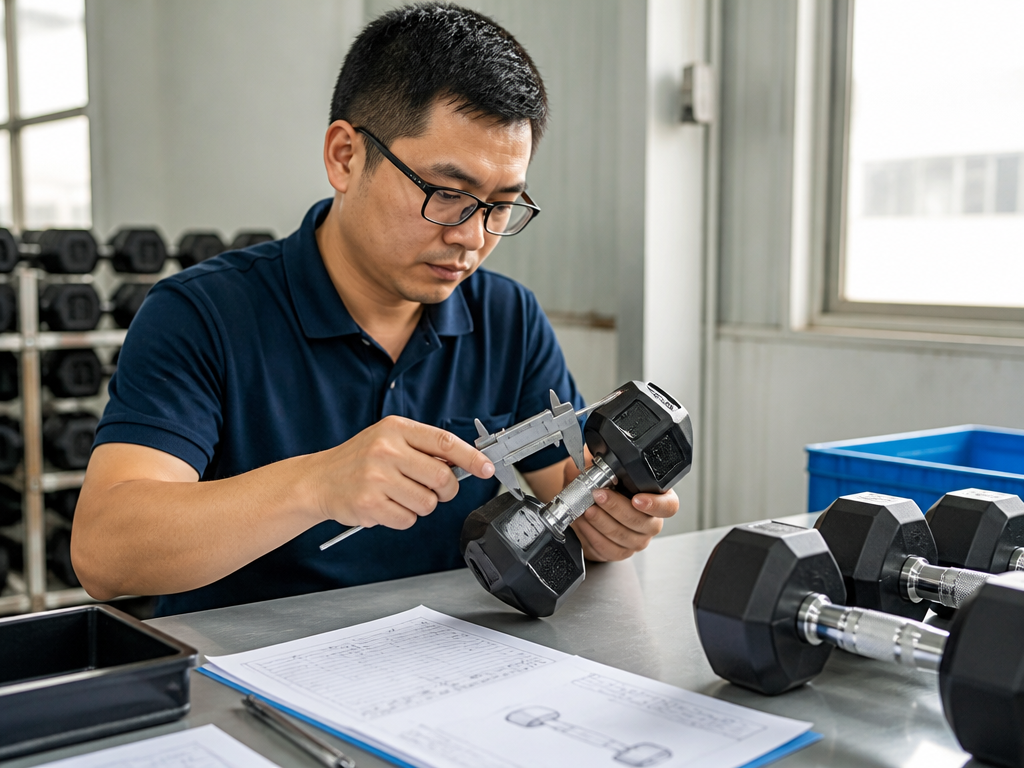
For structural products — racks, benches, cable machines — dimensional verification should cover the overall footprint (length, width, height), key functional dimensions (j-cup spacing, upright hole pitch for safety pins, seat dimensions, cable pulley alignment), and critical structural dimensions (upright wall thickness, crossmember section size). Use a vernier caliper or digital micrometer for thickness measurements — visual assessment of gauge is unreliable and should not be accepted as verification.
For modular products with multiple components (racks with attachments, multi-station systems, adjustable benches), verify that all mating surfaces, bolt holes, and attachment interfaces are within tolerance and function as intended. A misalignment of even 1–2mm at a bolt hole can make a third-party attachment incompatible, which is particularly significant if your marketing positions the rack as compatible with a specific attachment ecosystem.

Category 2: Material Specification Compliance
The material specification review at sample stage verifies that the factory has used the materials you specified — not substitutes, not different grades, not “equivalent” alternatives. This is one of the most important and least rigorously practiced aspects of sample review, because material non-compliance is invisible without deliberate testing.
Steel Grade and Wall Thickness Verification
For structural steel products, the most reliable field verification method for wall thickness is to request a cut cross-section of the tubing from the sample’s parent material batch. A cross-section cut perpendicular to the tube axis, polished and photographed, allows direct measurement of wall thickness against specification. For buyers conducting remote sample review, requesting this cross-section photo from the factory is a low-cost, high-information verification step.
Steel grade verification (confirming the alloy specification, yield strength, and tensile strength) requires a mill certificate from the steel supplier. Request the mill certificate for the steel lot used in the sample and verify that the specified grade (e.g., A36, Q235, A572 Grade 50) matches what was quoted. Mill certificate verification is standard practice in structural engineering; it is underutilized in fitness equipment sourcing despite the same structural logic applying.
Rubber Compound and Coating Verification
Rubber compound verification at sample stage should include Shore A hardness testing — a simple, non-destructive test that confirms the compound’s hardness is within the specified range for the coating type. Standard SBR rubber for fitness equipment typically runs 50–70 Shore A; CPU coating typically 55–75 Shore A; virgin rubber bumper plates typically 35–50 Shore A. If the factory cannot provide a Shore A measurement from the sample’s coating batch, request the rubber compound data sheet and cross-reference the hardness specification.
Adhesion testing — verifying that the coating is firmly bonded to the iron or steel core — can be conducted through a cross-cut adhesion test (applying a scoring grid to the coating and applying tape, then checking how much coating lifts). This test is specified in ASTM D3359 and provides a quantitative adhesion rating. A sample that fails adhesion testing at the initial review will certainly fail in commercial use; approving it is a guaranteed downstream quality problem.
Chrome and Surface Treatment Quality
Chrome-plated dumbbell handles and barbell shafts should be inspected under strong directional light for plating uniformity, coverage completeness (particularly at recessed areas and knurl valleys), and adhesion. Observe the plating under a magnifying glass at the handle ends and at any area where the base metal radius is tight — these locations are common sites for plating coverage failures that are invisible under normal lighting but become apparent with use.
According to ECQA’s fitness equipment quality inspection guidelines, proper surface treatment verification is one of the most technically demanding aspects of fitness equipment inspection — and one of the areas where professional inspection companies add the most value for buyers who lack in-house testing capability.
| Material / Surface | Verification Method | Acceptable Standard | Documentation Required |
|---|---|---|---|
| Steel wall thickness | Cut cross-section + caliper measurement | Within ±5% of specified gauge | Cross-section photo + measurement record |
| Steel grade / alloy | Mill certificate review | Matches specified grade designation | Mill certificate from production lot |
| Rubber compound hardness | Shore A durometer test | Within ±5 Shore A of specification | Durometer reading + compound data sheet |
| Rubber coating adhesion | Cross-cut adhesion test (ASTM D3359) | Classification 4B or 5B | Test result photograph |
| Chrome plating | Visual under magnification + directional light | Complete coverage, no voids or pinholes | Magnified photo at specified inspection points |
| Powder coat adhesion | Cross-cut adhesion test | Classification 4B or 5B | Test result photo + coating thickness reading |
| Weight accuracy | Calibrated scale measurement | Within specified tolerance (±2–3% standard; ±0.25% calibrated) | Actual vs. marked weight record for all denominations |
Category 3: Structural Integrity and Load Testing
Structural load testing is the most safety-critical component of fitness equipment sample review and the one most frequently omitted by buyers who do not have access to appropriate testing equipment. For strength equipment specifically — racks, benches, cable systems, and structural frames — load testing is not optional; it is the only reliable method of verifying that the product meets its rated structural capacity under real-use conditions.
Static Load Testing for Racks and Benches
Static load testing involves applying a defined load to the product’s critical structural points — typically 1.5× to 2× the rated working load — and holding it for a defined period (typically 15–30 minutes) while monitoring for visible deformation, weld cracking, or joint movement. For a bench rated at 500 lbs, a 750–1,000 lb static load test verifies the structural safety factor. For a power rack rated at 1,000 lbs, the load is applied to the safety pins and j-cups as well as the main uprights.
Buyers who cannot conduct load testing themselves should require the factory to provide load test records from the sample production, ideally witnessed by a third-party inspector. The load test should use the specific sample unit being reviewed, not a different test unit — production samples can vary from test prototypes. Request a written load test certificate specifying the applied load, duration, and outcome, signed by the inspector.
Functional Testing for Adjustable and Mechanical Components
Products with adjustable or mechanical components — adjustable benches, cable machines, pulley systems, Pilates reformer spring mechanisms — require functional cycling to verify smooth operation and engagement security throughout the adjustment range. For an adjustable bench, cycle through every angle position 20–30 times, confirming positive engagement lock at each position, no play or wobble when loaded, and smooth transition between positions. For cable pulley systems, run the cable through its full range of motion under load, checking for smooth movement and secure cable seating at the pulleys.
For Pilates equipment — reformers in particular — spring resistance, carriage movement smoothness, and footbar security are the primary functional parameters. Each spring resistance denomination should be measured against specification using a spring tension gauge, and the variation between springs within a set should fall within acceptable tolerance (typically ±5–10% for standard springs). The carriage should run smoothly without binding across its full range of motion, and the headrest and shoulder rest adjustments should engage and release cleanly.

Category 4: Branding, Labeling, and Marking Accuracy
Branding accuracy at sample stage is a category that brands consistently underestimate — not because they do not care about their brand identity, but because they focus on whether the logo looks correct and miss the compliance-critical labeling details that regulators and retail buyers require.
Logo and Brand Mark Review
Verify logo position, size, and placement against your approved brand guidelines. Check that: the logo dimensions match the approved artwork at ±2mm tolerance; the color matches the Pantone or CMYK specification under standard D65 daylight illumination (not factory fluorescent lighting, which distorts color perception); the edge definition is sharp with no bleed or pixelation for laser-cut or silk-screen logos; and the logo surface treatment (flush with the base, raised, debossed, or applied) matches the approved specification.
For rubber-coated products with embossed logos, verify that the emboss depth and definition are consistent across the sample set and match the approved mold specification. Emboss depth variations between left and right heads of the same dumbbell pair, or between units in the same weight denomination, indicate mold quality issues that will produce visible inconsistency in the commercial product.
Regulatory Labeling and Compliance Markings
Depending on your target market, fitness equipment is required to carry specific regulatory markings: CE marking and EN 957 compliance statements for European markets; ASTM standard compliance labels for US market products; country-of-origin markings required by customs regulations; weight marking accuracy (the marked weight on free weights must correspond to the actual measured weight within tolerance); and maximum user weight ratings for structural products.
Verify at sample stage that all required regulatory markings are present, accurately stated, and permanently applied. A sticker that will peel off after six months in a commercial gym environment does not constitute permanent marking — marking requirements typically specify durability under cleaning solvents and temperature cycling. As QCADVISOR’s fitness equipment inspection standards note, sourcing fitness equipment without verifying regulatory marking compliance exposes buyers to customs clearance issues and market withdrawal risk.
Serial Number and Traceability Marking
For commercial-grade fitness equipment going into gym facilities and institutional environments, serial number marking enables product traceability — critical for warranty management, recall management, and liability defense. Verify at sample stage that serial number placement is accessible for recording in a gym management system (not hidden under another component), that the marking method is permanent (laser engraving, embossing, or permanent label under a protective clear coat rather than exposed adhesive label), and that the serial number format matches any management system or inventory requirements specified by your commercial customers.
Category 5: Packaging Review
Packaging review at sample stage is one of the most neglected aspects of OEM sample approval — typically because packaging is perceived as a logistics function rather than a product quality function. In practice, inadequate packaging creates customer-facing problems: damaged products on arrival, difficult unboxing experiences, missing accessories, and retail presentation failures. These issues reflect directly on the brand, even though they originate from packaging decisions made during OEM development.
Protective Packaging for Transit Damage Prevention
Evaluate whether the packaging design provides adequate protection against the specific transit risks your shipping route presents. For transatlantic ocean freight on standard containers, the primary transit risks are stack compression, vibration, and moisture. Assess: whether the box compression rating (typically measured in kg/cm² or Edge Crush Test ECT) is adequate for your stacking height; whether internal cushioning prevents product-to-product contact during vibration; and whether the carton material is moisture-resistant or requires inner PE bag protection for humid shipping conditions.
Request a drop test of the packaged sample — dropping the unit from a height of 60–90cm onto each face, edge, and corner — and examine the product for damage after each drop. A well-designed package should absorb the drop energy without allowing the product to contact the carton wall. This test is particularly important for chrome-finished products and LCD display components, which are the most susceptible to cosmetic transit damage.
Retail and End-User Unboxing Experience
For products sold through retail channels or direct-to-consumer e-commerce, the unboxing experience is a brand touchpoint. Review: whether the product is immediately visible and well-presented when the carton is opened; whether assembly instructions (if any) are included and legible; whether all accessories and hardware are clearly organized and inventoried; and whether the packaging aesthetic is consistent with your brand positioning.
For fitness equipment sold in gift-oriented retail contexts — kettlebell sets, resistance accessories, compact dumbbells — branded retail packaging is particularly important. Review the printed artwork on the retail carton against your approved brand assets, checking color accuracy, layout alignment, and print quality under standard D65 daylight illumination. A retail carton with misaligned print registration or color drift from approved brand colors is not an acceptable basis for production approval.

Documenting the Approval Decision
A sample approval is only as strong as the documentation that records it. An email saying “sample approved, proceed to production” is legally and operationally weak — it does not specify what was approved, under what conditions, to what standard, and with what deviations (if any) explicitly noted. A proper sample approval record should include:
- Product identification: Product name, SKU, weight denomination (for free weights), color option, and any configuration specifics that differentiate this sample from others in the range.
- Approved sample reference number: A unique identifier that links the approval record to the specific physical sample unit (which should be retained and labeled by the factory as the production reference).
- Inspection results by category: Pass/fail/conditional results for each inspection category, with actual measured values recorded for all quantitative criteria (weights, dimensions, coating thickness, Shore A hardness).
- Deviation notes: Any deviations from specification that are being conditionally accepted, with explicit limits on acceptable deviation range in production.
- Approval conditions: Any actions required before or during production to address identified concerns (e.g., “improve logo emboss depth on right head to match left” or “confirm rubber compound certification before first production run”).
- Authorized signatories: Names, titles, and signatures of both buyer representative and factory QC representative, with dates.
This documentation serves multiple purposes: it provides the production team with a clear, unambiguous reference for mass production; it creates a contractual record of what was agreed; and it provides the basis for the pre-shipment inspection checklist that will be used to verify production conformance. Our manufacturing quality process provides structured sample approval documentation as a standard element of our OEM partnership workflow.
When to Conditionally Approve vs. Reject and Revise
Not every sample review results in a clean approval. Knowing when to conditionally approve (with documented deviations and correction requirements), when to request targeted revisions (specific issues that do not require a full sample remake), and when to reject and request a complete new sample is an important judgment that affects both your timeline and your cost.
Conditional approval is appropriate for minor cosmetic deviations (slight color variation within accepted tolerance, minor surface texture inconsistency that does not affect function or durability) where the issue is visible but not commercially significant and is explicitly documented with production limits. Targeted revision requests are appropriate for single-category failures (incorrect logo position, one weight denomination outside tolerance, packaging artwork error) where only the affected aspect needs to be corrected and re-submitted without recreating the entire sample. Full sample rejection is appropriate for structural failures, material specification non-compliance (wrong grade, wrong gauge), or functional failures — situations where the core product does not meet specification in ways that cannot be corrected without remanufacture.
| Sample Review Outcome | When Appropriate | Required Documentation | Timeline Impact |
|---|---|---|---|
| Full Approval | All criteria met within tolerance | Signed approval record + retained reference sample | None — production proceeds |
| Conditional Approval | Minor cosmetic deviations; documented limits acceptable | Signed approval with explicit deviation limits noted | Minimal — production proceeds with documented limits |
| Targeted Revision | Single-category failure (logo, one weight denomination, packaging artwork) | Clear written revision specification + re-submission timeline | 1–3 weeks for targeted re-submission |
| Full Sample Rejection | Structural failure, material non-compliance, functional failure | Detailed rejection report with specific failure evidence | 3–6 weeks for full sample remake |
Frequently Asked Questions
How many samples should I request before making an approval decision?
For free weights, request a minimum of two units per weight denomination (both the lightest and heaviest in the set, plus any intermediate denominations where quality risks are highest). For structural equipment, one complete unit is typically sufficient, supplemented by component samples where specific details need closer inspection. For color variants, request one sample per colorway — color consistency can vary significantly between colorways due to pigment batch differences. Always retain the approved sample physically for use as the production reference standard.
Can I conduct sample approval remotely without visiting the factory?
Remote sample approval — where samples are shipped to the buyer — is standard practice for most OEM relationships. It is generally reliable for cosmetic and dimensional review, provided the buyer has appropriate measurement tools and conducts the review systematically. For structural load testing and functional mechanism testing, remote approval has limitations; consider commissioning a third-party inspection company to conduct the physical testing at the factory and provide a certified test report. Do not rely on factory-supplied test results without independent verification for safety-critical structural components.
How do I handle a situation where the sample looks good visually but I am unsure about materials?
Request the material documentation that was required at the time of specification: mill certificate for the steel, rubber compound data sheet, coating thickness certificate. If documentation is unavailable or incomplete, commission an independent material test from a certified testing laboratory before approving production. The cost of destructive material testing on a sample is substantially lower than the cost of mass production rejection or field failure.
What is the difference between a pre-production sample and a counter sample?
A pre-production sample (PP sample) is produced by the factory before mass production begins, for buyer review and approval. A counter sample (sometimes called a “approval sample” or “sealed sample”) is the specific unit that, once approved, is retained by both parties as the reference standard for production conformance. The counter sample is the legal quality baseline — if mass production disputes arise, both parties reference the counter sample to determine whether production conforms to the agreed standard. Retain your counter sample carefully and ensure the factory retains an identical one.
Should sample approval be handled by the same person who manages commercial negotiations?
Ideally, sample approval should be led by a technically qualified person — someone with knowledge of the product’s material specifications, functional requirements, and applicable standards — rather than solely by a commercial manager focused on price and delivery. Commercial pressure to approve quickly in order to meet production timelines creates a real risk of approving samples that have technical shortfalls. Separating the technical approval process from commercial timeline management reduces this risk and produces better quality outcomes.
Conclusion
A rigorous fitness equipment sample approval process is not bureaucratic overhead — it is the most efficient investment a brand can make in production quality. Every issue identified and corrected at sample stage costs a fraction of what it costs to correct in mass production, and a fraction of a fraction of what it costs to manage as a customer complaint or product return. The investment required is a structured review protocol, appropriate measurement tools (or a third-party inspection partner), and the organizational discipline to document approvals with the specificity that production teams and quality inspectors can actually use.
If you are establishing an OEM production program for a new fitness equipment line or looking to formalize your sample approval process with your existing manufacturer, our team is available to discuss how we structure the sample and production approval process for our OEM partners across strength, Pilates, and senior wellness product categories.