Why the Number on the Product Is a Contract
Every plate, dumbbell, and kettlebell that leaves a factory carries a number on its surface, and that number is the most public promise a fitness brand makes: the customer owns a scale, the internet owns a comment section, and the distance between the printed weight and the actual weight is measurable by anyone with twenty dollars of equipment and a grievance. Yet in our four decades of manufacturing free weights in Taiwan for commercial brands, the line item most often missing from incoming purchase orders is the one that governs this promise: a stated weight tolerance, with a stated method of verification. Buyers specify colors precisely, logos to the millimeter, packaging in loving detail, and then write accurate weight or nothing at all on the one dimension their end customers can and do check. This article exists to fix that, and it is written from the factory’s side of the table on purpose: we know exactly which clauses make a tolerance real and which leave it decorative, because we are the party those clauses bind. The guide covers the fundamentals, what a tolerance actually specifies and why cast products vary at all; the working numbers, realistic weight tolerance standards by product category and market tier, from budget plates to competition kettlebells; the verification protocols that separate a promise from a wish; the contract clauses worth copying into your next specification; and the economics of tolerance, including the honest cases where demanding tighter numbers is the wrong decision. Read it before your next order, and the number on your product becomes what it should always have been: a specification with evidence behind it, rather than a hope with a logo on it.
A note on scope and sources keeps the guide honest. The recommendations here concern commercial free weights, the plates, dumbbells, and kettlebells bought at container scale by brands, distributors, and facility groups, and they draw on three kinds of authority: published engineering practice, the competition rules of strength sports, which are the only truly public, enforceable weight tolerance standards in this industry, and our own production data across millions of cast units. Where sport federations publish numbers, we cite them, because they anchor the conversation in verifiable documents rather than catalog adjectives; where the commercial market operates on convention rather than publication, we say so plainly, because one of the quiet problems in this category is that phrases like commercial grade and precision weighted have no legal definition, and a buyer who does not write their own number inherits whatever the factory’s habits produce. The disclosure that accompanies every article in this series applies here with extra force: we manufacture the products this guide discusses, a tolerance clause in your purchase order binds us specifically, and we still recommend you write one, because specified orders produce aligned expectations, fewer disputes, and better long-term relationships than trusting ones, a lesson the industry relearns at every claims negotiation, and one that costs a paragraph of contract language to apply.
Tolerance Fundamentals: Bands, Methods, and Tiers
Before product-specific numbers mean anything, three fundamentals need to be in place, and their absence is where most tolerance conversations go wrong before they begin. The first is definitional: a tolerance is not a single number but a band plus a method, and a specification that states one without the other is unenforceable in practice even when it looks precise on paper. The second is contextual: the market operates in tiers, budget, commercial, and calibrated, with genuinely different tolerance expectations and genuinely different prices, and importing a competition expectation into a budget order, or accepting a budget reality in a premium order, are the two symmetric mistakes buyers make. The third is causal: cast metal products vary for concrete manufacturing reasons, and a buyer who understands where the grams come from negotiates tolerances intelligently, distinguishing the factory that cannot hit a band from the factory that would simply rather not be asked to. The three subsections below take these in order, and together they form the vocabulary the rest of the article uses. One orienting observation before the detail: tolerance is the rare specification where the interests of a good factory and a serious buyer are almost perfectly aligned, because variance is expensive for both parties, the factory pays for it in rejects and rework, the buyer pays in complaints and returns, and a well-written tolerance clause is less a demand imposed on a supplier than a shared definition of what both sides are already trying to produce.
What a Tolerance Actually Specifies
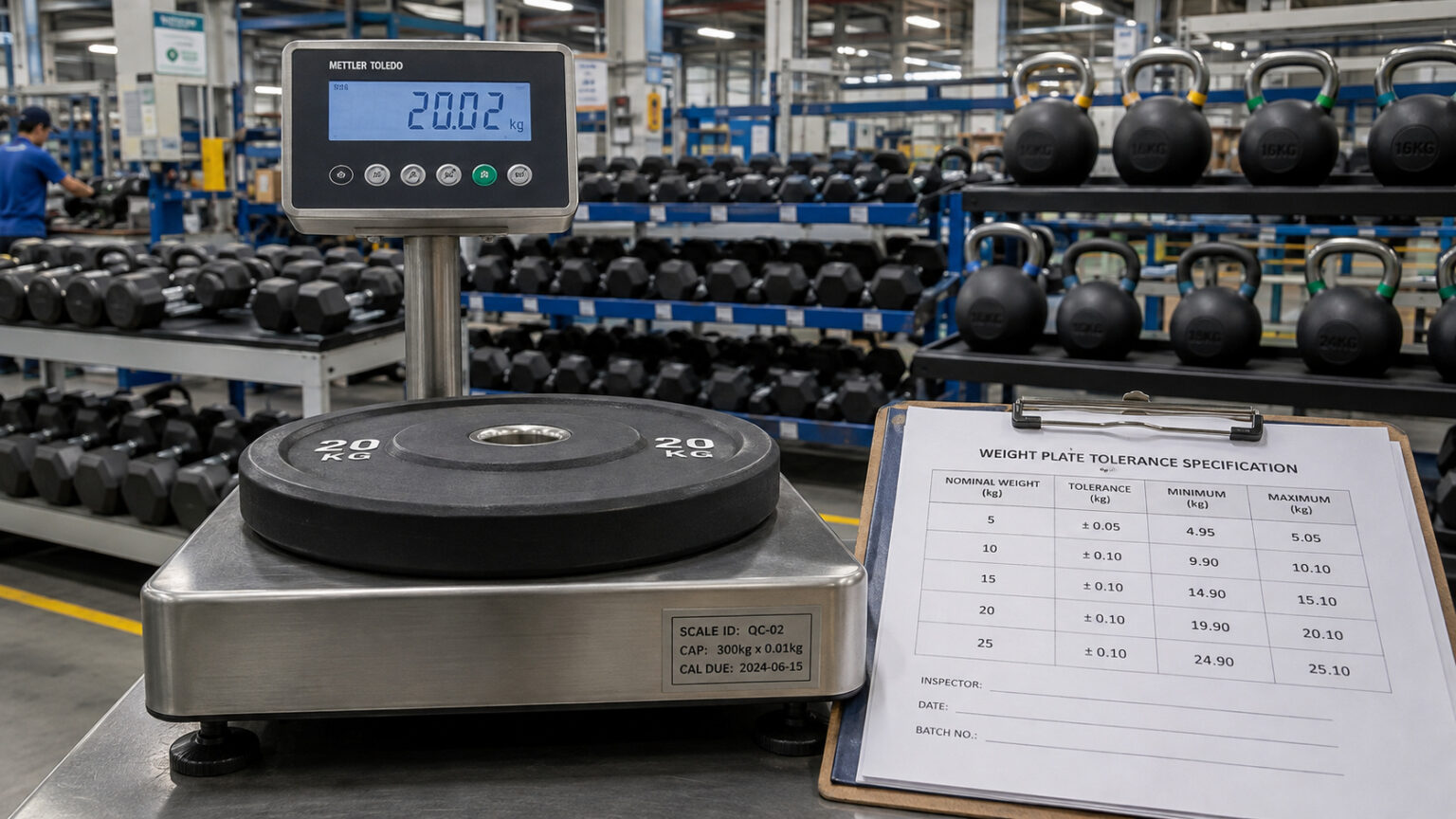
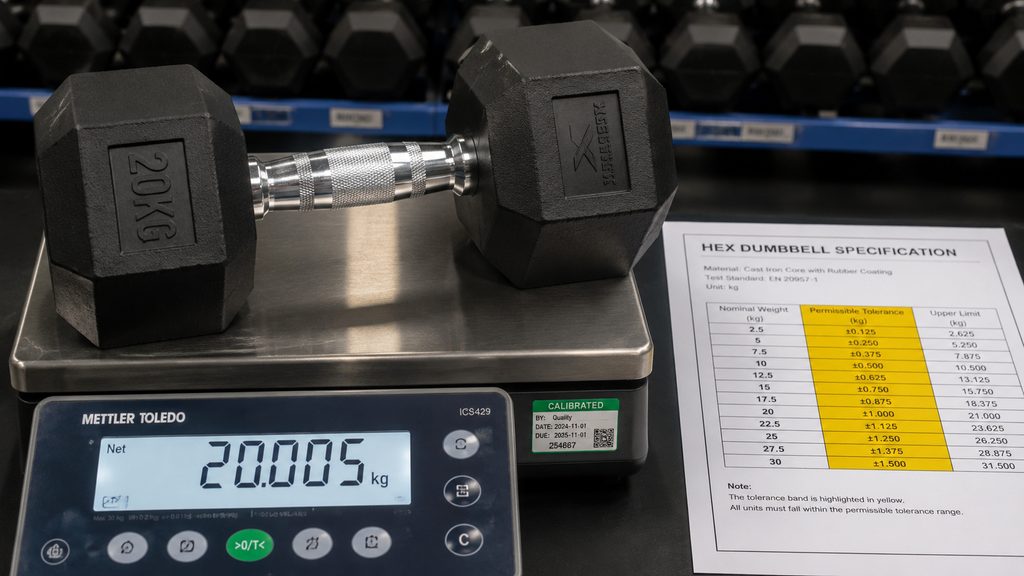
In engineering practice, a tolerance is the permitted deviation from a nominal value, stated with the conditions under which conformance is judged, the concept formalized in the reference on engineering tolerance, and every word of that definition earns its keep in a free-weight contract. The band itself can be symmetric, plus or minus two percent, asymmetric, plus nothing minus three percent for products where overweight is acceptable and underweight is not, or stepped, a percentage for heavy items and an absolute gram cap for light ones, where percentages mislead; all three forms appear legitimately in this industry, and the right one depends on the product, as the category sections show. The conditions matter as much as the band. A complete clause states the product state at measurement, which must be the finished, coated, assembled unit, because that is what the customer weighs, and coating and assembly add real grams; the instrument standard, a scale with current calibration, the practice documented in the reference on calibration; the sampling basis, every unit or a stated statistical sample; and the disposition rule for units outside the band, rework, reject, or downgrade. A specification that says plus or minus one percent and nothing else has specified almost nothing: one percent of what state of the product, measured how, on which units, with what consequence? The factory that asks those questions is being professional, not difficult, and the buyer who answers them in the original document, rather than in a dispute, has written the difference between a tolerance and a slogan.
The Three Market Tiers: Budget, Commercial, Calibrated
Tolerance expectations sort the free-weight market into three tiers, and knowing which tier you are buying in prevents both overpaying and overexpecting. The budget tier, big-box retail and entry home equipment, operates on wide bands, commonly around plus or minus three percent and sometimes worse on cheap cast plates, tolerated because the price point forgives it and the customers rarely weigh. The commercial tier, branded gym equipment, the tier most readers of this site buy or sell, operates on convention rather than publication: roughly plus or minus one to two percent on plates and dumbbells, tighter on premium lines, achievable by any disciplined factory and demanded explicitly by any serious buyer, because within this tier the band is set by negotiation, not by rulebook. The calibrated tier is where public weight tolerance standards actually exist, because strength sports must guarantee fairness: powerlifting’s rulebook requires that every competition disc weigh within 0.25 percent or 10 grams of its face value, per Section 2.3 of the IPF Technical Rules Book, and kettlebell sport caps deviation at one hundred grams per bell, per the equipment sections of the IUKL International Rules. These sport numbers are useful to commercial buyers less as targets than as calibration for the conversation: they show what manufacturing can achieve when it must, they price the top of the accuracy market, and they expose as marketing any catalog that claims competition accuracy at commercial prices without the weighing infrastructure that competition accuracy requires.
Why Cast Products Vary: The Manufacturing Chain
Grams of variance enter a free weight at three stages, and each stage responds to different controls, which is why a factory’s answer to where does your variance come from is one of the most diagnostic questions a buyer can ask. Casting is the first and largest source: molten iron, whose behavior as a material is described in the metallurgy reference on чугун, shrinks as it solidifies, shrinks unevenly as molds age, and fills differently as pouring temperature and speed drift, so two castings from the same pattern can differ by a full percent before any machining; disciplined melt control, mold maintenance, and pattern correction shrink this source, and porous, inconsistent castings from tired tooling are the signature of factories that have not invested in it. Machining and assembly are the second source: a cast plate can be corrected toward nominal by machining its faces or hub, which is exactly how calibrated discs achieve their gram-level accuracy, while assembled products like dumbbells stack the variance of two heads and a handle unless the factory weighs and matches components before joining them, the practice that separates matched pairs from lucky ones. Coating is the third source: rubber, urethane, and paint all add mass, encapsulation thickness varies with mold condition and material batch, and a product specified before coating can drift meaningfully by the time it is finished, which is why every serious tolerance clause specifies the finished state. The chain explains the tiers: budget products control none of these stages tightly, commercial products control casting and assembly with sampling-based verification, and calibrated products add unit-level correction and weighing, at a price that reflects the labor.
Weight Tolerance Standards by Product Category
With the fundamentals set, this section states the working numbers, the weight tolerance standards a knowledgeable buyer should specify for each product family at commercial grade, with the reasoning that lets you adjust them for your own market position. The table aligns each product family with the published international standard that governs its calibrated tier, quotes the tolerance exactly as the source document states it, and adds our commercial guidance where no standard exists, with the source documents listed in full immediately below the table, because a number without a citation is exactly the kind of specification this article argues against. Two universal rules frame the category detail. First, every band below is stated on the finished, coated product, weighed on a calibrated scale, because that is the only state the end customer ever meets; a supplier who quotes tolerances on raw castings is quoting a different, easier number, and the difference is not pedantry, it is several tenths of a percent of real mass. Second, the bands tighten as unit weight falls, not as it rises: a two percent error on a heavy plate is invisible in use, while the same percentage on a two-kilogram accessory is a clinically and commercially meaningful miss, which is why stepped clauses, a percentage or a gram cap, whichever is smaller, appear throughout the recommendations. Buyers should treat the table as a starting position for negotiation rather than a take-it-or-leave-it demand: a factory may legitimately propose adjustments for specific constructions, and the response that matters is whether the proposal comes with reasoning and evidence, the melt data, the weighing records, the process explanation, or with the bare assertion that the standard band is what everyone accepts, which is the assertion this article exists to retire.
| Продукт | Governing International Standard | Published Tolerance (as stated in the source) | Commercial Guidance Where No Standard Applies |
| Bumper plates / weightlifting discs | IWF Sport Equipment Licensing Guidelines, citing IWF TCR Regulation 3.3.3.6-3.3.3.7 | Competition discs >5 kg: +0.1% / -0.05%; discs ≤5 kg: +10 g / -0 g; training discs: ±0.8% | Specify ±1% of nominal, finished weight, for commercial bumpers |
| Cast iron / machined plates | IPF Technical Rules Book, Section 2.3(b) | “All discs used in competition must weigh within 0.25 percent or 10 grams of their face value” | ±2% plain cast; ±1% machined-face |
| Fixed dumbbells | No international standard published for fixed dumbbells | Nearest formal anchors: OIML R 111 stepped absolute tolerances; Weber-Fechner pair-comparison research | ±1.5-2% per unit, finished, with pair-match band at half the unit band |
| Гири | IUKL International Rules and Regulations, Sections 3.2-3.3 | “The weight of kettlebells should not deviate from nominal more than on 100 grams” | ±1.5-2% finished; stepped gram cap below 8 kg |
| Light accessories (<5 kg) / fractional weights | OIML R 111-1:2004, Table 1 (weight classes M1-M3) | Absolute maximum permissible errors per denomination, e.g. at 5 kg: ±0.25 g (M1), ±0.8 g (M2), ±2.5 g (M3) | Absolute caps of 50-150 g by product |
Sources for the table, in full: the International Weightlifting Federation’s Sport Equipment Licensing Guidelines, which reproduce the tolerance chart of IWF Technical and Competition Rules Regulation 3.3.3; the International Powerlifting Federation’s Technical Rules Book, Section 2.3, Bars and Discs; the International Union of Kettlebell Lifting’s International Rules and Regulations, equipment sections 3.2 and 3.3; and the International Organization of Legal Metrology’s OIML R 111-1:2004, Table 1. The commercial-guidance column is stated as our manufacturing recommendation, since no international body publishes tolerances for general fitness equipment, which is precisely why this article teaches buyers to write the number into their own contracts.
Plates: From Bumpers to Calibrated Discs
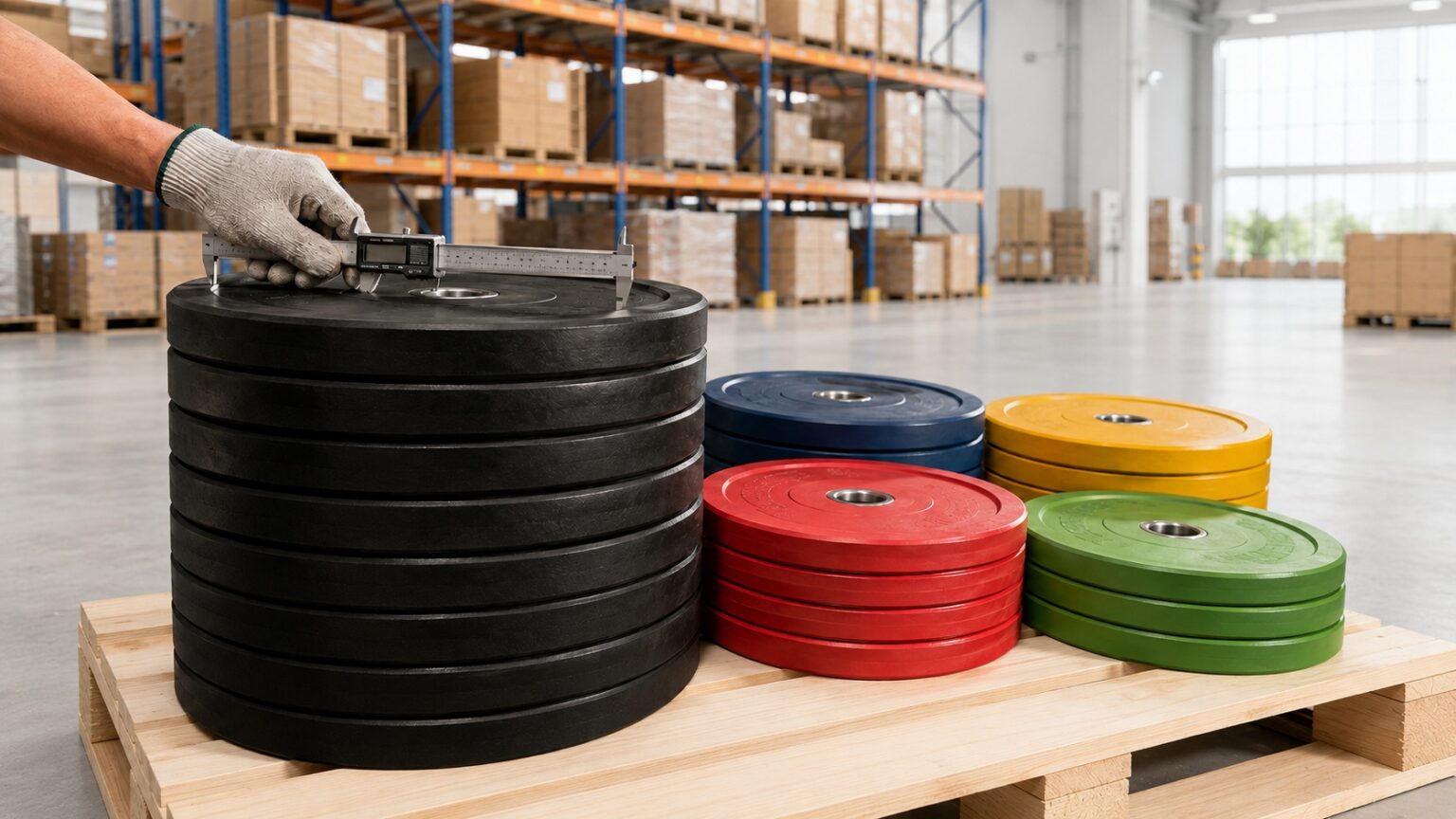
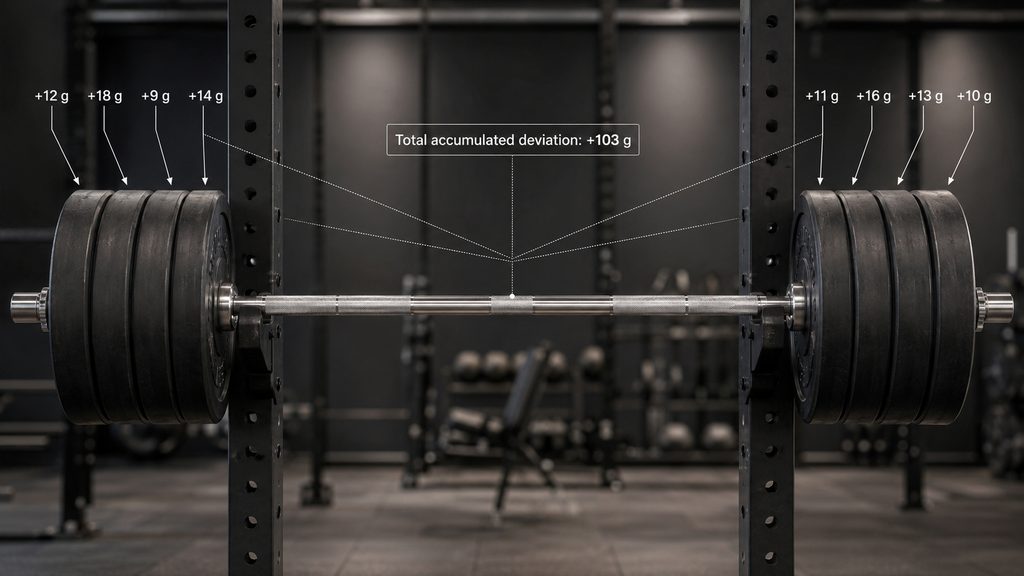
Plates deserve first treatment because they carry a variance mechanism the other categories lack: they are loaded in stacks, and stacks do arithmetic on your tolerance. A single plate at plus two percent is harmless; eight plates each at plus two percent put several extra kilograms on a bar whose user believes they know the load, and the error compounds silently because no single plate is out of specification. This stacking effect is the engineering argument for holding plates to the tightest commercial band in the free-weight family, plus or minus one percent finished for bumpers and machined-face iron, and it is also the argument for a clause unique to plates: batch-mean control, requiring that the average deviation across a production lot sit near zero, so errors cancel rather than accumulate, a requirement that costs a competent factory little and reveals an incompetent one immediately. Within the category, construction sets the achievable floor. Rubber bumpers carry encapsulation variance, so one percent finished is a disciplined target and sub-percent claims deserve weighing records; cast iron uncorrected can honestly hold two percent from good tooling; machined plates, where faces or hubs are cut to correct the casting, reach one percent routinely and gram-level accuracy when the process is built for it, which is precisely how competition discs reach their certified numbers. The weightlifting federation’s published figures are worth reading closely because their structure teaches a lesson: under the IWF equipment licensing rules, competition discs over 5 kilograms are held to plus 0.1 percent and minus 0.05 percent, discs of 5 kilograms and under to plus 10 grams and minus zero, and training discs to plus or minus 0.8 percent, an asymmetric scheme that permits slight overweight but essentially no underweight, because a sport that certifies records cannot credit a lifter with kilograms that were not on the bar. Buyers stocking calibrated or near-calibrated lines, like the plate families in our plates range, should expect per-unit weighing evidence as part of the deliverable, because at that tier the record is the product as much as the iron is.
Dumbbells: Pairs and the Stepped Band
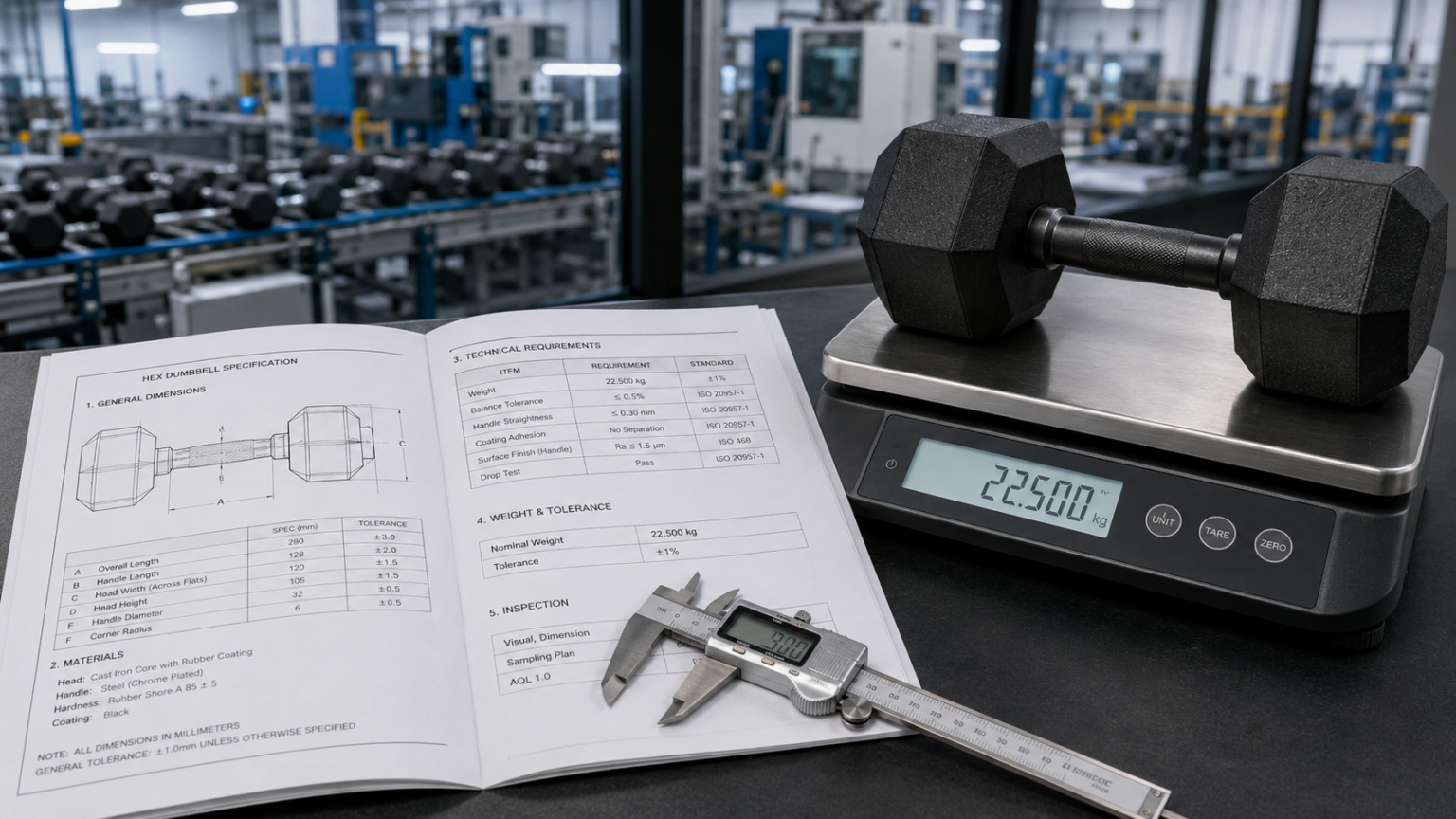
Dumbbell tolerance carries one insight that outranks every number in this subsection: the customer feels the difference between their two hands long before they detect a deviation from nominal, a perceptual asymmetry consistent with the Weber-Fechner law, whose founding experiments on lifted weights showed that humans detect proportional differences between two directly compared loads far more readily than deviations from a remembered absolute, which is why a dumbbell specification with a single band is half a specification. The complete clause carries two numbers, a unit band, plus or minus one and a half to two percent of nominal, finished, for commercial fixed dumbbells, and a pair-match band at half the unit band or tighter, applied to the two units boxed and sold together, which obliges the factory to weigh and pair at packing, a cheap process step that eliminates the complaint gyms actually receive. The second dumbbell-specific issue is the light end of the run: percentage bands mislead below roughly five kilograms, where two percent of a small number is a gram figure tighter than casting can hold while five percent is a miss a rehabilitation user will notice, so the professional form is a stepped clause, the percentage or an absolute gram cap, commonly one hundred to one hundred fifty grams, whichever is smaller, applied per size in the specification’s weight table, a structure with a formal precedent in legal metrology, where the international recommendation OIML R 111-1 states maximum permissible errors for calibration weights as absolute values per nominal denomination rather than as one flat percentage. Assembly is the third lever: matched heads weighed as a set with the handle before permanent joining is what makes tight bands achievable, and a factory’s willingness to describe its matching process is a direct read on whether its quoted band reflects a process or an aspiration, the same diagnostic logic we detail across the buying sequence in our guide to оценка надежности производителя оригинального оборудования (OEM). Specified this way, across the run of a commercial dumbbell line, weight accuracy stops being a per-unit lottery and becomes a fleet property your brand can print on a spec sheet.
Kettlebells: Single-Implement Accuracy and the Sport Benchmark
Kettlebells simplify the tolerance problem in one way and sharpen it in another. The simplification: bells are sold singly, so there is no pair-match clause and no stacking arithmetic, and the specification reduces to a clean unit band on the finished, coated product, plus or minus one and a half to two percent for commercial cast bells, with the same stepped gram cap below eight kilograms that dumbbells need, for the same percentage-arithmetic reasons. The sharpening: the kettlebell is the one commercial category whose top tier is governed by a published, enforceable number, the sport federations’ one-hundred-gram cap on competition bells, roughly four tenths of a percent on a 24-kilogram bell, and that number radiates useful discipline down the whole category. It proves the achievable: hollow-shell competition bells hit one hundred grams through in-process weighing and fill adjustment before sealing, so a factory claiming it cannot hold two percent on a solid cast bell is describing its choices, not its constraints. It prices the premium: the gap between a two-percent bell and a hundred-gram bell is weighing labor and rejection cost, and a supplier’s competition-grade quote should be explainable in exactly those terms. And it defines the evidence standard: sport-grade accuracy ships with per-bell weighing records, and a commercial buyer can adopt the same record habit at sampling scale for ordinary lines, which our own kettlebell range supports across its cast iron and competition tiers. One honest caveat completes the category: handle and coating mass on a kettlebell is proportionally larger than on a plate, so finished-state specification matters most here, and any tolerance quoted on bare castings should be politely returned for restatement.
Verification: Weighing Protocols That Make the Number Real
A tolerance without verification machinery is a decoration, so this section builds the machinery, on both sides of the transaction. The principle is the one this series applies to every specification: the clause must name who measures, with what instrument, on which units, keeping what records, with what consequence for failure, because each unnamed element is a place where the number quietly stops being real. Verification is also where the tone of a supplier relationship is set, and it is worth saying that a professional weighing protocol is not an accusation of bad faith; it is the shared instrument that protects both parties, the factory from unfounded claims, the buyer from unfound defects, and the relationship from the corrosive arguments that unmeasured disputes produce. In our experience the factories that welcome weighing clauses are precisely the ones that already weigh, because the clause costs them nothing and differentiates them from competitors who quote the same bands without the process behind them; hesitation about verification language is therefore itself a data point, one of the cheapest and most reliable screens available in supplier selection. The two subsections split the machinery naturally: the supplier-side protocol your specification should require the factory to run, and the buyer-side audit that confirms it worked, from incoming inspection to the third-party escalation path for orders and relationships where the stakes justify it.
The Supplier’s Protocol: Sampling, Scales, and Records
The supplier-side clause has four components, each one sentence long. Sampling: state the weighing basis per product tier, one hundred percent weighing for calibrated lines and pair-matched dumbbells at packing, statistical sampling at a stated rate, commonly two to five percent per batch with defined lot sizes, for standard commercial product, and note that in-process weighing, the checks the factory runs at casting and before coating for its own control, does not substitute for finished-goods verification, because only the finished unit is the product. Instruments: require scales of stated capacity and resolution appropriate to the product, under a calibration regime with current certificates available on request, which any factory operating a certified quality system under ISO 9001 already maintains as routine infrastructure. Records: require weights logged by batch with the production date and retained for a stated period, with reports delivered with each shipment for premium lines or on request for standard ones, because records that exist but cannot be produced have a way of not existing. Disposition: state what happens to out-of-band units, rework where the construction allows it, rejection where it does not, and never silent inclusion, with the reject rate itself reportable, since a factory’s rejection data is the most honest telemetry of its process health. None of this is exotic, all of it is standard practice at disciplined factories, and the complete clause fits in the quality section of a specification in under a page, which is a small price for converting the headline band from an adjective into an audit trail.
The Buyer’s Audit: Incoming Checks and Escalation Paths
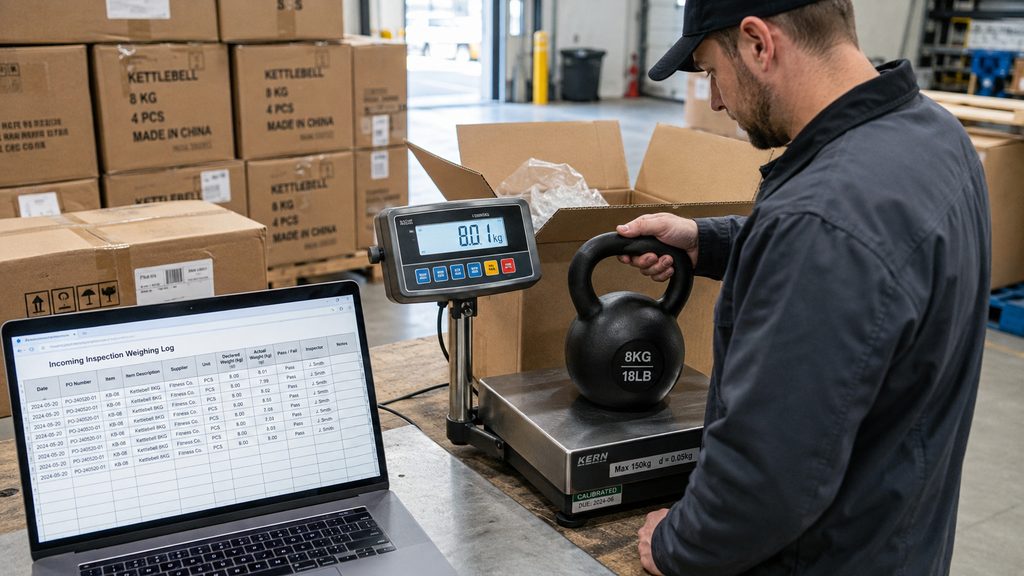
The buyer’s side of verification is cheaper than most buyers expect and neglected more often than any other step in the sourcing sequence. The baseline is incoming inspection: on each delivery, weigh a random sample across sizes and batches, twenty units is a meaningful sample for a container, on your own calibrated platform scale, against the specification’s bands, and log the results, a discipline that takes one person one hour and converts your acceptance window from a formality into a checkpoint, exactly the habit our sample approval checklist builds into the pre-production stage and this article extends to every shipment. Three refinements make the audit robust. Weigh at the extremes as well as the middle, the lightest and heaviest sizes, because that is where percentage and gram-cap clauses bite differently and where process weaknesses concentrate. Compare batch means, not just individual units, because a lot that passes unit bands while sitting uniformly at the top of them is telling you about the factory’s calibration drift, and on plates specifically, about stacking error your customers will assemble. And resolve disputes by instrument, not by argument: the specification should name the escalation, re-weighing on a mutually accepted calibrated scale, third-party inspection at the failing party’s cost for early orders or large claims, so that a disagreement about grams is settled the way grams are settled. Buyers placing first orders with a new supplier should also front-load the audit, witnessed or third-party weighing on the first shipments, stepping down as history accumulates, the graduated-trust pattern that avoids both the naivety and the paranoia that our guide to common sourcing mistakes documents at the two ends of the buyer spectrum.
A word on the buyer’s instrument itself, because the audit is only as good as the scale it runs on, and this is the one capital purchase the whole discipline requires. The working rule is that your instrument should resolve roughly ten times finer than the band you are checking: verifying a one-hundred-gram cap wants a scale reading to ten grams, and verifying one percent on a twenty-kilogram plate, a two-hundred-gram band, is comfortable on the same instrument, which in practice means a mid-range industrial platform scale rather than anything exotic, a few hundred dollars of equipment that pays for itself at the first successfully documented claim. Buy the scale with a calibration certificate, recalibrate it on the manufacturer’s schedule or annually, and keep the certificate with the weighing log, because an audit performed on an uncertified instrument hands the factory a legitimate objection exactly when you need standing. Place it thoughtfully: a hard, level floor, away from vibration, with a defined warm-up if the instrument specifies one, since platform scales drift on soft or uneven surfaces in ways that produce phantom failures. And weigh consistently: same scale, same location, units matching the specification, each result logged with product, size, batch, and date rather than scribbled on the carton, because six months later the log is evidence and the scribble is an anecdote. None of this exceeds the operational capacity of even a small import operation, and the asymmetry it creates is decisive: the buyer with a certified scale and a tidy log negotiates every weight conversation from documentation, while the buyer without one negotiates from impression, and factories can tell the difference in the first email.
The Contract Clauses: What to Write and How to Phrase It
Everything above condenses into contract language, and this section supplies it as a checklist table a buyer can adapt directly into the quality section of a specification or purchase order. The table’s purpose is practical: most tolerance failures we see in the industry are not factories defeating well-written clauses but orders that never contained the clauses at all, and the distance between the two states is roughly ten sentences of unglamorous text. Three usage notes make the table work. First, the clauses are a set, not a menu: the band without the finished-state definition is measurable against the wrong object, the state without the records is unverifiable, the records without disposition are consequence-free, and each row exists because its absence has generated a real dispute somewhere in this industry’s collective claims history. Second, the wording column is deliberately plain: tolerance clauses fail through ambiguity more often than through absence of legal polish, and a sentence a production manager can act on beats a paragraph only a lawyer can parse; specifications are read on factory floors, and the best contract language in this category is indistinguishable from good work instructions. Third, the table travels: the same ten rows govern plates, dumbbells, and kettlebells with only the numbers changing by category per the earlier table, which means a buyer can maintain one tolerance boilerplate across their entire free-weight program and review it annually as their tiers and volumes evolve, the single-document discipline that turns tolerance from a per-order negotiation into a standing property of how your brand buys.
| Clause | What to Write | Почему это существует |
| Tolerance band | Per-size band in a weight table; stepped gram caps at light sizes | One sentence bands hide light-end arithmetic |
| Measurement state | Finished, coated, assembled unit as shipped | The customer weighs the finished product, not the casting |
| Pair matching (dumbbells) | Pair band ≤ half the unit band; pairing at packing | Hands feel mismatch before deviation from nominal |
| Batch mean (plates) | Lot average deviation near zero, stated limit | Stacked plates do arithmetic on one-sided error |
| Sampling basis | 100% for calibrated/pairs; stated % per batch for standard lines | A band without a sampling rate is unaudited |
| Instruments | Calibrated scales, certificates available on request | Uncalibrated measurement settles nothing |
| Records | Batch logs retained; reports with shipment or on request | Unproducible records do not exist |
| Disposition | Rework or reject out-of-band units; no silent inclusion | A tolerance is as real as its reject pile |
| Incoming inspection | Buyer sampling rights on delivery; logged results | Acceptance windows expire; formalize the check |
| Dispute and escalation | Re-weigh on agreed scale; third party at failing party’s cost | Settle grams with instruments, not arguments |
Two companion instruments complete the clause set, and both cost nothing. The first is versioning anchored to golden samples: number and date the specification, reference it in every quotation and purchase order, and pair it with approved first units that both parties sign and retain, because the weight table governs what a scale can check while the samples govern everything it cannot, the coating texture, the handle feel, the finish standard that surrounds the number; a purchase order that references both, by document version and by sample identity, has closed the interpretive gaps that generate most quality disputes in this category. The second is the clause set’s least advertised use, supplier screening: send the ten rows to competing factories with your quotation request and read the responses as data. The factory that returns the table completed, ideally with its own weighing distribution from a comparable product attached, is showing you a process. The factory that accepts every clause instantly and unconditionally is showing you optimism, which is pleasant and unbankable. And the factory that resists writing any number down is showing you, in the politest possible venue, the exact conversation you would otherwise have had after the first shipment, relocated to the one moment when walking away is still free. Run the screen before samples rather than after, because tolerance posture is visible in paperwork weeks before it is visible in product, and the sequence that tests paper first, samples second, and containers third is the cheapest ordering of the three tuition payments this industry offers.
The Economics of Accuracy: When Tighter Is Wrong
An article urging buyers to demand tolerance discipline owes them the other half of the truth: accuracy costs money, the cost curve is nonlinear, and there are honest situations where the right decision is a looser band, knowingly chosen. The cost structure is easy to state. Moving from unspecified to a stated commercial band costs almost nothing, it mostly formalizes what a competent factory already does, and it is the step every buyer should take. Moving from two percent to one percent costs modestly, tighter process control, more sampling, a higher reject rate, and typically prices into the product at low single-digit percentages. Moving from one percent to calibrated territory is where the curve bends: unit-level weighing, correction machining or fill adjustment, individual records, and meaningful rejection rates can add real double-digit percentages to unit cost, which is why calibrated product is a distinct market tier and not a free upgrade. Given that curve, the professional buying posture is deliberate mismatch avoidance in both directions. Overspecification wastes margin: a budget home-market plate held to one percent spends money its customers will never detect, and a buyer who demands sport-grade paperwork on value-tier product is paying for evidence nobody will read. Underspecification wastes brand: a premium line at three percent will eventually meet a customer with a scale and a following. The tier table earlier in this article is the matching tool, and the honest test is a sentence long: who will weigh this product, with what instrument, and what will they do about what they find? Specify for that person, spend exactly enough to satisfy them, and put the savings into the specifications they will notice.
The same economic honesty applies to the supplier side of the conversation, and it reframes what a buyer should actually be optimizing for. The goal is not the tightest band a factory will sign, because factories under commercial pressure will sign bands their processes cannot hold, and a signed impossibility is worse than a negotiated reality: it guarantees either silent non-compliance, discovered by your customers, or a claims fight, discovered by your margins. The goal is the tightest band the factory can demonstrate, and the demonstration is more informative than the number: ask a candidate supplier for their actual weighing distribution on a comparable product, the histogram of finished weights from a recent production lot, and you will learn more in one chart than in any exchange of assurances, because a factory with real process control has that chart and a factory without one has adjectives. This is also where tolerance connects to the larger sourcing decision: a supplier’s tolerance performance is a proxy for their entire process discipline, the same melt control, in-process measurement, and record culture that produces accurate weights also produces straight handles, durable coatings, and consistent lead times, which is why weight accuracy questions belong early in supplier qualification, not late in dispute resolution. Buyers who want the full qualification sequence can pair this article’s clauses with the vetting framework in our reliability guide; buyers who want the shortcut can start from the other side of the table, since our Услуги OEM и ODM exist to co-author exactly these specifications, weighing protocols included, before the first container rather than after the first complaint.
A final economic note concerns markets and units, because tolerance interacts with a detail that surprises first-time importers: the pound-kilogram boundary. Product built for kilogram markets and relabeled for pound markets, or vice versa, carries conversion rounding on top of manufacturing variance, a 20-kilogram plate is 44.1 pounds, not the 45 its new label may imply, and a specification that ignores this stacks a systematic offset onto the random one, in exactly the direction customers with scales will find. The professional practice is to specify the nominal in the unit the product will be sold in, cast or mark the product in that unit, and state the tolerance band in the same unit, so the whole chain from mold to label to scale speaks one language; dual-marked product should state which unit is primary and controlled, with the second marking treated as informational. The same logic extends to market-specific expectations worth writing down rather than assuming: some markets weigh more than others, some retail channels run their own incoming checks with their own penalty clauses that your specification should anticipate and mirror, and some institutional buyers, education, government, medical, require conformance documentation as a condition of payment, which converts your supplier’s weighing records from good practice into a commercial requirement. None of these variations changes the toolkit this article has built; they change which clauses carry the load, and a buyer who states their destination market in the specification’s first line gives the factory what it needs to flag the interactions before they ship, which is one more instance of this guide’s only real thesis: everything about weight accuracy is cheaper in writing than in transit.
Часто задаваемые вопросы
What is an acceptable weight tolerance for weight plates?
Plus or minus one percent of nominal, on the finished plate, is the commercial standard worth specifying for bumpers and machined plates, with plain cast iron honestly holding around two percent. Budget plates commonly run three percent or worse. Because plates load in stacks, also specify batch-mean control so errors cancel rather than accumulate. Competition discs are a separate calibrated tier, checked to roughly ten grams under powerlifting rules.
How accurate are dumbbell weights really?
Commercial fixed dumbbells from disciplined factories hold plus or minus 1.5 to 2 percent of nominal, measured after coating, while budget product can miss by 3 percent or more with unmatched pairs. The figure users actually notice is pair mismatch, so a proper specification adds a pair-match band at half the unit band, applied to the two units sold together and verified by weighing at packing.
What weight tolerance should I demand from a fitness equipment supplier?
Specify a per-size band on the finished product: around one percent for bumpers and machined plates, 1.5 to 2 percent for cast dumbbells and kettlebells, with absolute gram caps below five kilograms where percentages mislead. Pair the band with a measurement method: calibrated scales, a stated sampling rate, batch records, and a disposition rule for out-of-band units. A band without a method is unenforceable.
Why do weight plates and dumbbells vary from their marked weight?
Because casting, assembly, and coating each add variance. Molten iron shrinks unevenly and molds wear, so raw castings differ; assembled products stack the variance of their components unless parts are weighed and matched; and rubber or urethane coatings add mass that varies with encapsulation thickness. Disciplined factories control each stage and verify finished weights; undisciplined ones ship whatever the chain produces.
How do you verify the weight tolerance of gym equipment?
Weigh a random sample on a calibrated platform scale against the specified band, on delivery rather than after the acceptance window closes. Sample across sizes and batches, include the lightest and heaviest items, compare batch averages as well as individual units, and log results. For disputes, re-weigh on a mutually accepted calibrated scale or use third-party inspection, with the specification naming who pays when a check fails.
Key Takeaways: Write the Number, Then Make It Real
The weight printed on a plate, dumbbell, or kettlebell is the one specification every end customer can audit, and this guide’s argument is that your purchase orders should treat it with corresponding seriousness. The working numbers are not exotic: one percent finished for bumpers and machined plates, one and a half to two percent for cast dumbbells and kettlebells with pair-match bands on dumbbells and stepped gram caps at the light end, batch-mean control on plates because stacks do arithmetic, and calibrated tiers, governed by the published weight tolerance standards of the strength sports, reserved for the products and customers that genuinely need them. The machinery matters as much as the numbers: finished-state measurement, calibrated instruments, stated sampling, retained records, explicit disposition, buyer-side incoming checks, and an instrument-based dispute path, ten clauses that fit on a page and convert the band from catalog language into an audit trail. The economics complete the picture: specify the commercial band always, buy accuracy beyond it only where someone will weigh, and prefer the supplier who demonstrates a distribution over the one who signs the tightest number, because demonstrated capability is the real product and tolerance performance is the cheapest proxy for total process discipline this industry offers. We manufacture to these clauses daily, they make us better as often as they test us, and the invitation that closes every article in this series applies with special fitness here: bring us your weight specification, or arrive with none and leave with one, because the number on your product is going on a scale either way, and the only question is whether you wrote the terms it will be judged by.