Corrosion is one of the most commercially significant failure modes in fitness equipment. Unlike structural fatigue or mechanical wear — failure modes that typically develop over years of use — corrosion can visibly degrade equipment appearance within months in a high-humidity environment, and can compromise structural integrity of load-bearing components within a few years if the surface protection system is inadequate. For fitness brands and distributors specifying products through OEM manufacturing programs, the anti-rust treatment applied to metal components is a specification decision with direct consequences for product longevity, warranty exposure, and brand perception.
Three treatment families dominate fitness equipment corrosion protection: galvanizing (hot-dip and electrolytic), phosphating (iron and manganese), and anodizing (exclusively for aluminum substrates). Each operates through a different mechanism, offers a different level of protection, applies to different materials, and carries different implications for cost and manufacturing process. Understanding the technical differences — not just the marketing descriptions — is essential for any brand making informed sourcing decisions.
Why Fitness Equipment Is Particularly Vulnerable to Corrosion
Fitness equipment operates in conditions that are especially aggressive for unprotected steel and aluminum. Commercial gyms maintain elevated humidity from human perspiration and ventilation challenges, with localized humidity peaks at equipment contact points. Sweat contains sodium chloride (common salt) and lactic acid — two of the most effective accelerators of electrochemical corrosion on unprotected ferrous metal. Home gym environments in coastal regions, basements, or unheated garages compound this with ambient humidity fluctuation and temperature cycling that drives condensation onto metal surfaces.
Weight plates, barbells, and rack uprights experience the most aggressive corrosion risk: direct sweat contact, mechanical abrasion from plates sliding on sleeves, and surface damage from drops and impacts that compromise protective coatings at those locations. Dumbbell handles and kettlebell bodies experience heavy sweat contact and mechanical wear at grip zones. For any product category that will reach commercial users, the surface treatment system must be specified for this service environment — not for a controlled indoor environment.
Treatment One: Hot-Dip Galvanizing
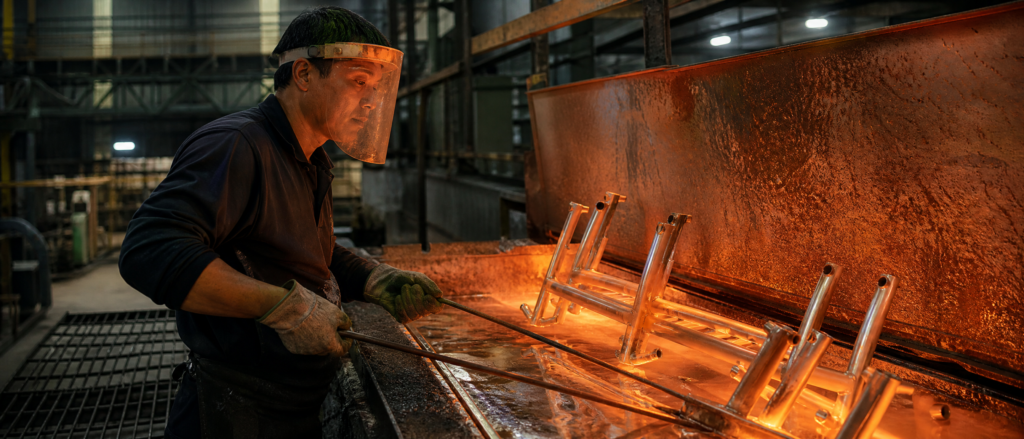
Hot-dip galvanizing is the most robust zinc-based corrosion protection available for steel fitness equipment components. In the galvanizing process, cleaned and fluxed steel parts are immersed in a bath of molten zinc at approximately 450°C (842°F). The zinc metallurgically bonds to the steel surface, forming a series of zinc-iron alloy layers capped by a pure zinc outer layer. This bond is structural — the coating is not a paint or an adhesive film applied to the surface, but an integrated metallurgical layer that cannot be mechanically separated from the substrate without destroying it.
The key protective mechanism of galvanizing is cathodic protection, also called sacrificial protection. Zinc is electrochemically more reactive than iron. When the galvanized coating is damaged — by scratching, impact, or wear — the exposed steel is protected by the surrounding zinc, which preferentially corrodes in place of the iron. This self-healing electrochemical protection continues as long as sufficient zinc remains around the damaged area, typically within 2–3mm of exposed steel. This mechanism means that galvanized coatings continue to protect steel even when the coating surface is physically damaged — a significant advantage over paint systems, which lose protection the moment the film is breached.
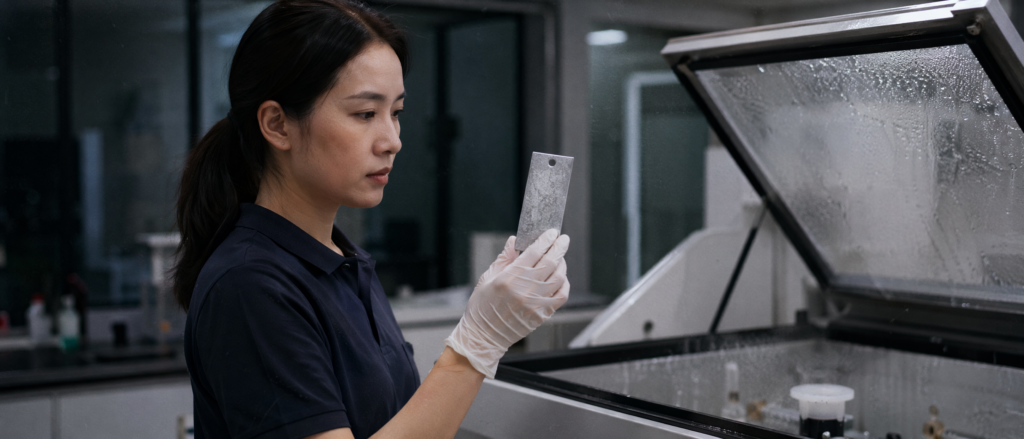
Typical coating thickness for hot-dip galvanizing on fitness equipment components ranges from 45–85 µm (micrometers), governed by EN ISO 1461 (Hot-dip galvanized coatings on fabricated iron and steel articles). At this thickness, hot-dip galvanized steel can achieve 500–1,000+ hours of salt spray resistance in testing to ISO 9227 or ASTM B117, the standard accelerated corrosion test methods used in the fitness equipment industry.
The limitations of hot-dip galvanizing are primarily dimensional and cosmetic. The 45–85 µm coating thickness adds measurably to part dimensions, which can affect tolerance-critical features such as barbell sleeve diameters or plate bore diameters. The finish appearance is matte silver-grey with visible surface texture — not always compatible with aesthetic expectations for premium consumer products. For barbells and rack components where the galvanized appearance aligns with an industrial aesthetic, this is acceptable; for consumer-facing products with branded color requirements, galvanizing is typically a base layer for subsequent coating rather than a final finish.
Treatment Two: Electrogalvanizing (Zinc Electroplating)
Electrogalvanizing applies zinc to steel through an electrochemical deposition process rather than a molten zinc bath. In electrogalvanizing, the steel part is immersed in a zinc salt solution and electrical current drives zinc ions from the solution onto the steel surface. The resulting zinc coating is thinner and more dimensionally uniform than hot-dip galvanizing, typically 5–25 µm.
The thinner coating means electrogalvanized steel offers less corrosion protection than hot-dip galvanized steel — typically 120–200 hours of salt spray resistance before red rust appears, compared to 500+ hours for hot-dip. However, the uniform thickness and smoother surface finish make electrogalvanizing compatible with tight-tolerance components and provides a better substrate for subsequent painting or powder coating than the rougher hot-dip surface. Many fitness equipment components that require a painted or powder-coated finish receive electrogalvanizing as a rust-inhibiting primer layer before the topcoat is applied.
For fitness equipment exposed to direct sweat contact in commercial environments, electrogalvanizing alone — without a topcoat — is generally insufficient as the sole corrosion protection system. It is appropriate for internal structural components not exposed to moisture, or as the base treatment in a multi-layer system.
Treatment Three: Phosphating
Phosphating is a chemical conversion coating process that converts the steel surface into a layer of metal phosphate crystals. Unlike galvanizing, which deposits a zinc layer on top of the steel, phosphating chemically transforms the steel surface itself into a corrosion-resistant compound. The two phosphate types relevant to fitness equipment are iron phosphate and manganese phosphate.
Iron phosphate produces a thin (0.5–1.5 µm), light blue-grey conversion coating on steel. It provides modest corrosion protection on its own — typically 50–100 hours of salt spray resistance — but significantly improves paint and powder coat adhesion. Iron phosphating is primarily used as a pre-treatment stage before painting rather than as a standalone anti-corrosion treatment. Most powder-coated fitness equipment components receive iron phosphating immediately before the powder coat is applied to ensure the coating bonds reliably to the steel and does not delaminate under mechanical stress or moisture exposure.
Manganese phosphate produces a thicker (5–15 µm), dark grey-black conversion coating with a crystalline surface texture. It offers better inherent corrosion resistance than iron phosphate and provides superior lubricity — the crystalline surface retains oil effectively, making manganese phosphate the treatment of choice for moving steel surfaces such as barbell sleeve mechanisms, chain links, and weight stack guide rods. Manganese phosphated barbell sleeves that are lightly oiled during assembly present an excellent combination of corrosion resistance and low-friction rotation performance.
Neither iron nor manganese phosphate replaces a topcoat for exposed fitness equipment surfaces in commercial environments. Both are most effective as part of a system: phosphate conversion + powder coat (iron phosphate) or phosphate conversion + light oil treatment (manganese phosphate for moving parts). As a standalone treatment, manganese phosphate alone achieves 100–200 hours of salt spray resistance; combined with oil and a topcoat, this extends significantly.
Treatment Four: Anodizing (Aluminum Substrates Only)
Anodizing is an electrochemical process exclusive to aluminum. It cannot be applied to steel and is irrelevant to iron, zinc, or steel components. In the anodizing process, the aluminum part is immersed in an acidic electrolyte solution and electrical current causes the aluminum surface to oxidize, forming a thick, dense layer of aluminum oxide (Al₂O₃) integral to the aluminum substrate. This oxide layer is significantly harder than raw aluminum, highly corrosion-resistant, and can be dyed in a wide range of colors before being sealed to lock in the dye and close the porous oxide structure.
In fitness equipment, anodizing is relevant for aluminum components: dumbbell handles made from aluminum alloy, kettlebell bodies in cast aluminum, and adjustable dumbbell handle mechanisms with aluminum structural elements. Anodized aluminum handles offer a characteristic hard, smooth surface with excellent grip feel, high abrasion resistance, and color stability. The anodized layer does not peel, chip, or flake — failure, when it occurs, is by gradual surface abrasion that reduces the oxide layer thickness over time, rather than coating delamination.
Type II anodizing (conventional sulfuric acid anodizing) produces a 5–25 µm oxide layer and is the standard for most fitness equipment applications. Type III (hard coat anodizing) produces a thicker, 25–100 µm layer with significantly higher hardness and wear resistance, appropriate for high-abuse components such as powerlifting equipment or handles exposed to heavy chalk and abrasive training environments. Hard coat anodized surfaces typically appear darker and more matte than Type II anodized surfaces.
Salt spray resistance for anodized aluminum is typically 336–500 hours before visible corrosion in neutral salt spray testing to ISO 9227. In practice, anodized aluminum fitness equipment handles in commercial gym environments typically outlast the structural steel components of the same equipment in terms of surface condition, provided the anodizing is properly sealed and the seal is not compromised by sustained acid contact (from concentrated sweat in high-volume facilities).
Comparison Table: Anti-Rust Treatments at a Glance
| Treatment | Substrate | Thickness (typical) | Salt Spray Hours (standalone) | Mechanism | Best Application | Surface Finish |
|---|---|---|---|---|---|---|
| Hot-dip galvanizing | Steel / iron | 45–85 µm | 500–1,000+ | Cathodic (sacrificial zinc) | Barbells, rack uprights, structural components | Matte silver-grey, textured |
| Electrogalvanizing | Steel / iron | 5–25 µm | 120–200 | Barrier + cathodic (thinner zinc) | Pre-treatment for paint/powder coat; internal components | Smooth, shiny silver |
| Iron phosphating | Steel / iron | 0.5–1.5 µm | 50–100 | Conversion coating (paint adhesion) | Pre-treatment before powder coat on frame components | Light blue-grey, smooth |
| Manganese phosphating | Steel / iron | 5–15 µm | 100–200 | Conversion coating + oil retention | Barbell sleeves, moving parts, load-bearing mechanisms | Dark grey-black, crystalline |
| Type II anodizing | Aluminum only | 5–25 µm | 336–500 | Electrochemical oxide layer | Dumbbell handles, kettlebell bodies, aluminum frame parts | Smooth, semi-gloss; dyeable |
| Type III hard coat anodizing | Aluminum only | 25–100 µm | 500+ | Thick electrochemical oxide layer | High-abuse handles, competition equipment, powerlifting gear | Hard matte, darker tone |
Powder Coating as the Topcoat System — and Why It Requires a Pretreatment
The majority of painted or color-finished fitness equipment uses powder coating as the topcoat. Powder coating is a dry finishing process in which electrostatically charged powder pigment particles are applied to a grounded metal part and then cured in an oven at 160–220°C, forming a hard, continuous film. Powder coats are highly durable, provide good impact and abrasion resistance, and offer a wide range of colors and textures.
However, powder coating is not an anti-corrosion treatment on its own — it is a barrier coating that prevents moisture contact with the substrate. When the powder coat is damaged — by impact, wear, or manufacturing defect — the exposed steel surface is unprotected and corrosion begins. The durability of a powder-coated fitness equipment finish depends critically on the pretreatment system applied before the powder coat.
A steel fitness equipment frame that receives iron phosphating before powder coat will resist corrosion significantly longer than one that receives powder coat over bare steel, because the phosphate layer improves coating adhesion and provides a degree of corrosion inhibition at the coating-metal interface. A rack upright that receives zinc electroplating before powder coat adds cathodic protection that continues to function even if the powder coat is locally damaged. For any powder-coated fitness equipment intended for commercial use, an appropriate pretreatment — iron phosphating at minimum, electrogalvanizing for higher-demand applications — must be included in the manufacturing specification.
How to Specify Anti-Rust Treatment in OEM Purchase Orders
Specifying anti-rust treatment in OEM sourcing documentation requires more precision than most buyers apply. Common mistakes include using marketing language (“rust-resistant,” “anti-corrosion coated”) without dimensional or performance specifications, and failing to specify the pretreatment system separately from the topcoat.
A complete surface treatment specification for a powder-coated steel rack upright would read: “Iron phosphating per [process standard], coating weight 0.4–1.0 g/m², followed by thermosetting polyester powder coat, film thickness 60–100 µm, gloss 20–30 GU (semi-matte), color [RAL code or Pantone reference], minimum 240 hours salt spray resistance per ISO 9227 before first rust.” This specification defines the pretreatment, the topcoat chemistry and thickness, the appearance parameters, and the performance requirement — leaving no ambiguity for the factory.
For a hot-dip galvanized barbell shaft, the specification would reference EN ISO 1461 for the galvanizing process and specify the minimum average coating thickness (typically ≥45 µm per ISO 1461 for this part thickness), with performance verification via salt spray testing. For a manganese phosphated barbell sleeve, the specification would include the phosphate crystal structure requirements and the post-treatment oil or wax to be applied to complete the corrosion protection system.
Environmental and Regulatory Considerations
Surface treatment processes are subject to environmental regulations that affect both manufacturing facility operations and the end product composition. Brands sourcing into the EU, UK, or other markets with chemical regulatory frameworks should confirm that the surface treatment processes applied by their OEM manufacturer comply with relevant regulations.
Hexavalent chromium (Cr6+) — once widely used as a passivation treatment on zinc-plated steel to improve corrosion resistance — is now restricted under the EU RoHS Directive and REACH Regulation. Modern zinc plating for fitness equipment must use trivalent chromium (Cr3+) passivation or alternative passivation chemistries. When reviewing a potential OEM supplier’s surface treatment capabilities, confirmation that hexavalent chromium passivation is not used in their zinc plating process is an important compliance checkpoint.
Cadmium plating — historically used in high-corrosion applications — is similarly restricted under RoHS and REACH and is not an appropriate surface treatment for any fitness equipment supplied to regulated markets. Phosphating chemistry must also be reviewed for compliance with waste water treatment regulations at the manufacturing facility, as phosphate-laden process water requires treatment before discharge.
Cost Implications: What Each Treatment Adds to Manufacturing Cost
Surface treatment cost varies significantly across the options described in this guide, and understanding the cost structure helps brands make trade-off decisions when optimizing a product specification for a target price point.
Iron phosphating is the lowest-cost pretreatment option — a chemical bath process with minimal consumable cost and fast processing time. It adds marginal cost to the total part cost and is included as a standard step in most powder-coated fitness equipment production without significant price impact. Brands should not compromise on iron phosphating as a powder coat pretreatment — the adhesion improvement it provides prevents coating delamination failures that generate warranty claims far more expensive than the pretreatment itself.
Electrogalvanizing adds moderate cost — typically a 3–8% increase in part cost depending on part size and batch volume — and requires an external electroplating subcontractor for manufacturers without in-house electroplating capability, which adds lead time and logistical complexity. For high-volume programs with established subcontractors, the cost and lead time impact is manageable and justified for commercial-grade specifications.
Hot-dip galvanizing adds the highest cost among zinc-based treatments — typically 10–20% of the base steel fabrication cost for structural components — but delivers the highest protection level and the lowest lifecycle cost for components that are expected to remain in service for 10+ years in commercial environments. For rack systems and structural frames sold with long-term warranties, the cost of hot-dip galvanizing is easily justified when weighed against the cost of warranty replacements or facility goodwill.
Manganese phosphating is moderate in cost — comparable to electrogalvanizing — and is almost universally applied to barbell sleeves by quality manufacturers. The lubricity benefit it provides is part of the performance characteristic of the product, not simply a corrosion protection add-on.
Anodizing costs depend significantly on color and type. Clear Type II anodizing for aluminum handles adds a moderate cost premium over raw aluminum finish. Colored anodizing (dyeing) and hard coat (Type III) anodizing add further cost but deliver meaningfully better performance and aesthetic quality. For mid-to-premium priced dumbbell products, anodized handles are cost-effective relative to the perceived quality improvement they deliver to end users.
Matching Treatment to Product and Market
Selecting the correct anti-rust treatment requires matching the protection level to the product’s end-use environment, the product’s aesthetic requirements, the substrate material, and the target market’s regulatory requirements. No single treatment is optimal for all applications.
For commercial gym barbells destined for high-use facilities with heavy sweat exposure: a combination approach — manganese phosphating on the sleeves for corrosion resistance and lubricity, with a hard chrome or stainless steel shaft option for the highest-specification products — delivers the most appropriate performance profile. For budget-segment barbells, electrogalvanizing with a clear powder coat is a cost-effective alternative.
For rack systems and storage equipment: iron phosphating with high-build powder coat (80–120 µm film thickness) is the standard specification. For facilities in coastal or high-humidity regions, specifying electrogalvanizing before powder coat adds meaningful corrosion protection at a modest cost premium.
For aluminum dumbbell handles: Type II anodizing in the appropriate color for the product design is the correct treatment. Hard coat (Type III) should be specified for commercial-grade dumbbells in facilities with heavy usage and chalk environments. Brands should confirm the anodizing facility’s quality control process includes seal quality testing (typically by conductance measurement per ISO 2931) as unsealed anodized surfaces have significantly reduced corrosion resistance.
Alexandave’s manufacturing capabilities support all of the treatment systems described in this guide across the relevant product categories in our range. Our engineering team can advise on the appropriate treatment system for your specific product and market combination during the OEM/ODM specification process. View our full range of barbells, explore our manufacturing capabilities, or contact our team to discuss surface treatment specifications for your product program. Detailed surface treatment options and performance data are available in our OEM/ODM services documentation.
Frequently Asked Questions
What is the best anti-rust treatment for commercial gym barbells?
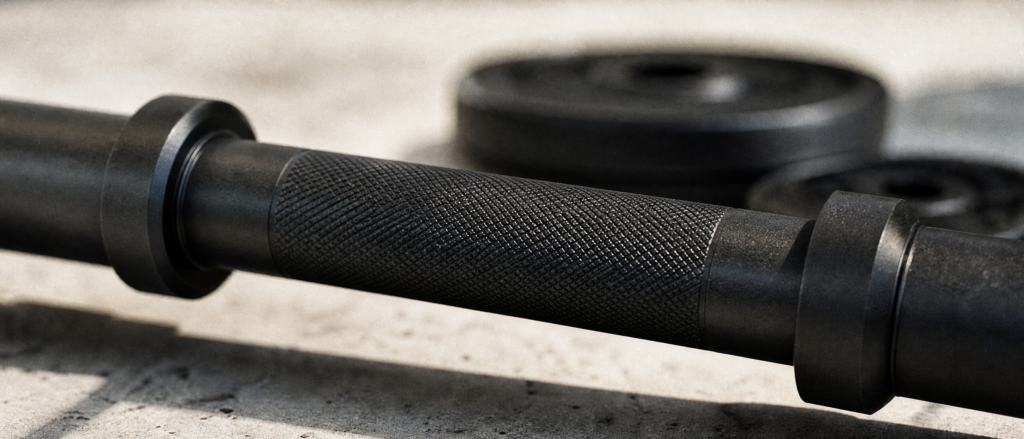
For commercial gym barbells, the most effective corrosion protection combines manganese phosphating on the rotating sleeves — for both corrosion resistance and lubricity — with a hard chrome or bright zinc treatment on the shaft. Stainless steel shafts eliminate corrosion concerns entirely at a higher material cost. For standard commercial barbells in budget-to-mid price points, electrogalvanizing the shaft with a clear or black oxide topcoat provides acceptable protection for most commercial environments. The shaft knurling area is the most vulnerable zone — any treatment applied must be durable enough to survive repeated sweat contact and mechanical wear at the knurl.
How many hours of salt spray resistance should fitness equipment meet?
Salt spray resistance requirements depend on the product category and target market. As a general guideline: entry-level home fitness equipment should achieve minimum 96 hours before first rust per ISO 9227; commercial gym equipment should achieve minimum 240 hours; high-specification commercial or competition equipment should achieve 500+ hours. Premium products with hot-dip galvanizing or stainless steel components can achieve 1,000+ hours. Always specify the applicable test standard (ISO 9227 or ASTM B117), the test duration, and the acceptance criterion (first appearance of red rust) in OEM purchase orders.
Can anodizing be applied to steel fitness equipment?
No. Anodizing is an electrochemical oxidation process exclusive to aluminum and its alloys. It cannot be applied to steel, iron, or zinc. Steel components that require a black or colored surface finish with good corrosion resistance should use black oxide treatment plus oil, zinc-nickel plating, powder coating over a zinc pretreatment, or — for the highest performance — hot-dip galvanizing. Aluminum-bodied fitness equipment components such as dumbbell handles, kettlebell bodies, and aluminum frame elements are the appropriate candidates for anodizing.
What is the difference between iron phosphating and manganese phosphating for fitness equipment?
Iron phosphating produces a thin, light-colored conversion coating primarily used to improve paint and powder coat adhesion on steel frames and structural components. It provides modest corrosion protection on its own and is used almost exclusively as a paint pretreatment. Manganese phosphating produces a thicker, dark grey-black crystalline coating with better inherent corrosion resistance and excellent oil-retention properties that reduce friction. Manganese phosphate is used on moving steel surfaces such as barbell sleeves, chain links, and weight stack mechanisms — applications where both corrosion protection and lubricity are required. The two treatments serve different functions and are rarely interchangeable.
Is hexavalent chromium still used in fitness equipment surface treatments?
Hexavalent chromium (Cr6+) is restricted under the EU RoHS Directive and REACH Regulation and should not be present in fitness equipment supplied to EU, UK, or other markets with similar chemical regulations. Modern zinc electroplating for fitness equipment uses trivalent chromium (Cr3+) passivation or chromate-free alternatives. Fitness brands sourcing OEM equipment for regulated markets should confirm that their manufacturer’s surface treatment processes comply with RoHS and REACH restrictions on Cr6+ and other regulated substances. Request a material declaration or RoHS compliance statement from your manufacturer as part of the supplier qualification process.
Conclusion
Anti-rust treatment selection for fitness equipment is a technical decision that directly affects product longevity, commercial warranty exposure, and end-user experience. Hot-dip galvanizing delivers the highest protection level for steel structural components through its cathodic sacrificial mechanism. Phosphating — iron for paint adhesion pretreatment and manganese for moving surfaces — provides targeted corrosion resistance in combination with appropriate topcoats or oil treatments. Anodizing offers durable, attractive corrosion protection for aluminum-bodied components with additional advantages of hardness and color stability. No single treatment is correct for all applications — the selection must match the substrate, the end-use environment, the aesthetic requirements, and the regulatory framework of the target market.
For OEM buyers, translating this understanding into purchase order specifications requires explicit dimensional and performance language — not marketing shorthand. Specifying the treatment process, the resulting coating thickness, the performance standard, and the acceptance criterion at outgoing inspection ensures that the anti-rust system actually delivered by the factory matches the system evaluated on the approved sample.
Alexandave supports all of the anti-rust treatment systems described in this guide across our barbell, plate, dumbbell, and rack product lines. Our OEM/ODM program includes surface treatment specification consultation as a standard part of the product development process, and our quality assurance protocols include salt spray testing verification for applicable product categories. To discuss surface treatment options for your fitness equipment program, contact our team. Our manufacturing capabilities page provides additional detail on our surface treatment processes and quality verification systems.