One Frame, Two Studios: Why Configuration Is the Real Decision
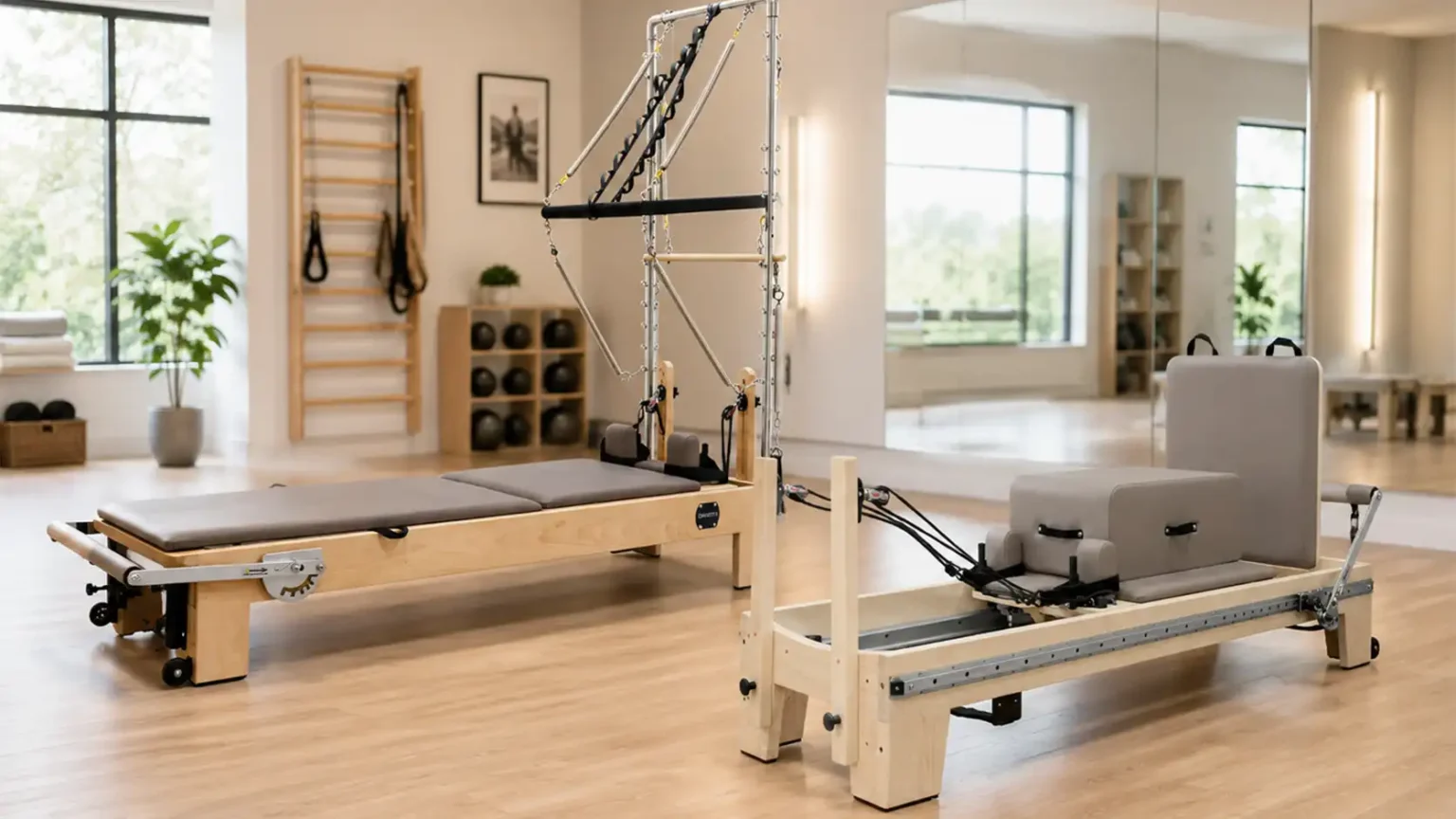
After a studio settles the frame material question, the catalog presents a second fork that shapes the business more deeply than most buyers expect: the same reformer is offered plain, a clean full rail machine with nothing above carriage height, or with a half tower rising at the head end, a frame of uprights carrying a push-through bar, roll-down bar, and a set of springs that effectively bolts a second apparatus onto the first. The price difference looks modest next to the frame decision, the photos look similar from most angles, and many buyers treat the tower as an accessory checkbox, which is precisely the mistake this guide exists to prevent. The reformer configuration you choose determines which repertoire your studio can teach, which client populations you can serve, how many machines fit in the room, how classes flow, and what your schedule can sell for years, and unlike upholstery or color, it is expensive to revisit after delivery. As a Taiwan-based manufacturer that has built strength and Pilates apparatus since 1980, and whose Axispila line produces both configurations, full rail reformers and half tower models, in both maple and aluminum frames, we sit where we have sat in every comparison on this site: we build both, we profit either way, and the only useful article is the one that matches the configuration to the studio rather than upselling the taller machine. This guide defines each configuration precisely, walks through the repertoire, space, and financial trade-offs, and closes with a decision framework by studio type, with our own product line appearing as a disclosed case study rather than a conclusion.
Two framing notes sharpen everything that follows. First, the comparison is not between a reformer and a cadillac: the half tower is the middle point of a three-step ladder that runs from the plain reformer, through the tower-equipped reformer, to the full trapeze table, and understanding what the middle step does and does not add is most of the buying decision; a later section places all three honestly. Second, the decision is portfolio-level, not machine-level. Almost no studio should ask which configuration is better in the abstract, because the practical question is what mix a room of six, eight, or ten machines should carry: all full rail for a group-class boutique, all towers for a rehabilitation clinic, or, very commonly, a deliberate mix that pairs a tower row with a plain fleet. The method tradition matters here too: the tower’s spring and bar work descends directly from the trapeze-table lineage of the method’s founder, the history summarized in the reference on Joseph Pilates, while the group reformer format that fills modern boutique schedules is a contemporary development that leans on the plain machine’s simplicity, so the configuration choice is also, quietly, a choice about where your studio sits between classical depth and contemporary throughput. Neither position is wrong; a studio that knows which one it occupies has already done half the deciding, and the sections below supply the other half.
It is worth naming, before the definitions, why this particular purchase resists the usual research methods, because the failure pattern is consistent enough that we can describe it from the manufacturer’s side of the inquiry inbox. Reformer buyers researching frames can feel the difference in a showroom; buyers researching springs can count and test them; but the reformer configuration question hides its consequences in the schedule rather than in the machine, and a demo session cannot simulate a year of Tuesday timetables. The studio owner who tries both machines for twenty minutes learns that both feel excellent, which is true and unhelpful, because the tower’s value is not in how it feels under one practiced body but in which sessions it makes sellable and which room layouts it forecloses. This is why the best predictor of configuration satisfaction we observe is not equipment knowledge but schedule honesty: the buyers who arrive with a draft timetable, this many group slots, this many privates, this share of rehabilitation clientele, choose quickly and repent rarely, while the buyers who arrive with a mood board choose slowly and call back within the year, usually about retrofits. The practical instruction falls out directly, and it costs nothing: before reading a single specification page, write the weekly schedule you genuinely expect to run in year two, price each session type, and keep that page beside every quote you compare, because a configuration is a machine for delivering a timetable, and only the timetable can say which machine that is.
What Each Configuration Actually Is
Precision about hardware prevents most configuration regret, so this section defines the two machines and their neighbors before any comparison begins. The vocabulary in catalogs is looser than buyers assume: tower, half trapeze, half cadillac, and wall unit are used interchangeably by different brands, mat conversion kits vary in what they include, and the words full rail describe the rail geometry rather than the presence or absence of anything above it, which is why two studios comparing quotes are frequently not comparing the same machines. The three subsections below fix the terms as this guide uses them, and as our own product line names them: the full rail reformer, the reformer whose rails run the frame’s full length and which carries no vertical structure; the half tower reformer, the same full rail machine with a tower assembly and, usually, a mat conversion at the head end; and the adjacent apparatus, the cadillac trapeze table and combination machines, that sit above both in capability and in price. Buyers who internalize these definitions gain a practical superpower for the quoting process: they can ask every manufacturer the same three questions, what exactly is on the tower, what does the mat conversion include, and what does the machine measure with everything installed, and the answers convert marketing photographs into comparable specifications, which is the same discipline this site recommends for every equipment category and which matters doubly in a product family where one word, tower, spans hardware that varies this much.
The Full Rail Reformer, Defined
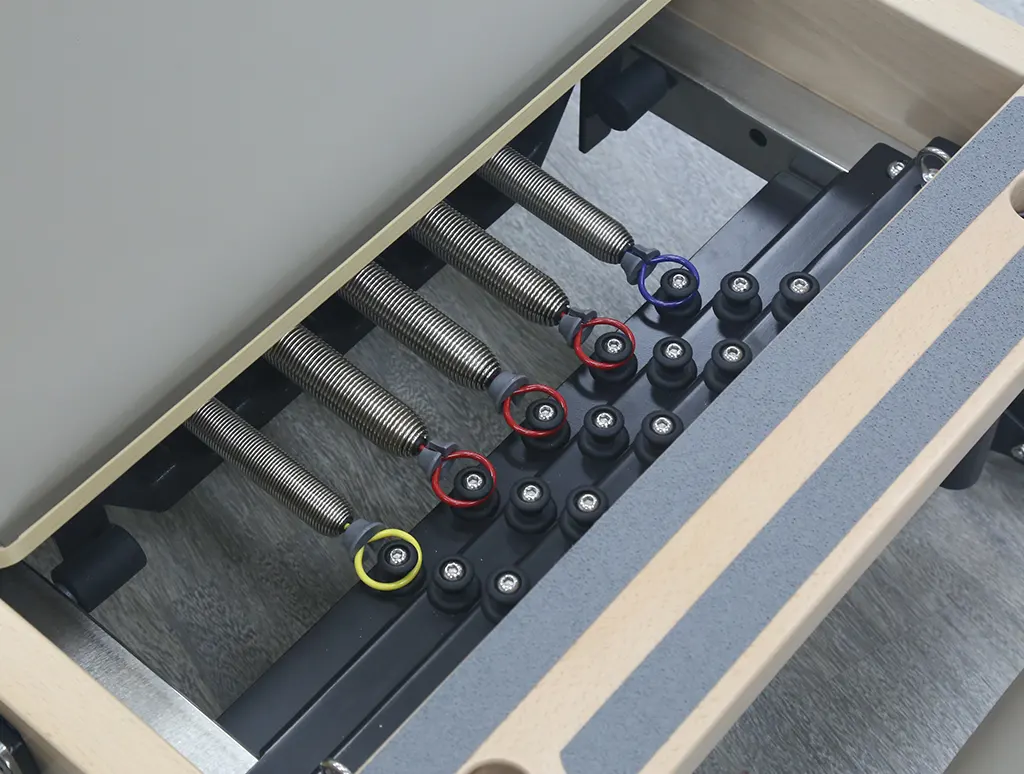
The full rail reformer is the reformer in its purest commercial form: a frame, maple or aluminum, whose carriage rails run the full length of the machine, a spring bar with its gear system, a footbar, shoulder rests, headrest, straps and risers, and nothing rising above carriage height. Full rail describes the rail geometry, rails that extend the complete frame length rather than stopping short, which yields the longest usable carriage travel the footprint allows, a property tall clients and long-spine work reward, and a consistent ride along the entire stroke. Its virtues are the virtues of simplicity. Sightlines stay clear across a room of machines, which is why group-class studios overwhelmingly choose it: one instructor can see every client’s spine and pelvis from one position, and the room photographs as the calm horizontal plane that boutique marketing loves. Transitions are fast because there is no vertical hardware to negotiate, which keeps a 50-minute group class moving through its sequence without traffic jams. There is less to maintain, fewer springs, no push-through safety chain to inspect, no bar bushings to wear, and less to buy, since the plain machine is the cheapest door into reformer work at commercial quality. Its limits are the mirror of its virtues: the repertoire is bounded by what carriage, straps, footbar, and box can load, the vertical and standing spring work of the tower tradition is unavailable, and clients whose programs need fixed-point spring assistance, common in rehabilitation, will need a different machine somewhere in the building. A full rail fleet is therefore a bet that your schedule lives in group reformer programming, and for a large share of modern studios, that bet is simply correct.
The Half Tower Reformer, Defined
The half tower reformer starts from the same full rail machine and adds a tower assembly at the head end: two uprights and a crossbar carrying a push-through bar, sprung from above or below and secured by a safety chain or strap, a roll-down bar on sliders or hooks, and a set of long and short springs with eyelets at multiple heights for arm and leg work. Most commercial packages, ours included, pair the tower with a mat conversion, a padded platform section and sitting box arrangement that turns the carriage end into a stable mat surface, because much tower repertoire is performed lying or seated on a flat platform rather than a rolling carriage; a buyer comparing quotes should confirm what the conversion includes, since this is where packages quietly differ. What the tower adds functionally is a second training station occupying the same footprint: the machine remains a complete reformer, and it gains most of the spring-and-bar vocabulary of the trapeze-table tradition, roll-downs and roll-backs against the bar, push-through sequences for spinal articulation and shoulder mechanics, standing and kneeling spring work, leg springs for hip work in every plane, all anchored to fixed points rather than a moving carriage, which changes the motor problem the client solves and is precisely why instructors prize it. The costs are concrete: a meaningful price premium over the plain machine, added height that changes room sightlines, slower transitions when a class alternates between carriage and tower work, more components to inspect and maintain, and an instructor requirement, because tower repertoire is its own training, and a tower no one on staff can teach is expensive sculpture. The configuration earns its keep exactly where those costs are outweighed, and the middle sections of this guide map where that is.

What Neither Is: Cadillacs, Combos, and Wall Units
The honest way to frame the half tower is as the middle rung of a ladder, and the rungs above it deserve definition so buyers know what they are not buying. The cadillac trapeze table is the full expression of the tower tradition: a raised, stable table inside a complete four-poster frame with an overhead canopy, carrying the full trapeze, push-through bar, roll-down bar, fuzzy loops, and spring array. Because the table is high, stable, and surrounded by fixed anchor points, it is the preferred apparatus for one-on-one rehabilitation, assisted work with elderly or acutely limited clients, and the deepest classical repertoire; it is also a dedicated footprint that teaches no group reformer classes, which is why even reformer-centric studios typically hold exactly one, and why our own line builds it as a separate apparatus rather than a reformer option. Reformer-cadillac combinations, machines that attempt the full canopy above a working reformer, exist and serve space-starved clinics, with the trade-off that both halves inherit compromises. Wall units and springboards, spring-and-bar stations mounted to the studio wall, deliver a useful slice of tower work at low cost and zero floor footprint, and are the strongest budget alternative for a full rail studio that wants spring repertoire without new machines. Placing the half tower on this ladder clarifies its identity: it is the configuration that captures most of the tower vocabulary while remaining a group-class-capable reformer, less capable than a cadillac for pure rehabilitation, far more schedulable than one for everything else, and that dual citizenship, not any single exercise, is what the premium actually buys.
Repertoire and Programming: What Each Configuration Unlocks
Equipment decisions are programming decisions wearing hardware, so this section translates the two configurations into what a schedule can actually sell. The method itself, whose principles and apparatus lineage are summarized in the overview of Pilates, spans mat work, reformer work, and the spring-and-bar tradition of the tower and cadillac, and a studio’s configuration mix determines how much of that span its timetable can cover without renting capability it does not own. The stakes are commercial as much as methodological: classes are the product, the machines are the factory, and a configuration that cannot teach a class category leaves that revenue to the studio down the street. It is worth saying plainly that both configurations teach excellent Pilates, and that strengthening work of either kind sits comfortably inside the twice-weekly muscle-strengthening guidance that public-health bodies such as the World Health Organization recommend for adults; the question is never whether one machine is legitimate but which client populations and class formats each one serves best. The three subsections below take the main programming territories in turn: the group reformer format that fills boutique schedules and favors the full rail; the tower repertoire that deepens programming and justifies the taller machine; and the rehabilitation and special-population work where the tower’s fixed anchor points move from nice-to-have toward requirement. Read them with your intended timetable, not an idealized one, in hand, because the configuration only pays for the classes that actually appear on your schedule.
Group Reformer Programming on the Full Rail
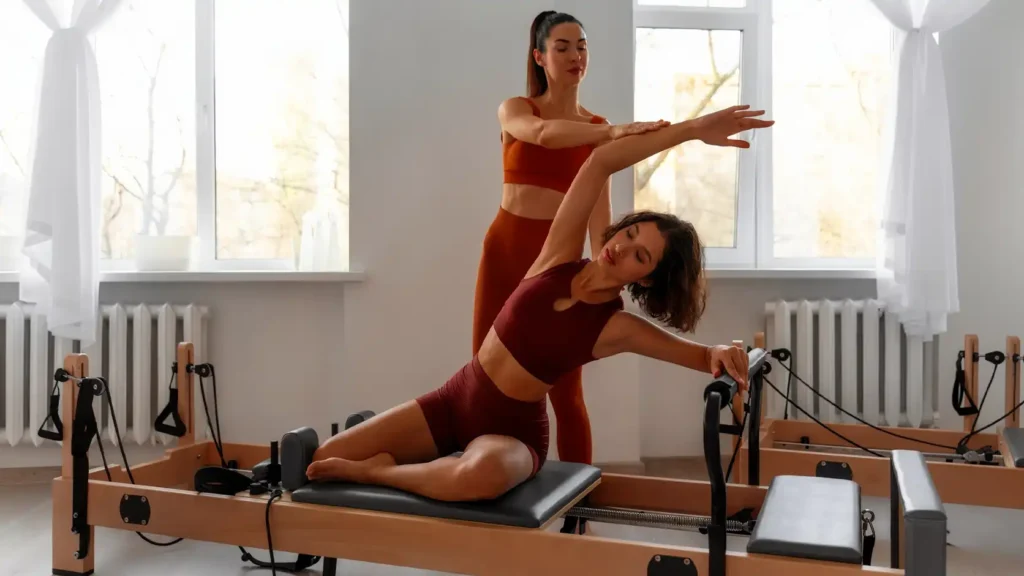
The group reformer class, six to twelve machines moving through a synchronized sequence under one instructor, is the economic engine of the modern boutique studio, and it is a format the full rail configuration serves almost perfectly. The reasons are operational. Group flow depends on every client transitioning at the same tempo, and the plain machine’s vocabulary, footwork, straps, box work, standing and kneeling variations, transitions cleanly because everything happens at carriage height with no vertical hardware to mount, adjust, or duck under. Instruction at ratio depends on sightlines, and a flat fleet lets one instructor read ten spines at a glance, a real safety property when the ratio is one to ten rather than one to one. Pacing depends on simplicity of setup, and spring changes plus footbar positions are the only adjustments the format needs. The full rail’s long carriage travel earns its keep here too, accommodating the full height range of a public class roster without special setup. What the format loses without towers is real but bounded: some studios run tower classes as a premium small-group format, and a full rail fleet cannot host them, though a wall-mounted springboard row often restores that category at a fraction of the cost and footprint. The honest summary for a group-first business plan is that towers on every machine buy little that the format uses, slow the transitions the format depends on, and spend budget the studio could put into one or two more machines, which is usually the higher-revenue purchase; the full fleet of plain machines is not the budget choice in this scenario, it is the correct one.
Tower Work: Springs, Bars, and the Vertical Plane
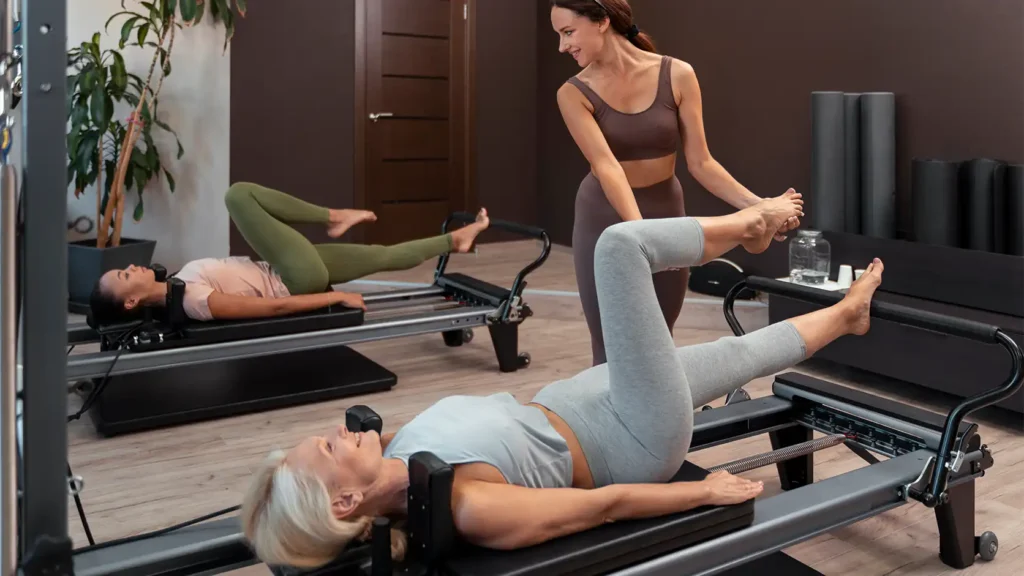
The tower’s repertoire is what the premium buys, and it deserves a concrete description rather than a mystique. Spring work from fixed points changes the physics of the exercise: on the reformer, resistance comes through a rolling carriage the client must control; on the tower, springs anchor to the frame, so load is applied to a limb or the spine while the body rests on a stable surface, which lets the instructor isolate a joint, assist a movement, or resist it, with far finer control. The push-through bar drives spinal articulation and shoulder-girdle sequences that have no full equivalent on carriage and straps; the roll-down bar builds the roll-back and roll-up family against calibrated assistance; leg springs load hip flexion, extension, abduction, and circles in side-lying and supine positions the reformer reaches only awkwardly; arm springs train pressing and pulling from kneeling, seated, and standing positions that add a vertical-plane vocabulary to a horizontally organized machine. Programmatically this shows up three ways. Private and duet sessions gain depth, because an instructor can move one client between carriage and tower without changing stations, which is why tower models concentrate in the private-training rooms of otherwise group-oriented studios. Small-group tower classes become sellable, a premium format at four to six clients that some studios price above standard reformer classes. And instructor development compounds, because staff trained in tower work design better carriage-only classes too. The risk disclosure is staffing: tower repertoire requires trained instructors, and a studio buying towers ahead of its team’s education should budget for the training, not just the steel, or the uprights will spend their first year holding resistance bands.
Rehabilitation and Special Populations
The configuration decision tilts furthest toward the tower where the clientele is oldest, most limited, or recovering, which is why clinics and studios with physical-therapy referral relationships weight their fleets differently than boutiques. The mechanics are straightforward: rehabilitation work needs stable surfaces, fixed anchor points, and finely adjustable assistance, and the half tower supplies all three, a mat platform that does not roll, springs that can assist a movement as easily as resist it, and bars that give a recovering client something fixed to organize against. A post-surgical knee can work leg springs in ranges a rolling carriage would not yet permit; an older client with balance risk can do standing spring work holding a stable frame; a back-care program can progress spinal articulation on the push-through bar with the instructor’s hands free to guide. None of this replaces medical care, and studios should be scrupulous about scope: Pilates apparatus work supports rehabilitation under appropriately qualified instruction, often alongside licensed physical therapy, and general health authorities such as Mayo Clinic’s strength-training guidance emphasize professional supervision when working around injury, a boundary the studio’s marketing should respect as carefully as its programming does. For fleet planning, the practical rule that falls out of this section is a ratio: the higher the share of your revenue that comes from privates, older adults, and referral-based clientele, the higher the share of towers your room should carry, running from a couple of tower machines in a boutique’s private room to a tower-majority or all-tower fleet in a clinic, where the group-class economics that favor the full rail barely apply and the fixed-point repertoire is the daily product.
Space, Cost, and Operations: The Unromantic Comparison
Repertoire sells the configuration; the floor plan and the ledger have to live with it, so this section runs the unromantic numbers before the decision framework assembles everything. The comparison table below summarizes the two configurations across the dimensions that recur in real purchasing conversations, and two of them deserve the deeper treatment the subsections provide: space, because the tower’s added height and end-clearance requirements interact with ceilings, sightlines, and row layouts in ways a spec sheet does not volunteer; and money, because the honest financial comparison is not the invoice difference but the difference in what each configuration earns per square meter of studio per week. The operational rows of the table are worth a sentence each here. Maintenance favors the plain machine, which has fewer springs to log and rotate, no push-through safety hardware to inspect, and no bar bushings to wear; a tower row adds perhaps minutes per machine to a monthly routine, trivial for a maintained studio and compounding for a neglected one. Instructor requirements favor the plain machine today and the tower over a career, since tower-trained staff widen what every machine in the room can do. Resale mildly favors the tower in private-sale markets, where home buyers prize the one-machine-studio quality, and favors the plain machine in bulk fleet sales to other studios. None of these rows decides the purchase alone; the framework section weighs them by studio type, which is where the same numbers produce opposite correct answers.
| Dimension | Réformateur à rail complet | Half Tower Reformer |
| Repertoire span | Complete reformer vocabulary | Reformer vocabulary plus tower spring-and-bar work |
| Group class fit | Excellent: sightlines, fast transitions | Good, with slower transitions and blocked sightlines |
| Privates and rehab fit | Adequate for general clients | Strong: fixed anchor points, mat platform, assistive springs |
| Footprint and height | Machine footprint only, carriage-height profile | Same floor footprint, tower height and end clearance added |
| Price | Baseline commercial price | Meaningful premium for tower and mat conversion |
| Maintenance | Springs, wheels, upholstery | Adds tower springs, push-through safety hardware, bar wear points |
| Staffing requirement | Standard reformer certification | Tower-trained instructors to realize the value |
| Best-fit buyer | Group-format boutiques, franchise fleets | Clinics, private-training rooms, mixed studios, home studios |
Footprint, Height, and Room Flow
On paper the two configurations occupy the same floor rectangle, roughly 2.4 to 2.9 meters long and about 0.7 meters wide depending on model, and that equivalence misleads, because the tower changes the room in three dimensions the floor plan does not show. Height is first: a half tower typically rises to around 1.5 to 1.8 meters above the floor, which is comfortably clear of standard ceilings but not of sloped attic studios, soffits, or hanging fixtures, and any studio planning ceiling-mounted fans, projectors, or acoustic panels should overlay the tower positions before ordering. Working clearance is second: tower exercises put clients kneeling and standing at the head end and swing the push-through bar through an arc beyond the frame, so a tower row needs more end clearance than a plain row, a requirement that surfaces exactly when a studio tries to upgrade an existing tightly packed full rail layout in place. Sightlines and room feel are third and least tangible: a fleet of plain machines reads as an open horizontal field, an instructor sees across it and daylight moves through it, while a row of towers builds a partial wall, which is why mixed studios almost universally place towers along the back or side wall rather than mid-floor, keeping the group-class field open and the tower work visually contained. None of this argues against the tower; it argues for placing the configuration decision inside a measured floor plan rather than a catalog page, and the studios that do so, taping machine rectangles and tower arcs onto the actual floor before signing the order, report the fewest post-delivery surprises of any purchasing habit we know.
Budget, Utilization, and Revenue per Square Meter
The financial comparison between the two reformer configurations begins with the invoice and should not end there. The tower package, uprights, bars, springs, mat conversion, commands a meaningful premium over the plain machine, and multiplying that premium across an eight-machine fleet is real money; the question a business plan must answer is what the premium earns. The earning logic runs through utilization: a machine generates revenue only in the hours a class or session occupies it, so the tower pays when it enables sessions that would not otherwise exist, the premium small-group tower class, the private client whose rehabilitation needs only a tower serves, the clinic contract that requires fixed-spring work, and fails to pay when it stands in a group-class row teaching the same carriage repertoire the cheaper machine teaches. This is why the all-tower boutique is usually a planning error and the all-tower clinic usually is not, and why the mixed fleet, towers where privates and rehab happen, plain machines where the group schedule lives, so often wins the spreadsheet. Two further financial notes complete the picture. Longevity is configuration-neutral: both machines, built to commercial grade, are decade-plus assets whose real cost is purchase price divided by service years, the arithmetic this site applies to every category, and the quality markers that protect those service years, certified quality systems of the ISO 9001 kind, documented load ratings, serviceable spring and wheel components, matter more than the configuration choice itself. And upgrade paths are real but not free: many manufacturers, ourselves included, can supply tower assemblies for tower-ready frames, so a studio uncertain today can buy plain machines with a confirmed retrofit path, paying a small option premium instead of a large configuration bet, provided, and this is the caveat that matters, the frame is specified as tower-compatible at the original order.
Ownership costs deserve their own honest paragraph, because the tower’s premium continues quietly after the invoice. The added hardware adds inspection points: tower springs and their eyelets should join the same rotation-and-replacement log as carriage springs, the push-through bar’s safety chain or strap is a genuine safety component that must be checked for wear and correct rigging on a stated schedule, bar sliders and hooks develop play with years of use, and the tower’s frame anchorage should be torque-checked periodically like any bolted structural joint. None of this is burdensome, a maintained studio absorbs it in minutes per machine per month, but it must actually happen, because tower hardware failures are the rare reformer incidents with injury potential, and an inspection log is also the documentation an insurer or a warranty conversation will ask for. Insurance itself is worth a call before purchase: some policies price rehabilitation-adjacent programming differently, which interacts with what the tower enables a studio to offer. On the asset side of the ledger, both configurations depreciate the way commercial Pilates apparatus generally does, slowly and with strong residual value, and a documented maintenance history is the single largest lever on resale price for either machine. The summary financial picture is not that the tower is expensive to own, it is not, but that its costs are of a different kind: the full rail machine’s ownership cost is almost entirely upholstery, wheels, and springs, while the tower adds a small, permanent discipline of safety-relevant inspection, and a studio should adopt the discipline or decline the configuration, because the middle path, towers without the log, is the only genuinely bad option on the table.
A Decision Framework by Studio Type
The trade-offs above assemble into a usable framework once a buyer names their studio type honestly, because the same reformer configuration question produces different correct answers in different businesses, and most configuration regret we encounter traces to a studio answering for the business it aspired to rather than the one its schedule actually runs. The table below states the pattern recommendations plainly, and three notes govern their use. First, the mixed fleet is the default for full-service studios for structural reasons, not indecision: group classes and private sessions are different products with different equipment economics, and a room that hosts both should be configured in zones, an open full rail field for classes, a tower row along a wall for privates and rehab, in a ratio that follows the revenue split, commonly one tower per three to five plain machines in class-led studios and inverted in clinic-led ones. Second, the framework prices growth: a studio planning to add rehabilitation or clinical referral revenue within the fleet’s service life should buy tower-ready frames even where it defers the towers, because the retrofit path costs little at order time and much after. Third, no row of the table outranks a measured floor plan and a staffing audit, the two instruments that catch the errors the table cannot see, the ceiling that will not clear a tower, the team with no tower training, the schedule with no slot for the premium class the tower was supposed to teach. Used with those instruments, the framework reduces a seemingly stylistic choice to what it actually is: an allocation of repertoire, space, and budget to the clients a studio genuinely serves.
Two worked examples show the framework operating on real numbers. A boutique opening with eight machines and a schedule of thirty group classes and ten privates per week sits squarely in the class-led pattern: seven full rail machines fill the group field, one half tower model stands against the side wall for the privates, and the budget saved against an all-tower fleet funds better flooring and a second instructor certification, purchases that earn weekly revenue rather than standing unused between privates; if the private book grows, the tower-ready frames absorb one or two retrofits without disturbing the room. A rehabilitation-adjacent studio opening with five machines, fifteen privates, ten duets, and six small-group slots inverts the logic: four towers carry the fixed-point work that is the actual product, one plain machine serves the group slots and athletic clients, and the cadillac question moves onto the table for year two as referral volume justifies it. Notice what decided each case: not the machines’ merits, which are identical in both scenarios, but the revenue mix each schedule sells, which is the whole method of this guide compressed into two paragraphs. Notice also what neither case chose, the uniform fleet bought for visual symmetry, because symmetry is the one buyer instinct this decision consistently punishes: a room that looks perfectly uniform on opening day and cannot host a category of session is not simple, it is incomplete, and the mixed reformer configuration that photographs slightly less tidily is, for most full-service businesses, the room that actually pays its rent.
| Studio Type | Recommended Configuration | Reasoning |
| Group-class boutique | Full rail fleet; consider one tower or a springboard wall | Sightlines, transitions, and machine count drive revenue; tower repertoire is a niche add-on |
| Full-service studio (classes + privates) | Mixed fleet, roughly 3-5 full rail per tower, towers wall-placed | Zones match products: open field for classes, fixed-point work for privates |
| Rehabilitation clinic / PT practice | Tower-majority or all-tower, plus consider a cadillac | Fixed anchors, mat platforms, and assistive springs are the daily product |
| Classical studio | Towers throughout, cadillac and full apparatus set | The spring-and-bar lineage is core repertoire, not an add-on |
| Franchise / multi-site chain | Standardized full rail fleet, tower-ready frames | Uniformity simplifies training and maintenance; retrofit path preserves options |
| Home studio | Single half tower reformer with mat conversion | One footprint carries the widest solo repertoire; the tower replaces machines there is no room for |
How Axispila Builds Both: A Disclosed Case Study
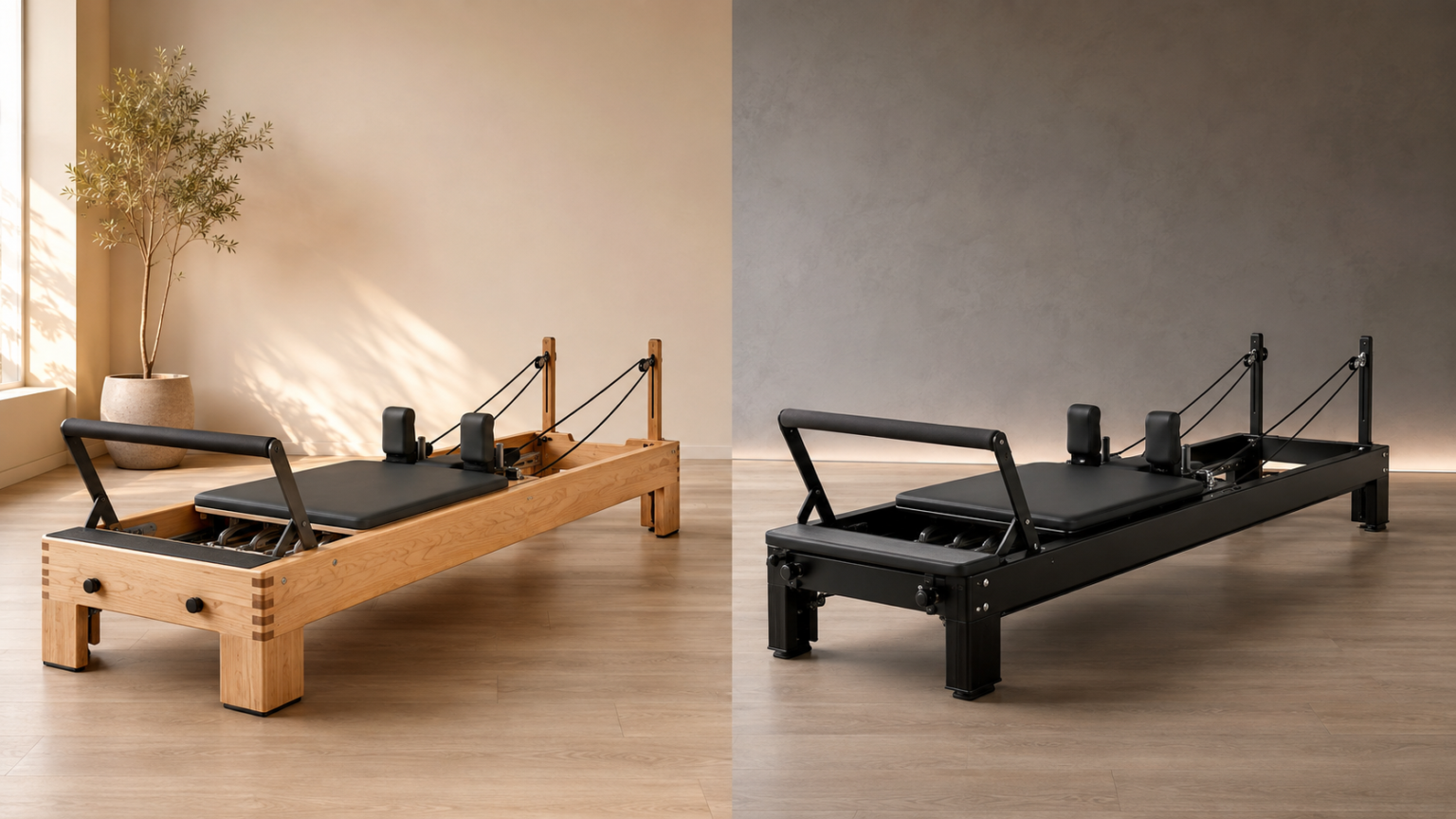
The fairest way to close the technical argument is to show how a manufacturer resolves it in steel and maple, so this section describes our own line with the disclosure repeated: these are our products, on the Axispila Pilates equipment manufacturing page, and the guide’s reasoning stands independently of them. Our reformer range is built full rail across the board, full-length rails for maximum carriage travel, in both frame materials this site has compared before, and each frame is offered in both configurations: the Advanced and Deluxe Full Rail Pilates Reformers and the Aluminum Deluxe Full Rail Reformer as plain machines, and the same platforms as the Pilates Reformer with Half Tower and Mat, the Deluxe Full Rail Reformer with Half Tower and Mat, and the Aluminum Deluxe Full Rail Reformer with Half Tower. The parallel structure is deliberate and is itself a buying lesson: because the tower models share their frames, rails, and carriage systems with the plain models, a mixed fleet rides identically across both rows, which is precisely what a full-service studio wants, and the tower decision becomes a pure configuration choice rather than a change of machine. Around the reformers, the line carries the adjacent apparatus this guide placed on the ladder, the Cadillac Trapeze Table for clinics and classical rooms, the Combo Stability Chair, ladder barrels in three adjustment systems, and spine correctors, so studios can zone a complete room from one specification language, and the whole catalog is visible under our Pilates equipment tag. For studios and distributors buying at fleet scale, the configuration flexibility extends to business terms: our Services OEM et ODM build both configurations under private label, with upholstery, color, and branding options, and the specification conversation, which configuration mix, which ratio, tower-ready or tower-equipped, is exactly the conversation this guide has rehearsed, which is why we wrote it.
A short buying checklist converts the case study into questions any manufacturer, ourselves included, should answer in writing. Ask what the tower package includes, itemized: push-through bar with its safety mechanism, roll-down bar, spring set with counts and attachment heights, mat conversion contents, because packages differ and quotes that look apart are often fleets apart in contents. Ask for dimensions with the tower installed, height, end clearance for the push-through arc, and confirm them against your measured floor plan and ceiling. Ask whether plain frames are tower-ready and what the retrofit costs and involves, in parts and in labor, because a cheap machine with no upgrade path is a different asset than a cheap machine with one. Ask for load and durability documentation on the frame and the tower anchorage, the commercial-grade evidence this site’s manufacturing guides treat at length, and for the maintenance schedule the tower hardware adds. And ask how the configuration decision interacts with the frame material decision covered in our maple versus aluminum comparison, because the two choices compound: an aluminum half tower model, for example, is the natural specification for a stacking, relocating, or humidity-challenged operation that still wants tower repertoire. A supplier who answers these questions crisply is showing you their engineering; one who answers with photographs is showing you their marketing, and on a purchase that configures your studio for a decade, the difference is worth the extra email, and it is the difference the conversation with us is set up to have.
Foire aux questions
What is the difference between a full rail reformer and a half tower reformer?
A full rail reformer is a reformer with full-length carriage rails and no vertical structure; a half tower reformer is the same machine with a tower at the head end, adding a push-through bar, roll-down bar, and spring anchor points, usually with a mat conversion platform. The tower adds the spring-and-bar repertoire of the trapeze-table tradition while the machine remains a complete reformer underneath.
What is the tower on a reformer used for?
The tower anchors springs and bars to fixed points, enabling exercises a rolling carriage cannot load: push-through bar work for spinal articulation and shoulder mechanics, roll-down bar sequences, and arm and leg spring work in supine, side-lying, kneeling, and standing positions. Because the springs can assist as well as resist, tower work is especially valuable in private training and rehabilitation with older or recovering clients.
Do Pilates studios need reformers with towers?
Not all of them. Group-class boutiques usually run better on plain full rail fleets, which cost less and keep sightlines and transitions fast, with tower repertoire covered by one tower machine or a wall springboard. Studios with significant private, classical, or rehabilitation revenue benefit from a tower row, and clinics often need tower-majority fleets. The right answer follows the schedule’s revenue mix, not the catalog.
How much space does a half tower reformer need?
The same floor rectangle as the plain machine, roughly 2.4 to 2.9 meters by about 0.7 meters depending on model, plus vertical clearance for a tower standing roughly 1.5 to 1.8 meters tall and extra end clearance for the push-through bar’s arc and for clients standing or kneeling at the head end. Check sloped ceilings, fans, and fixtures against tower positions, and plan tower rows along walls in mixed studios.
Can you add a tower to a reformer later?
Often, but only if the frame was built for it. Many manufacturers offer tower assemblies as retrofits for tower-ready frames, which makes buy-plain-now, add-towers-later a sound strategy for growing studios. The frame must be specified as tower-compatible at the original order, since towers anchor into the frame structure. Confirm retrofit availability, parts cost, and installation requirements in writing before choosing the plain configuration for that reason.
Key Takeaways: Configure the Studio You Actually Run
The full rail versus half tower decision looks like a hardware option and is actually a business plan stated in equipment, and it resolves cleanly once it is read that way. The full rail reformer is the group-class machine: cheapest per station, fastest in transition, clearest in sightlines, complete in carriage repertoire, and the correct fleet for boutiques and franchises whose revenue lives in the class schedule. The half tower reformer is the depth machine: a full reformer plus the fixed-point spring and bar vocabulary that privates, classical work, and rehabilitation actually use, worth its premium exactly where those sessions appear on the schedule and wasted where they do not. Most full-service studios should buy both, in zones and in a ratio that follows the revenue split, with towers along the wall and the class field kept open; clinics should tilt tower-heavy; home studios get the most repertoire per square meter from a single tower machine; and any studio uncertain about its future should buy tower-ready frames and purchase the option instead of the bet. Whatever the mix, insist on the same discipline this site applies to every category: itemized package contents, installed dimensions checked against a measured floor plan, documented load ratings, a written retrofit path, and a staffing plan that can actually teach what the steel makes possible. Choose the reformer configuration that matches the studio you run today with a clean path to the one you are building, and the machines disappear into the background of a schedule that simply works, which is all equipment is ever supposed to do.