Three years ago, a fitness equipment brand asking its OEM manufacturer about ESG compliance was likely to receive a polite but non-committal response. Today, the same question is increasingly a qualification criterion — appearing in procurement scorecards, RFQ documentation, and supplier onboarding checklists from commercial gym chains, institutional buyers, and European distributors. ESG in fitness equipment manufacturing has moved from a corporate responsibility aspiration to an active sourcing dimension, and the brands that understand what buyers are actually asking for — and what manufacturers can credibly provide — are better positioned to win contracts and build durable distribution relationships in regulated markets.
This article examines the current state of ESG as a fitness equipment sourcing consideration: what is genuinely being required versus what is still aspirational, which certifications carry credible weight, how the EU’s regulatory framework is accelerating the transition, and what OEM buyers need to understand about sustainable manufacturing claims before including them in sourcing criteria or marketing claims.
Why ESG Is Entering the Fitness Equipment Sourcing Conversation
The fitness equipment industry’s ESG reckoning is being driven from multiple directions simultaneously. Consumer expectations, institutional procurement policies, EU regulatory requirements, and the fitness industry’s own positioning as a health and wellness category are all converging to make sustainability credentials a commercial differentiator rather than a peripheral concern.
Consumer and Operator Demand
A 2025 McKinsey survey found that over 60% of consumers across Europe consider a company’s environmental practices before making purchasing decisions. For commercial gym operators — who position themselves as health and wellness lifestyle brands — this consumer expectation creates reputational pressure to ensure their equipment sourcing aligns with the sustainability values they market to members. A premium gym chain communicating its commitment to sustainability while fitting out its facilities with equipment from manufacturers with no environmental reporting or certification faces a credibility gap that sophisticated members increasingly notice.
وفقًا لـ IndigoFitness’s ESG Report 2025, leading fitness equipment brands are now committing to verified, externally-audited ESG performance — including ISO 14001 environmental management certification, verified carbon reporting aligned with international frameworks, and net-zero operations targets. IndigoFitness specifically has committed to achieving net-zero across all operations by 2035 and reports its emissions against the Streamlined Energy and Carbon Reporting (SECR) framework. From manufacturing at their UK headquarters to sourcing FSC-certified materials, every decision is guided by responsibility to reduce environmental impact. This type of integrated, documented ESG approach is becoming the benchmark against which procurement teams in institutional channels increasingly evaluate competing suppliers.
EU Regulatory Pressure: CSRD and CBAM
The European regulatory framework is the most significant structural driver of ESG integration in fitness equipment sourcing chains. Two directives are particularly consequential:
Corporate Sustainability Reporting Directive (CSRD): The CSRD requires companies above defined thresholds — over 250 employees, EUR 50 million in revenue, or EUR 25 million in total assets (meeting two of three criteria) — to report on their sustainability performance under the European Sustainability Reporting Standards (ESRS). Critically, CSRD’s Scope 3 reporting requirements extend reporting obligations into the supply chain: large fitness equipment brands and distributors operating in the EU must report on the emissions associated with purchased goods and services, which includes the manufacturing carbon footprint of their fitness equipment OEM suppliers.
This Scope 3 requirement creates a direct commercial link between a fitness equipment brand’s CSRD reporting obligations and its OEM manufacturer’s willingness and ability to provide verifiable emissions data. Brands that cannot obtain Scope 3 emissions data from their manufacturing partners face reporting gaps that expose them to regulatory compliance risk and audit findings. Manufacturers who can provide verified production carbon footprint data — ideally calculated using ISO 14040/44 Life Cycle Assessment methodology — become preferred partners for CSRD-obligated brands.
Carbon Border Adjustment Mechanism (CBAM): While currently focused on carbon-intensive sectors (cement, aluminum, steel, electricity), the EU’s Carbon Border Adjustment Mechanism signals the direction of travel for trade policy: goods produced with high carbon intensity will face higher import costs in the EU market as the carbon price differential between EU and non-EU production is levied at the border. Fitness equipment is not currently in CBAM scope, but the steel and aluminum inputs used in fitness equipment manufacturing are directly affected — and fitness equipment produced from high-carbon steel inputs may face CBAM implications as the mechanism’s scope is reviewed.

The Three Pillars of ESG Applied to Fitness Equipment Manufacturing
ESG encompasses Environmental, Social, and Governance dimensions — each of which has specific application in the context of fitness equipment manufacturing. Understanding what each pillar means in practice helps brands and buyers distinguish genuine ESG performance from marketing language.
Environmental: The Material and Energy Dimension
Environmental performance in fitness equipment manufacturing is primarily measured across three variables: material inputs, energy consumption, and waste management. For fitness equipment specifically, the most significant environmental impact dimensions are:
Recycled material content: A 2024 sustainability report found that recycled rubber plates reduce emissions by 25% compared to virgin materials, while bamboo reduces manufacturing emissions by 15%. For OEM programs that include rubber-coated products, specifying a minimum verified recycled rubber content percentage — and requiring a material data sheet confirming the compound composition — is the most accessible environmental improvement lever available to most brands. Recycled rubber for fitness equipment is commercially available and cost-effective at specified quality levels; it does not require premium pricing if managed correctly at the OEM specification stage.
Energy source and efficiency: Manufacturing energy consumption is typically the largest single source of production-stage carbon emissions. Factories operating on grid-mix electricity with significant coal generation in their regional grid have materially higher Scope 2 emissions per unit produced than factories running on renewable energy tariffs or with on-site solar generation. Asking a manufacturer what percentage of their production energy comes from renewable sources — and requesting documentation — is a basic ESG sourcing question that credible manufacturers should be able to answer.
Waste and by-product management: Metal scrap from steel fabrication, rubber flash from molding, solvent waste from surface treatment, and packaging waste from incoming materials all represent environmental management considerations. Factories with formal waste management programs — documented recycling rates, licensed waste contractors, and waste generation per unit metrics — demonstrate operational environmental discipline beyond basic compliance.
Social: Labor Standards and Supply Chain Ethics
The social dimension of ESG in fitness equipment OEM sourcing encompasses worker welfare, labor rights compliance, supply chain transparency, and community impact. For buyers sourcing from Asian manufacturing facilities, the relevant social standards include:
SA8000 Certification: The SA8000 standard — developed by Social Accountability International — is the most rigorous and widely recognized international standard for workplace social compliance. It covers child labor prohibition, forced labor prohibition, health and safety, freedom of association, non-discrimination, disciplinary practices, working hours, and compensation. SA8000 certification requires third-party audit by an accredited certification body and periodic surveillance audits. For fitness equipment brands marketing to European institutional buyers or major US retail chains, SA8000 certification from their OEM manufacturer provides documented social compliance assurance that internal audits cannot replicate.
Working Hours and Compensation: Factory labor compliance — specifically adherence to legal maximum working hours and payment of statutory minimum wages and benefits — is a baseline requirement in most major retailer and institutional buyer supplier codes of conduct. Brands sourcing from factories that systematically exceed legal working hour limits or that pay below statutory minimums face reputational and legal exposure in markets where supply chain labor practices are subject to disclosure and reporting obligations, including the EU’s upcoming Supply Chain Due Diligence Directive.
Conflict Minerals: For fitness equipment containing electronic components or specific metals (tungsten, tantalum, tin, gold), OECD Due Diligence Guidance for Responsible Supply Chains of Minerals from Conflict-Affected and High-Risk Areas imposes conflict mineral reporting obligations for brands selling to US public companies and EU-regulated entities. While most strength training equipment is not directly affected by conflict mineral reporting, brands with smart connected fitness product lines should confirm whether their electronic component sourcing triggers these obligations.
Governance: Transparency, Documentation, and Accountability
The governance dimension of ESG in manufacturing covers the organizational systems, documentation, and accountability structures that give substance to environmental and social commitments. Without governance infrastructure, environmental and social claims are unverifiable assertions rather than credible sustainability credentials.
Key governance indicators for fitness equipment OEM manufacturers include: ISO 14001 Environmental Management System certification (which requires documented environmental objectives, progress monitoring, and management review); ISO 45001 Occupational Health and Safety Management System certification; published ESG or sustainability reports with quantitative performance data; third-party verification or audit of reported performance; and an accessible dispute and grievance mechanism for workers and supply chain stakeholders.
As Health Club Management’s sustainability feature notes, the fitness equipment industry’s credibility problem on sustainability is the prevalence of unsubstantiated claims: “Operators should demand to know exactly where products are sourced from and suppliers should be transparent. Evidence and accountability are key, not just empty gestures.” A manufacturer who claims sustainability credentials without providing verifiable documentation should be treated with the same skepticism as one who claims product quality certifications without providing the certificate.

ESG Certifications That Matter in Fitness Equipment Sourcing
The certification landscape around sustainability and ESG is complex — there are hundreds of environmental and social certifications in existence, with varying levels of rigor, relevance, and market recognition. For fitness equipment OEM sourcing, the following certifications carry genuine weight in institutional and European procurement processes:
| Certification | Scope | Relevance to Fitness Equipment | Market Recognition |
|---|---|---|---|
| ISO 14001 | Environmental Management System | Confirms documented environmental management at the factory | High — required by many EU institutional procurement programs |
| ISO 45001 | Occupational Health & Safety | Worker safety management at manufacturing facility | High — increasingly required alongside ISO 14001 |
| ISO 50001 | Energy Management System | Documented energy efficiency and renewable energy transition | Medium — valued in energy-intensive manufacturing |
| SA8000 | Social Accountability (labor rights) | Worker welfare, fair wages, working hours compliance | High — required by major retail chains and EU institutional buyers |
| FSC Chain of Custody | Sustainable forestry (wood/paper) | Relevant for wooden fitness equipment (benches, Pilates apparatus) | Medium — required for certified sustainable wood products |
| OEKO-TEX STANDARD 100 | Harmful substance testing (textiles) | Relevant for upholstery and foam components | Medium — valued in EU consumer products |
| GRI-aligned reporting | Sustainability performance disclosure | Provides third-party verified emissions and social data | High — recognized by institutional buyers and CSRD reporting |
Lifecycle Design as an ESG Strategy: Durability Over Disposability
One of the most strategically coherent ESG arguments in fitness equipment — and one that aligns commercial interests with environmental interests — is the case for lifecycle extension through durable design. A fitness machine that operates reliably for 15 years produces significantly lower lifetime environmental impact per hour of use than one requiring replacement after 5 years, even if the latter has a slightly lower production carbon footprint. Durability is the most accessible ESG lever available to fitness equipment manufacturers that lack the infrastructure for ISO 14001 certification or verified carbon reporting.
Modular Design and Repairability
Modular product architecture — where components can be replaced individually rather than requiring complete product replacement — extends equipment lifecycles and reduces waste from premature disposal. A power rack designed with replaceable j-cups, interchangeable safety bar receivers, and modular crossmember connections allows facility operators to update specific damaged or worn components without replacing the entire unit. For a commercial gym operator managing equipment on a 10-year lifecycle, modular repairability is a financial and environmental win simultaneously.
Leading fitness equipment manufacturers are now explicitly committing to extending product lifecycles with modular design and flexible maintenance as a core ESG strategy — recognizing that the most impactful environmental contribution a fitness equipment manufacturer can make is ensuring its products remain in service as long as possible. For OEM buyers specifying structural fitness equipment, including modular component availability and repair documentation in the product specification brief is a practical ESG integration that requires no additional certification infrastructure.
Refurbishment Programs and End-of-Life Responsibility
The circular economy concept — where products are designed for reuse, refurbishment, or material recovery at end of life — is gaining institutional traction in fitness equipment, particularly in European markets where extended producer responsibility legislation is advancing. Brands that establish refurbishment or take-back programs for end-of-life equipment — particularly commercial gym operators transitioning to new equipment generations — create circular commercial models that align with ESG values while generating positive brand associations and potential secondary revenue streams.
From an OEM manufacturing perspective, designing for refurbishability means specifying surface treatments that can be stripped and reapplied, upholstery systems that can be re-padded without frame replacement, and component standards that remain consistent across product generations so that older frames can accommodate newer attachments. These design decisions cost nothing at the specification stage but create significant lifecycle value — both commercial and environmental — over the product’s service life.
The Cost of Sustainability: What ESG Compliance Actually Costs OEM Programs
A practical concern for brands considering ESG integration in their OEM sourcing is cost impact. Will requiring sustainability documentation, certified materials, and audit compliance from manufacturing partners increase unit costs in ways that compromise competitiveness? The honest answer is: it depends on what is being required, and how it is being implemented.
Low-cost ESG steps (minimal unit cost impact):
- Requesting existing certifications and documentation from manufacturers (zero marginal cost)
- Specifying minimum recycled rubber content (30–40% recycled SBR content adds minimal cost if managed at specification stage; forced recycled content above quality thresholds can affect surface integrity)
- Requiring material compound data sheets for rubber components (zero marginal cost)
- Requesting factory energy source information (zero marginal cost)
Medium-cost ESG steps (moderate unit cost impact, manageable):
- Third-party social compliance audit cost (typically shared across all buyers from the factory; incremental per-unit cost is minimal at production volumes above 1,000 units per year)
- FSC-certified packaging and retail carton (FSC certification adds approximately 5–15% to packaging material cost)
- Life Cycle Assessment (LCA) carbon footprint calculation (one-time study cost, amortized across production volumes)
Higher-cost ESG steps (meaningful unit cost impact):
- Virgin natural rubber specification (40–70% higher rubber compound cost versus recycled SBR)
- Premium renewable energy surcharge on production electricity (if factory purchases green energy certificates)
- Full SA8000 certification compliance (factory-level investment; does not directly increase product unit cost but affects overall factory economics)
For most OEM programs at commercial volume, the ESG integration steps with material impact on unit economics are those requiring premium material specifications — particularly natural rubber versus recycled SBR, and FSC-certified wood components. These specification choices are appropriate for premium-positioned product lines where the ESG credentials support price premium maintenance; they are not appropriate for cost-competitive mass-market programs where the margin impact cannot be recovered through pricing.
The key discipline is matching ESG investment to market channel requirements and price positioning — applying premium ESG specifications where they are commercially justified, and focusing on zero- and low-cost ESG documentation steps for all programs regardless of channel. This differentiated approach avoids both the greenwashing risk of claiming sustainability without documentation and the margin erosion risk of applying premium ESG specifications to cost-sensitive product lines.
Greenwashing vs. Genuine ESG: How to Tell the Difference
The commercial value of sustainability credentials has created incentives for manufacturers to make environmental claims that exceed their actual performance. “Eco-friendly,” “green manufacturing,” and “sustainable materials” are phrases that appear in factory marketing materials without necessarily corresponding to verified or verifiable practices. Buyers should apply a simple verification standard: any ESG claim should be backed by a specific document, certification, or data point that can be independently confirmed.
Questions that distinguish genuine ESG performance from marketing language:
- “You mention ISO 14001 certification — can you provide the current certificate number and issuing body?” → Genuine: immediate certificate provision. Flag: delay, incomplete certificate, or inability to provide issuing body verification.
- “What percentage of your production energy comes from renewable sources?” → Genuine: specific percentage with utility bill or renewable energy certificate documentation. Flag: vague answer (“we use solar energy”) without quantification.
- “What recycled material content percentage is in the rubber compound for these dumbbells? Can you provide the compound data sheet?” → Genuine: specific percentage with compound data sheet. Flag: “we use recycled rubber” without content percentage.
- “Has your factory been audited for social compliance in the past two years? Can you share the audit summary?” → Genuine: audit report or summary provided. Flag: verbal assurance of compliance without documentation.
وفقًا لـ Dcycle’s ESG guide for wellness and fitness businesses, “working with equipment suppliers to understand the carbon footprint of gym machinery, and favoring manufacturers with verified environmental credentials, strengthens the full value chain” — a principle that applies equally whether the buyer is a gym operator evaluating equipment suppliers or a fitness brand evaluating OEM manufacturing partners.
Practical ESG Integration in OEM Sourcing: A Framework for Brands
For fitness equipment brands at various stages of ESG integration, the following framework provides a staged approach to incorporating sustainability criteria into OEM sourcing without creating unrealistic requirements or disrupting established manufacturing relationships.
Stage 1: Baseline Documentation (All Brands)
Begin by requesting existing documentation from current and prospective OEM manufacturers: ISO 14001 certificate (if applicable), any available sustainability or environmental policy document, basic facility energy source information, and material supplier certifications for rubber compound and steel inputs. This baseline assessment identifies where documentation exists and where gaps need to be addressed.
Stage 2: Specific Performance Data (Brands with Institutional or European Customers)
For brands supplying institutional buyers or European distribution channels where CSRD Scope 3 reporting requirements may apply, request production-stage carbon footprint data for key product categories. Work with your OEM manufacturer to understand whether they have conducted a Life Cycle Assessment (LCA) or Greenhouse Gas Protocol product carbon footprint calculation. If not, support the calculation using industry-average emission factors from recognized databases (ecoinvent, IPCC) as a starting point pending manufacturer-specific data.
Stage 3: Sourcing Specifications and Contractual Requirements (Brands Pursuing ESG Leadership)
For brands positioning ESG as a market differentiator, integrate sustainability requirements into OEM production agreements: minimum recycled rubber content percentages for rubber products; renewable energy sourcing requirements or preference in production scheduling; social compliance audit requirements (SA8000 or equivalent); and annual ESG reporting provision obligations. These contractual requirements create accountability structures that transform sustainability commitments from aspirations into operational standards.
Is ESG Becoming a True Sourcing Standard, or Still a Nice-to-Have?
The honest answer as of mid-2026 is that ESG has become a genuine sourcing requirement for a defined subset of the fitness equipment market — and an emerging standard for a broader segment — while remaining largely optional for others.
Where ESG is a genuine requirement today: European institutional procurement programs (public sector gyms, healthcare facilities, school and university facilities); major retail chains in Northern Europe with published supplier codes of conduct that include ESG criteria; commercial gym chains committed to published sustainability targets who are beginning to incorporate supply chain criteria into procurement; and B-corps or purpose-driven fitness brands whose market positioning is directly tied to verifiable sustainability credentials.
Where ESG is an emerging differentiator (becoming a requirement within 2–4 years): US institutional channels (university athletics, corporate wellness, hotel fitness); commercial gym operators seeking to future-proof their supplier relationships against anticipated regulatory requirements; and fitness equipment brands targeting premium positioning in any geography, for whom ESG credentials reinforce the quality and values-alignment messaging that supports premium pricing.
Where ESG remains largely optional: commodity fitness equipment for price-sensitive retail channels; mass-market home fitness products where purchase decisions are dominated by price and review count; and markets where regulatory frameworks have not yet introduced supply chain ESG reporting obligations.
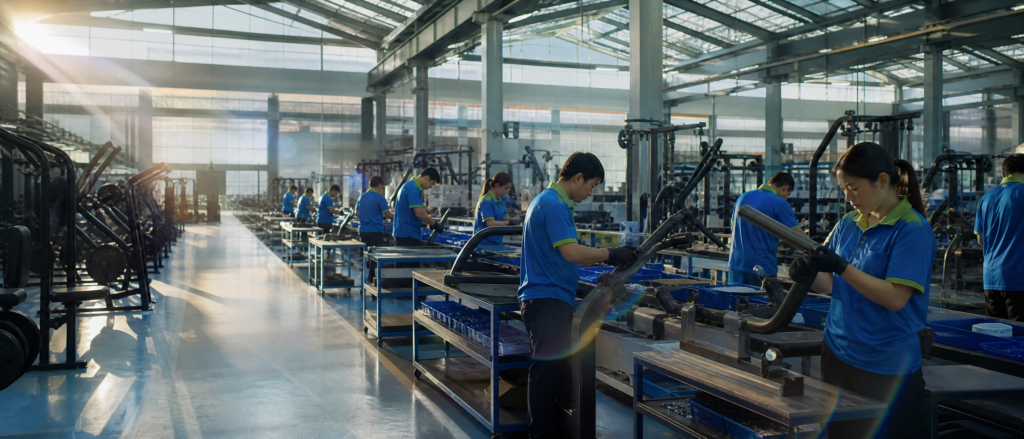
The trajectory is clear: the segment where ESG is a genuine requirement is growing faster than the segment where it remains optional. Brands and manufacturers who invest in genuine ESG capability now are building infrastructure that will become a competitive necessity rather than a differentiator within a business cycle’s timeframe. Our manufacturing advantages page outlines our quality management infrastructure — including ISO certification and quality system commitment — as the governance foundation on which ESG reporting development is built.
الأسئلة الشائعة
Is ISO 14001 certification required for fitness equipment OEM manufacturing?
ISO 14001 is not legally required for fitness equipment manufacturing, but it is increasingly required by institutional buyers and European distribution partners as a condition of supplier qualification. It is the most recognized international standard for environmental management systems and provides third-party verification that a factory has documented, systematic environmental management processes in place. For manufacturers seeking to serve European institutional channels or major retail chains, ISO 14001 is effectively a commercial prerequisite.
What does CSRD mean for fitness equipment brands selling in Europe?
The EU Corporate Sustainability Reporting Directive (CSRD) requires companies above defined thresholds (250+ employees, €50M revenue, or €25M assets) to report sustainability performance under ESRS standards, including Scope 3 supply chain emissions. For fitness equipment brands in scope, this means reporting on the carbon footprint of purchased goods — including OEM-manufactured fitness equipment. Brands must work with their OEM manufacturers to obtain verified production carbon footprint data, making manufacturer ESG transparency a commercial requirement rather than an optional feature.
What is the environmental benefit of recycled rubber in fitness equipment?
Recycled rubber in fitness equipment — used for weight plate coatings, dumbbell surfaces, and gym flooring — reduces manufacturing emissions by approximately 25% compared to virgin rubber materials, according to a 2024 industry sustainability report. It also diverts post-consumer rubber waste (primarily from end-of-life vehicle tires) from landfill disposal. For brands specifying recycled rubber content in OEM programs, the sustainability benefit is material and documentable — making it one of the most accessible environmental improvements available within standard fitness equipment product categories.
What is greenwashing and how can fitness equipment buyers avoid it?
Greenwashing refers to environmental claims that are unsubstantiated, exaggerated, or misleading relative to actual performance. In fitness equipment sourcing, greenwashing appears as claims like “eco-friendly manufacturing” or “sustainable materials” without verifiable certification or data behind them. To avoid greenwashing, apply a verification standard: any sustainability claim should be backed by a specific, independently confirmable document — certificate, data sheet, audit report, or energy contract. Claims without documentation should be treated as marketing language rather than performance evidence.
Should small fitness equipment brands include ESG criteria in OEM sourcing?
Small brands serving primarily price-sensitive consumer channels may not face immediate ESG sourcing requirements, but beginning to build ESG awareness and baseline documentation into OEM sourcing processes is advisable. The investment is modest (requesting existing certifications and material documentation costs nothing), and the information gathered provides a foundation for more comprehensive ESG integration as the brand grows into channels where these requirements become material. Brands targeting premium consumer positioning, specialty retail, or any institutional or European distribution should treat basic ESG documentation as a current commercial necessity rather than a future aspiration.
الخلاصة
ESG in fitness equipment manufacturing has crossed the threshold from optional aspiration to commercial differentiator — and for a growing subset of procurement programs, a genuine requirement. The EU regulatory framework, institutional buyer purchasing standards, and consumer expectations in premium markets are all driving the same direction: documented, verifiable ESG performance from manufacturers and the brands they supply.
For OEM buyers evaluating manufacturing partners in this environment, the message is practical: request documentation, verify certifications, and distinguish between manufacturers with genuine ESG infrastructure and those with marketing language. For brands building their own ESG narrative, the material sourcing decisions made at the OEM specification stage — recycled rubber content, energy source verification, social compliance documentation — are where the authentic sustainability story is built or compromised. If you are developing a fitness equipment OEM program with ESG requirements or looking for a manufacturing partner who can provide credible sustainability documentation, connect with our team to discuss our quality and environmental management credentials.