Every year, the same scenario plays out across the fitness equipment industry: brands that underestimated peak demand find themselves out of stock during the highest-revenue weeks of their calendar, while their OEM factory is already committed to other customers’ orders and cannot accelerate production on short notice. The resulting stockouts cost revenue, damage retailer relationships, and hand market share to competitors who planned earlier. Meanwhile, brands that over-ordered to protect against stockouts sit on excess inventory that ties up working capital and creates markdown pressure at season’s end. Factory Capacity Planning for Fitness Equipment.
Getting peak-season inventory planning right is one of the most commercially significant operational challenges for fitness equipment brands sourcing through OEM manufacturing programs. It requires understanding the seasonality patterns that drive demand in your specific market segments, the total lead time from purchase order to shelf-ready product, the capacity constraints and advance booking requirements of your manufacturing partner, and the inventory positioning strategies that balance stockout risk against holding cost. This guide addresses all four dimensions from the perspective of a manufacturer who sees the planning failures — and successes — of dozens of brands every year.
The Fitness Equipment Seasonal Demand Calendar
Fitness equipment demand is among the most seasonally concentrated in the consumer goods industry. Understanding the structure of that seasonality — not just the peak period but the entire annual demand curve — is the foundation of effective capacity planning.
The dominant demand peak in the fitness equipment calendar is the January–February window, driven by New Year’s resolution behavior. In the North American market, fitness equipment sales typically spike 40–60% above baseline in January, with the peak concentrated in the first two to three weeks. Brands supplying large-format retailers (mass merchant, sporting goods chain, e-commerce) must have product in the retailer’s distribution center by December 15–20 at the latest to participate fully in this peak. Working backward from this receiving deadline, with ocean freight transit times of 20–35 days from Taiwan depending on destination port, and customs clearance adding 5–10 days, a December 20 DC receiving deadline requires factory shipment departure by approximately November 10–20 at the latest.
The secondary demand peak occurs in March–April, driven by spring fitness motivation and tax refund spending in the U.S. market. This secondary peak is smaller than the January peak but still significant — typically 15–25% above baseline. For brands with direct-to-consumer e-commerce channels, this secondary peak can be as commercially important as the January peak, as DTC shipping lead times are shorter than retailer replenishment cycles and allow more agile inventory positioning.
The Q3 trough — June through August — represents the lowest demand period in the fitness equipment calendar in temperate markets. Ironically, this is the period when production capacity at OEM factories is often most readily available, making it the ideal time to place peak-season production orders. Brands that place their Q4/Q1 production orders in May–June secure capacity and favorable pricing; brands that wait until September find constrained factory availability and urgent premium pricing.
A third demand inflection — often overlooked in planning models — occurs in October, when gift-purchase behavior begins and consumers start researching fitness equipment for holiday gifting. This October bump requires product availability well ahead of Black Friday (late November), which is itself a major fitness equipment demand event for brands with retail and DTC presence.
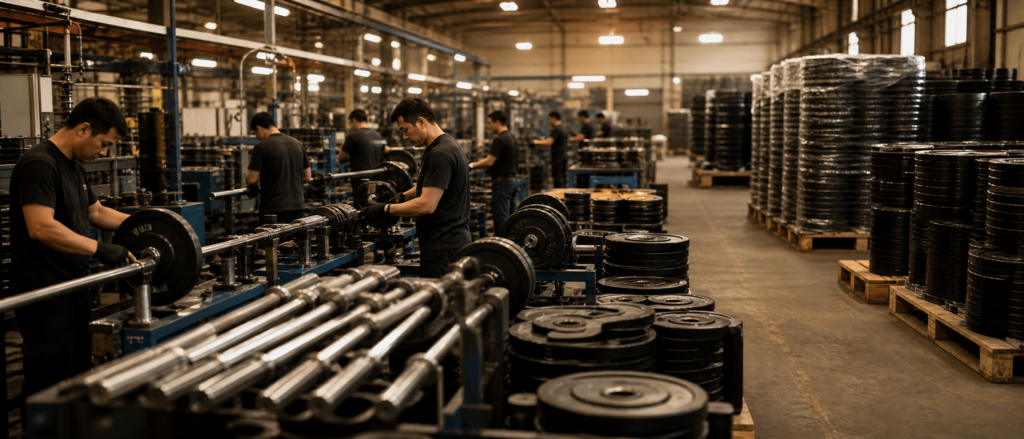
Total Lead Time Analysis: The Planning Horizon Every Brand Must Know
The fundamental error in peak-season planning is underestimating total lead time. Total lead time is not production lead time — it is the sum of every stage from purchase order placement to product availability for sale at the destination. For fitness equipment sourced from Taiwan OEM manufacturers, total lead time for a standard order in a normal capacity environment typically runs 90–130 days from PO to shelf-ready product.
The components of total lead time are:
Order confirmation and material procurement (1–2 weeks): After purchase order receipt, the factory confirms specifications, allocates production capacity, and initiates raw material procurement if materials are not already in stock. For custom configurations — specific colors, branded components, packaging artwork — longer lead times may apply if custom materials must be ordered.
Production lead time (4–8 weeks): The actual manufacturing period, from first production operation to finished goods ready for outgoing quality inspection. For standard catalog items with readily available materials, four to six weeks is typical. For complex assemblies, large quantities, or items requiring extended surface treatment cure times, six to eight weeks is more realistic.
OQC inspection and shipment preparation (1–2 weeks): Outgoing quality inspection, correction of any defects found, packaging completion, loading, and export documentation preparation. Third-party pre-shipment inspection, if required, adds 3–5 business days for inspection booking and report turnaround.
Ocean freight transit (3–5 weeks): From port of loading in Taiwan to port of discharge at destination. Typical transit times: Taiwan to U.S. West Coast 14–18 days; Taiwan to U.S. East Coast 28–35 days via Suez Canal; Taiwan to UK/EU 25–30 days. Port congestion at peak shipping seasons (Q3–Q4 when retailers are building inventory for the holiday peak) can add 5–14 days to these figures unpredictably.
Customs clearance and inland freight (1–2 weeks): Import customs processing, duty payment, container deconsolidation, and final inland delivery to the buyer’s warehouse or retailer DC. At congested ports during peak periods, customs queues can extend this further.
Adding these components for a Taiwan-to-U.S. East Coast shipment: 2 + 6 + 2 + 35 + 14 = 59 days minimum, 16 + 10 = 91 days maximum — a range of roughly 60–100 days from PO to U.S. warehouse delivery. For a December 20 U.S. warehouse target, this means placing the purchase order no later than September 12 in the optimistic scenario, or August 10 in the conservative scenario.
Most brands building peak-season inventory should be placing production purchase orders in Q2 (April–June) for Q4 receipt. Orders placed in August for December delivery are already racing against the calendar in a conservative planning model, and orders placed in September are cutting it dangerously close.
Factory Capacity Constraints: Why Early Booking Matters
OEM factories do not have infinite capacity. Each manufacturing facility has defined weekly production capacity for each product category — the maximum number of units that can be produced and processed through QC per week given current equipment, labor, and material throughput constraints. When multiple brands are competing for that capacity during the same production window, the brands that confirmed their orders earliest typically receive priority scheduling.
In the fitness equipment industry, Q3 production windows (July–September factory production for Q4 delivery) are heavily contested among all brands supplying the global retail channel. Factories with established reputations for consistent quality accumulate order books that fill up in Q2 for these windows. A brand that approaches its OEM partner in August asking for October delivery on a significant order will frequently be told that capacity is committed and the earliest available window is November at best — too late for the January peak.
Capacity reservation mechanisms vary by manufacturer, but common approaches include formal capacity reservation agreements — where the buyer commits to a minimum order quantity within a window in exchange for the factory holding that production capacity — and rolling forecast systems where the buyer provides 12-month demand visibility updated monthly, allowing the factory to plan raw material procurement and labor scheduling accordingly. Brands that can provide reliable forward demand forecasts are valuable customers to OEM factories, because reliable forecasts allow more efficient capacity utilization. Factories typically reward reliable forecast partners with priority scheduling, more competitive pricing, and greater flexibility in order adjustments.

Buffer Stock Strategies for Fitness Equipment Brands
Even with careful advance ordering, demand uncertainty makes some level of buffer stock a rational risk management tool for brands with significant seasonal exposure. The question is not whether to hold buffer stock but how much, where to position it, and at what cost.
Safety stock at origin (factory-held inventory): Some brands arrange with their OEM partner to hold a quantity of finished goods at the factory against a confirmed purchase order, ready for immediate shipment on short notice. This approach reduces total lead time to shipping transit only, providing maximum flexibility to respond to demand upside. The cost is the factory’s warehousing charge and the tied-up working capital of the pre-produced inventory. For high-turn items where demand upside risk is significant, factory-held safety stock is often cost-effective relative to the stockout cost it prevents.
Safety stock at destination distribution center: Positioning finished goods inventory at a domestic DC (or 3PL) before peak season begins allows rapid replenishment of retail orders without relying on ocean freight lead times. The inventory must be in the DC before demand accelerates — for the January peak, this means DC-ready by December 1 at the latest. The cost is domestic warehousing plus the interest cost of early inventory positioning.
Air freight for demand response: For high-value, compact items (dumbbells, kettlebells, accessories) where the unit value-to-weight ratio supports air freight economics, maintaining a small production reserve at the factory and air freighting on confirmed demand provides rapid response capability. Air freight typically costs 4–8× ocean freight per kg but reduces transit time from 3–5 weeks to 3–5 days. For a $200 dumbbell set weighing 20 kg, the incremental air freight cost of $80–120 is 40–60% of the product cost — viable only for high-margin products or critical stockout situations.
How to Communicate Forecast Requirements to Your OEM Partner
Effective forecast communication is a collaborative process, not a one-way instruction. The most productive OEM partnerships around capacity planning involve the buyer sharing demand visibility proactively and the manufacturer sharing production capacity visibility in return, creating a planning dialogue that allows both parties to optimize their respective positions.
A useful forecast communication structure for annual capacity planning involves a 12-month rolling forecast updated quarterly — or monthly during the four months preceding peak season. The forecast should specify, by SKU, the planned order quantity and the target factory shipment date (not the target receipt date — it’s easier for the factory to plan around shipment dates than receipt dates). The forecast should also indicate which quantities are “firm” (within the agreed lead time and purchase committed), “likely” (probable within a defined planning horizon, typically 30–60 days out), and “indicative” (12-month horizon demand estimate for capacity planning purposes only).
Sharing the basis for the forecast — sell-through data from retail partners, year-over-year demand trends, planned promotional events — allows the factory’s planning team to sense-check the forecast against their own market visibility and flag potential capacity conflicts or raw material lead time issues before they become surprises. Factories that serve multiple brands in the same category often have aggregated market intelligence that can make their production plans more accurate than any individual brand’s forecast alone.
Planning Across Multiple SKUs and Product Lines
Brands with multi-SKU portfolios face an additional complexity: factory capacity allocation across product lines that may compete for the same production resources. A barbell manufactured on the same production line as a dumbbell handle bar represents a capacity competition — more barbell production time means less dumbbell handle production time in any given week.
Effective multi-SKU planning requires understanding which products share production resources at the factory and communicating planned order mix — not just total volume — well in advance. A factory that receives a forecast of “1,000 units across product A, B, and C” cannot plan as effectively as one that receives “400 units of A, 350 units of B, and 250 units of C by [specific dates].” The more specific the quantity and timing communication, the more accurately the factory can schedule production and avoid scheduling conflicts.
For brands introducing new SKUs into an existing OEM program, additional lead time is required for tooling (if new molds or fixtures are required), sample development, and sample approval. New SKU introductions that are planned for peak-season availability must complete the sample development cycle no later than three to four months before the planned production window — meaning new SKU development should begin eight to ten months before the first peak-season ship date is targeted.
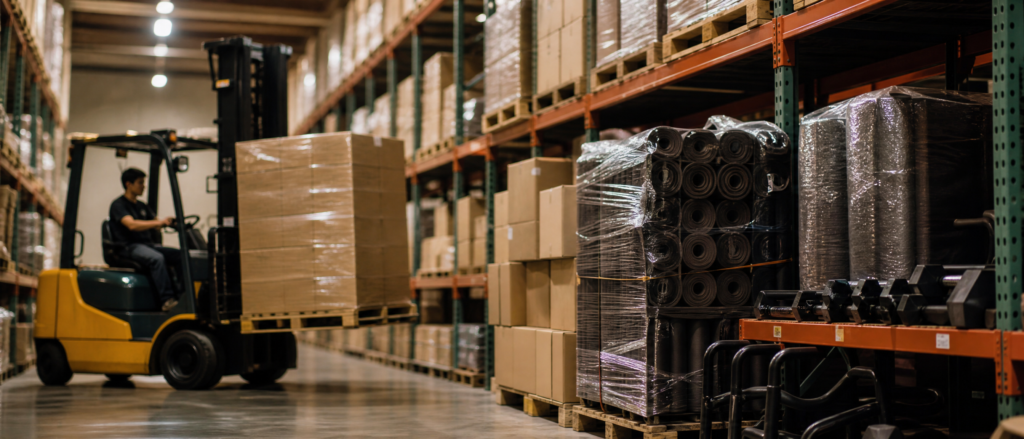
Comparison: Peak-Season Planning Approaches and Their Trade-offs
| Planning Approach | When PO Is Placed | Inventory Risk | Stockout Risk | Working Capital Impact | Suitable For |
|---|---|---|---|---|---|
| Early commitment (Q2 order for Q4) | April–June | Higher (long before demand is confirmed) | Low | High (early inventory) | High-volume brands with stable demand history |
| Rolling forecast with capacity reservation | Commitment in Q2, quantity confirmed Q3 | Moderate | Niskie–umiarkowane | Moderate | Established OEM relationships with forecast discipline |
| Late ordering (Q3 for Q4) | July–August | Lower (order placed closer to demand confirmation) | High (capacity constrained) | Lower (later cash outflow) | Small brands with limited capital; not recommended for peak items |
| Safety stock at factory (pre-build) | Q2 production, demand-triggered shipment | Higher (pre-built unsold inventory) | Very low | Bardzo wysoki | High-margin fast-movers; key staple SKUs |
| Air freight on demand | Any (production reserve held) | Low | Low (for committed reserve quantity) | High (freight premium) | High-value compact items; emergency replenishment |
Managing Disruption Risk: When Lead Time Assumptions Break Down
Even the most carefully constructed lead time model is based on assumptions that can be invalidated by external events. The COVID-19 pandemic demonstrated dramatically how quickly ocean freight lead times could extend from 30 days to 90+ days due to port congestion, container shortages, and vessel schedule disruptions. Similar disruptions have been caused by canal blockages (Suez Canal, 2021), port labor actions (U.S. West Coast), and geopolitical trade tensions that redirect vessel traffic to longer routes. Any peak-season plan that treats the planning lead time as a fixed constant rather than a range with upside risk is systematically underestimating the probability of a stockout.
Building disruption risk into the capacity planning model requires acknowledging the “bad scenario” lead time explicitly. If normal ocean transit from Taiwan to the U.S. East Coast is 32 days, the bad-scenario lead time might be 50–55 days based on historical congestion episodes. A plan that would succeed only if transit time stays at 32 days is a fragile plan; a plan that can absorb 50-day transit and still arrive in time has structural resilience.
Several practical approaches reduce disruption exposure. Splitting a large order across two vessels — one earlier than needed, one on the regular schedule — provides a hedge: if the first vessel is delayed, the second arrives on time; if both arrive on time, the brand has earlier-than-needed inventory, which is a working capital cost rather than a stockout crisis. For key SKUs where stockout is commercially unacceptable, the additional cost of a split shipment is typically justified by the revenue protection it provides.
Building a “finish goods buffer” with the OEM factory — a small quantity of the most critical SKUs held in finished goods at the factory after initial production, against confirmed purchase commitment — provides a final insurance layer. If the primary shipment is delayed, this factory buffer can be air-freighted to the destination market at higher cost but in time to prevent a peak-season stockout. The existence of this option, even if rarely exercised, changes the commercial risk profile of the peak-season plan from a single-point-of-failure scenario to a multi-layer resilience model.
The Manufacturer’s Perspective: What Good Partners Do Differently
From the OEM factory’s perspective, the brands that consistently secure peak-season capacity and avoid supply crises share a set of behaviors that distinguish them from the brands that end up on the wrong side of capacity constraints every year.
Good planning partners communicate annually — not just at the point of placing orders. An annual meeting in Q1 or Q2, even a one-hour call, to share the brand’s demand outlook for the coming 12 months and discuss capacity availability is more valuable than reactive order placement later in the year. This communication gives the factory visibility to plan raw material procurement (particularly for steel, which has extended mill lead times), and it signals to the factory that this customer values the relationship enough to invest in collaborative planning.
Good planning partners honor their forecasts. A brand that consistently provides 12-month rolling forecasts but then orders significantly below forecast damages the factory’s planning efficiency — the factory held capacity against the forecast, turned away other orders, and procured materials based on the stated demand that did not materialize. Factories have long memories about forecast accuracy by customer, and it directly affects how much capacity premium and planning service they extend in subsequent seasons.
Good planning partners build enough lead time into their planning cycle to accommodate unexpected delays — not just in production but in shipping, customs, and retail receiving. The brands that assume everything will go perfectly and plan accordingly have no buffer when the inevitable surprise occurs.
Najczęściej zadawane pytania
When should fitness equipment brands place peak-season production orders with OEM factories?
For the January fitness demand peak — the largest in the annual calendar — brands targeting North American markets should place production orders with their Taiwan OEM partner no later than June, and ideally by April–May, to ensure factory capacity is secured and product arrives at the destination warehouse by mid-December. Orders placed in July–August still have a chance at December delivery depending on factory capacity availability, but the risk of delayed production due to constrained capacity is significantly higher. Orders placed in September for December delivery are typically too late for the January peak in most planning scenarios.
What is the typical total lead time for fitness equipment from a Taiwan OEM factory to the US market?
For fitness equipment sourced from Taiwan OEM manufacturers destined for the U.S. market, total lead time from purchase order to warehouse delivery typically runs 60–100 days. This includes order confirmation and material procurement (1–2 weeks), production (4–8 weeks), QC and export preparation (1–2 weeks), ocean freight transit (2–5 weeks depending on destination coast), and U.S. customs clearance and inland delivery (1–2 weeks). West Coast U.S. delivery is generally 60–75 days from PO; East Coast U.S. delivery typically runs 80–100 days.
How does factory capacity reservation work for peak-season production?
Factory capacity reservation typically involves a formal agreement where the buyer commits to a minimum order quantity within a specified production window, and the factory agrees to hold that production capacity for the buyer. The buyer provides a deposit or confirmed purchase order to formalize the commitment. In exchange, the factory prioritizes the buyer’s scheduling within the reserved window and procures raw materials based on the committed quantity. Rolling forecast systems — where the buyer provides monthly updated 12-month demand visibility — allow the factory to plan capacity allocation without formal reservation agreements, but require consistent forecast accuracy from the buyer to be effective.
What are the main seasonal demand peaks for fitness equipment globally?
The dominant peak is January–February, driven by New Year’s resolution behavior globally, with the sharpest spike in North America and Europe. A secondary peak occurs in March–April (spring fitness motivation and tax refund spending in the U.S.). An October–November inflection occurs as holiday gift purchasing begins. The Q3 trough (June–August) is the lowest demand period in temperate markets, though emerging market growth and counter-seasonal southern hemisphere patterns are beginning to flatten this trough for globally diversified brands. China’s domestic market has a unique seasonality profile driven by Golden Week and Lunar New Year that differs significantly from Western patterns.
How should brands balance early inventory commitment against the risk of over-ordering?
The optimal approach is to distinguish between “core” and “seasonal upside” inventory commitments. Core inventory — the quantity the brand is highly confident it can sell based on prior year sell-through and confirmed retail orders — should be committed early (Q2) to secure factory capacity. Seasonal upside — additional quantity that would only sell if demand comes in above plan — should be structured as a factory-held option, with the factory agreeing to produce a defined additional quantity on short notice (2–3 weeks) if the brand exercises the option by a specified date. This approach combines the capacity security of early commitment with the flexibility to avoid over-ordering if demand underperforms.
Wnioski
Peak-season inventory planning for fitness equipment is not a logistical task to be delegated to a procurement team two months before the demand peak — it is a strategic decision that must be made six to nine months in advance, informed by reliable demand forecasting, a precise understanding of total supply chain lead time, and a collaborative relationship with an OEM manufacturing partner that can provide both capacity visibility and planning flexibility.
The brands that consistently capture peak-season revenue without stockout crises or excess inventory write-downs are those that treat capacity planning as a year-round discipline: placing Q4 orders in Q2, sharing 12-month rolling forecasts with their manufacturer, and building enough buffer into their plans to absorb the delays and surprises that are inevitable in global supply chains.
Alexandave’s OEM program is designed to support precisely this kind of collaborative capacity planning. Our production planning team works with buyers on 12-month rolling forecast visibility, capacity reservation for peak windows, and flexible production structures that accommodate both firm commitments and demand-responsive upside options. We also provide buyers with proactive lead time alerts when our factory planning team identifies emerging constraints — raw material delivery delays, tooling lead time extensions, or vessel booking availability — that could affect committed shipment dates. This transparency allows our OEM partners to make informed adjustments to their supply chain plans before constraints become crises. Our Strona poświęcona usługom OEM/ODM covers the full scope of our production planning support. To discuss your capacity requirements for the upcoming peak season, skontaktuj się z naszym zespołem — the earlier the conversation, the more options we can offer. Our strona poświęcona możliwościom produkcyjnym provides additional context on our production capacity and planning processes, and our Sekcja „Najczęściej zadawane pytania” addresses common questions from new OEM program partners.