The Frame Question Every Studio Faces
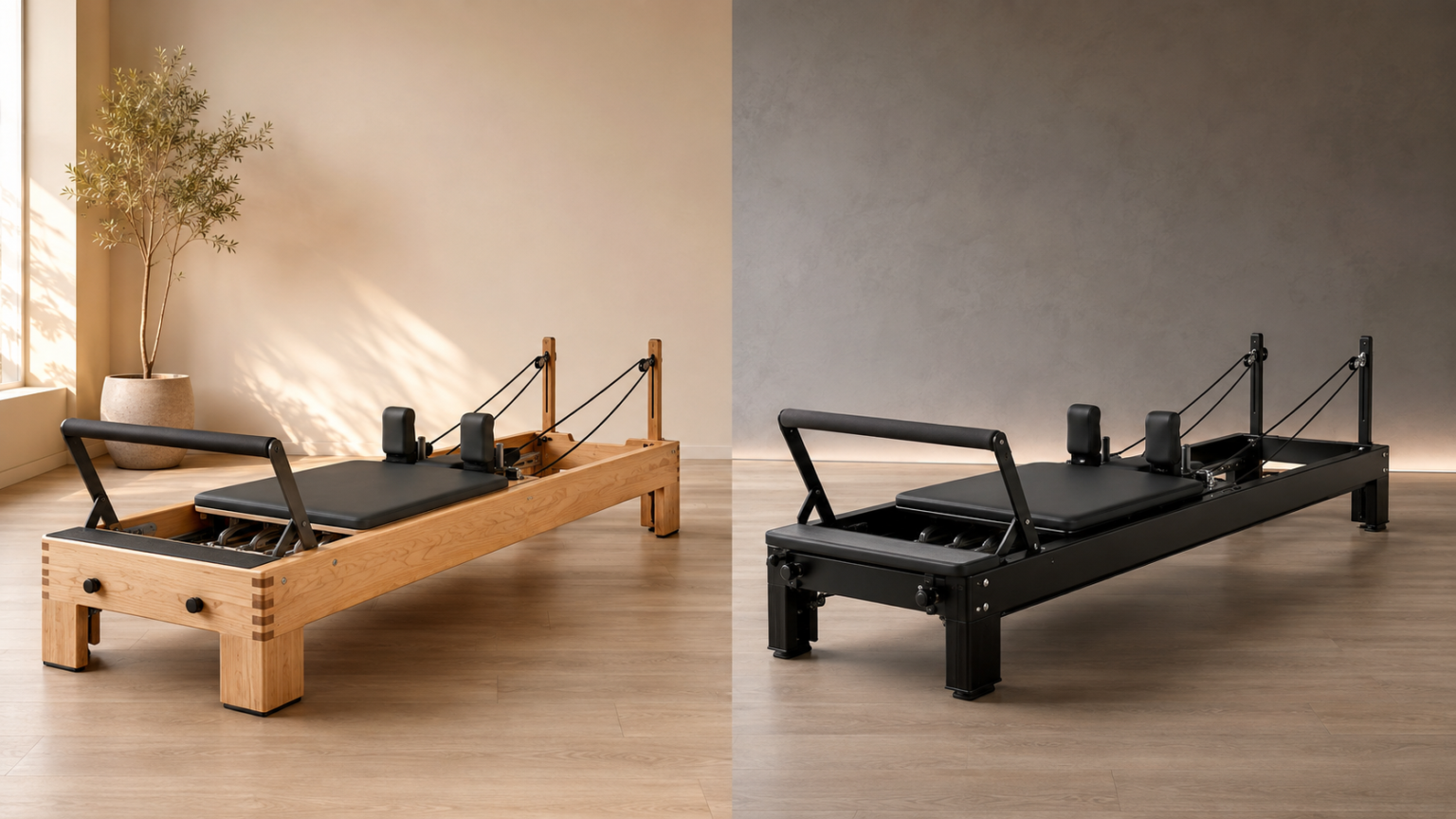
Every Pilates studio owner who has priced reformers has met the fork in the catalog: the warm, furniture-grade presence of a maple frame on one page, and the sleek, powder-coated precision of an aluminum frame on the next, often from the same manufacturer, often at surprisingly different prices, and always with partisans insisting that only one of them is the real thing. The frame is not a cosmetic choice. It is the chassis of the most-used apparatus in your studio, the structure that carries a moving carriage, a spring-loaded load path, and a client’s full bodyweight through thousands of repetitions a week, and it determines more than buyers expect: how the reformer feels under a rolling carriage, how the room sounds at full occupancy, how much maintenance the fleet demands, how the equipment survives humidity and relocation, and what your studio photographs like on the website that sells memberships. As a Taiwan-based manufacturer that has built strength and Pilates apparatus since 1980, and whose Axispila line includes commercial reformers in both maple and aluminum construction, we sit in the same position we have occupied in earlier comparisons on this site: we build both, we profit either way, and the only recommendation worth writing is the one that matches the frame to the studio rather than to a marketing narrative. This guide walks through what the frame actually does mechanically, the honest strengths and trade-offs of each material, a side-by-side comparison on the dimensions that decide real purchases, and a studio-type framework for choosing, with our own products offered as a case study rather than a conclusion. The stakes scale with the arithmetic every studio owner already knows: a reformer fleet is typically the largest equipment investment the business makes, it is bought in multiples rather than singles, and it will outlast several generations of flooring, paint, and programming trends, so a frame decision made on a showroom impression compounds, for better or worse, across every machine and every year of a very long service life.
Two notes frame the comparison before it starts. First, the material debate inherits a century of history: the apparatus tradition descends from the wooden equipment Joseph Pilates built by hand, a lineage summarized in any account of Pilates and its method, and classical studios often choose wood partly for that continuity, which is a legitimate reason that no engineering table should dismiss. Aluminum arrived with the contemporary and group-reformer movement, where fleets of ten or twenty machines, stacking, and daily intensity rewrote the requirements. Neither lineage owns correctness; they optimized for different studios, and both materials have since matured far beyond their stereotypes, with modern maple frames engineered well past furniture standards and modern aluminum frames refined well past their utilitarian origins. Second, the frame is one subsystem of a reformer, not the whole machine: springs, carriage wheels, rails, upholstery, and hardware determine as much of the daily experience as the frame material does, and a beautifully framed reformer with mediocre running gear is a mediocre reformer. This guide isolates the frame because the frame is the decision buyers agonize over, but the purchasing checklist at the end deliberately reconnects it to the whole apparatus, because studios buy reformers, not frames, and the comparison only matters inside a machine built well everywhere else. With those two frames of reference in place, the lineage and the whole-machine view, the material comparison can proceed on its merits, starting with a precise account of what the frame is actually asked to do, because a surprising share of the marketing claims on both sides dissolve the moment the job description is written down clearly.
What the Frame Actually Does
Before weighing materials, it helps to be precise about the job description, because the frame earns its keep in three distinct ways that the marketing conversation usually blurs into the single word quality. Structurally, the frame is a beam system: it must hold the rails straight and parallel under a dynamic, moving load, resist twisting when a client loads one side harder than the other, and do so not just on delivery day but after years of cycles, relocations, and cleaning chemistry. Acoustically, the frame is a soundboard: every carriage return, spring change, and footbar adjustment either disappears into the structure or reverberates through it, and a room of eight reformers multiplies whatever each frame contributes. Experientially, the frame is the studio’s furniture: it sets the visual temperature of the room, signals positioning to prospective clients before a single class is taught, and takes the scuffs, mop splashes, and sunlight of daily commercial life on its own surface. The three subsections below treat each job in turn, because maple and aluminum divide their advantages across these jobs rather than winning or losing them all, and a buyer who knows which job matters most in their studio has already done most of the deciding. The blurring is not accidental, incidentally: sales conversations naturally emphasize whichever job the machine on the showroom floor performs best, which is why arriving with the three-job framework already in hand converts the demo from a presentation you receive into an examination you conduct. Everything here applies to any manufacturer’s reformer, ours included, and the case-study section later will be read more usefully with these three jobs in mind.
Structure: Stability Under a Moving Load
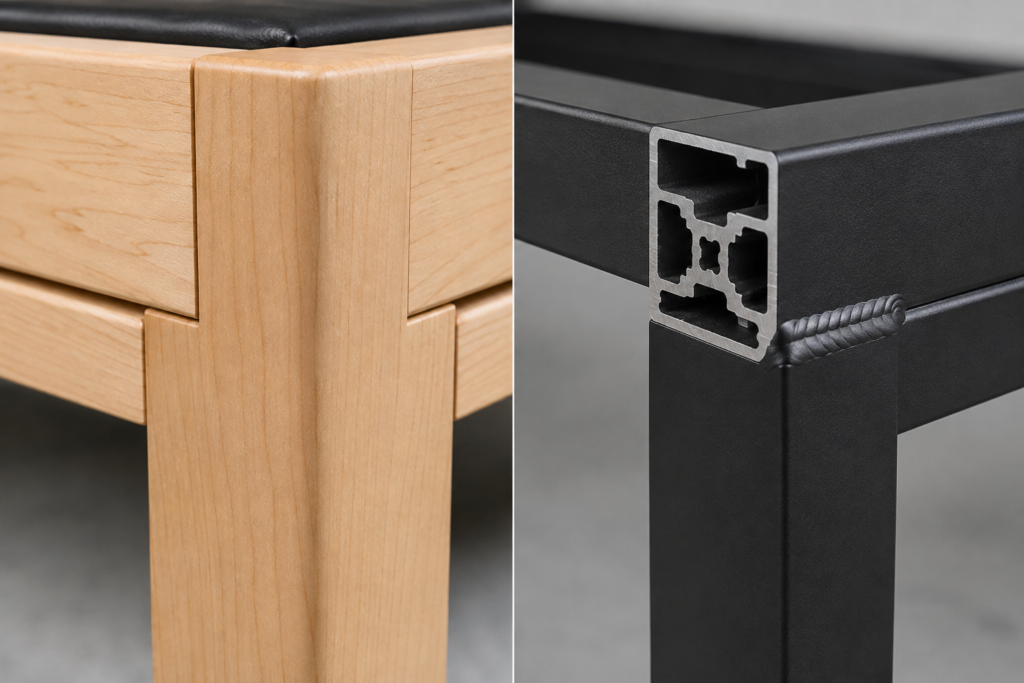
A reformer’s structural problem is unusual in fitness equipment: the load is not static and centered but rolling, spring-tensioned, and constantly redistributed as the client moves through exercises, which means the frame’s stiffness matters less as a maximum and more as a consistency, the property engineers call torsional rigidity. A frame that flexes unevenly lets the rails go subtly out of parallel, and the client feels it as a carriage that runs differently at the two ends of the machine or drifts under asymmetric load. Both materials solve this problem well when engineered properly and poorly when not. Hard maple, the dense North American species profiled in the reference on the sugar maple, has excellent stiffness for its weight and damps vibration naturally, but its structural performance depends on joinery: a well-made mortise-and-bolt maple frame is effectively monolithic, while a poorly jointed one develops the micro-movement that studios experience as creaks and eventual rail misalignment. Aluminum, typically extruded alloys of the family described under 6061 aluminium alloy, delivers its stiffness through profile design rather than mass: a well-designed box or rail extrusion is extremely consistent, immune to seasonal movement, and holds tolerances that wood cannot promise, but a frame built from undersized extrusions to hit a price point flexes visibly and, unlike wood, transmits rather than absorbs the resulting vibration. The buyer’s structural test is the same for both: load the carriage heavily, run it hard to both ends, press laterally on the rails, and feel for any difference between the machine’s corners, because a frame that passes loaded is a frame, and a frame that only passes empty is a photograph. Run the same test on the most-used demo machine the manufacturer will let you touch, not only the newest one, because structural quality is easiest to judge where a few thousand hours of use have already interrogated the joinery or the welds on your behalf.
Acoustics: How the Room Sounds at Full Occupancy
Sound is the most underrated variable in reformer selection, and it is where the materials genuinely diverge rather than merely differing in execution. Wood is a natural damper: maple absorbs and shortens vibration, which is why a well-built maple reformer produces a low, muted carriage sound and why classical studios are notably quiet even at full occupancy. Aluminum is a natural conductor: undamped, an aluminum frame rings, and every wheel imperfection, spring transition, and footbar clank arrives in the room brighter and longer than the same event on wood. Manufacturers know this, and modern aluminum reformers close the gap with engineering, polymer wheel compounds, damped rail interfaces, isolation bushings at hardware points, and extrusion profiles shaped to break up resonance, so a current-generation aluminum machine from a serious builder runs far quieter than the category’s reputation, though in a silent room a trained ear will still place the two materials blind. Why this matters commercially depends entirely on format. A group studio running eight to twelve machines with music and instruction absorbs machine sound easily, and the aluminum fleet’s other virtues dominate; a boutique or clinical studio built around quiet, hands-on instruction hears every carriage return, and maple’s acoustic signature is a genuine amenity that clients notice without knowing what they are noticing. The practical evaluation is embarrassingly simple and almost never done: demo the actual model in a quiet room, run the carriage at class tempo, change springs, and listen from the greeting desk, because the sound you hear there is the sound your studio will make for the next decade, multiplied by every machine in the order and every class on the schedule.
Presence: Aesthetics, Surface Life, and the Studio Brand
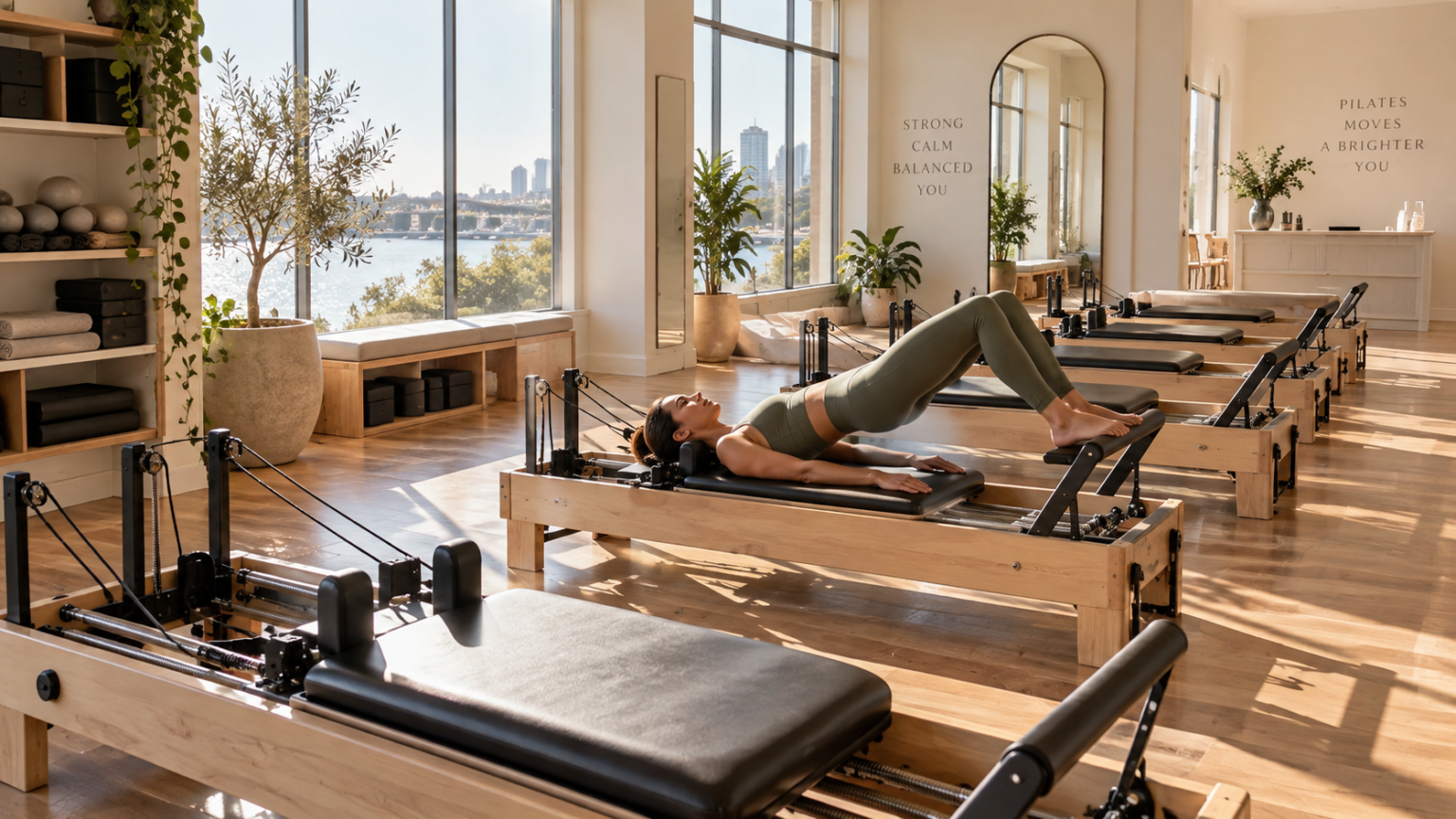
The third job is the one studio owners feel least entitled to weigh and should weigh more heavily: the frame is the largest visual object in the room, multiplied by however many machines the studio runs, and it does brand work every hour the studio is open. Maple reads as warm, established, and classical; it photographs beautifully in natural light, anchors the wellness-oriented aesthetic that many boutique and clinical studios sell, and ages the way good furniture ages, developing patina rather than shabbiness when maintained. Its surface life is the trade: lacquered wood takes scuffs and moisture marks, disapproves of harsh cleaners, and asks for the occasional refinish over a long fleet life, obligations the maintenance discussion below quantifies. Powder-coated aluminum reads as contemporary, athletic, and precise; it matches the design language of modern group-fitness spaces, offers color flexibility wood cannot, and its surface, a baked polymer coat over a metal that already resists corrosion, shrugs off the cleaning chemistry and traffic that commercial schedules impose, with anodized variants, produced by the electrochemical process described under anodizing, pushing surface durability further still. Neither aesthetic is superior; they are signals aimed at different clients, and the honest question is which room your target member expects to walk into. A studio’s photography, pricing, and positioning should agree with its frames, because the reformer fleet is not equipment in the brand’s background, it is the background, and buyers who choose the frame their brand argues for stop second-guessing the choice the day the room is assembled. It is worth noting that presence also interacts with pricing power in a way owners can test against their own market: studios routinely photograph their equipment for every acquisition channel they use, and the frames appear in more of a studio’s marketing surface than any other purchase it makes, which means the frame budget is partly a marketing budget, and comparing frame options on equipment price alone quietly excludes the line item doing some of the work.
Maple Frames: Strengths and Trade-offs
The case for maple begins with the reasons it became the classical standard and survives every generation of alternatives, and it deserves to be made on engineering grounds rather than nostalgia alone, because the nostalgia is doing less of the work than either its fans or its critics assume. Structurally, hard maple at proper sections is stiff, heavy enough to feel planted without anchoring, and naturally damped, delivering the stable, quiet ride the previous section described; experientially, it carries the method’s visual heritage and a warmth no coating replicates; and commercially, a well-maintained maple fleet holds value in the resale market precisely because these virtues do not expire with fashion. The trade-offs are equally real, mostly environmental and operational, and the studios that regret maple purchases are almost never disappointed by the material’s character; they are surprised by its obligations, which an honest guide states up front rather than in the care manual. The two subsections below make both halves concrete: first the properties that justify maple reformer frames as a premium choice rather than a sentimental one, then the climate, handling, and maintenance realities that should qualify the choice before any deposit is paid. Read together, they reduce the maple decision to one question with an honest answer: is the ride, sound, and presence this wood provides part of what your studio sells, and can your building, climate, and operating rhythm afford what it asks in return?
Why Hard Maple Became the Classical Standard
Maple’s position in the apparatus tradition is usually explained by history, but the history itself has an engineering explanation: among the hardwoods available at furniture scale, hard maple offers an unusually good combination of stiffness, density, surface hardness, and workability, which is why it also dominates bowling lanes, basketball courts, and butcher blocks, applications that share the reformer’s requirement of taking concentrated dynamic loads for decades without complaint. In a reformer frame, that translates into rails that hold their line under a rolling carriage, a structure whose mass keeps the machine planted through vigorous work without floor anchoring, and the natural vibration damping that gives wooden machines their characteristically quiet, absorbed ride. The material rewards good manufacturing and exposes bad: kiln drying to correct moisture content, grain-matched section selection, and joinery designed as an engineered system rather than furniture assembly are what separate a maple frame that serves thirty years from one that creaks in five, which is why the provenance questions, how the wood is dried, how joints are constructed, whether load specifications are published, matter more for wood than for any other frame material. Aesthetically, maple’s contribution is not merely looking traditional; it is the visual warmth that wellness-positioned studios photograph, price, and sell, an asset with measurable brand value that belongs in the purchase arithmetic. And at end of life, wood alone offers genuine renewal: a tired maple frame can be refinished to nearly new presence, an option no coated metal provides, which quietly underwrites the resale values that make maple’s higher entry price smaller across a full ownership horizon than the invoice suggests.
Maple’s Care, Climate, and Handling Realities
The obligations arrive in three families, and none of them should surprise a buyer who has been told the truth. Climate first: wood is hygroscopic, exchanging moisture with the room’s air, and seasonal humidity swings move it, minutely but really, which quality builders accommodate through drying standards, sealing, and joint design that allows movement without loosening. In stable, conditioned spaces this is a non-issue for decades; in humid coastal and tropical markets, or buildings whose HVAC swings hard between seasons, it is a real engineering demand, and the correct response is not to avoid wood but to interrogate the builder: what moisture content is the lumber dried to, how are the joints designed for movement, what does the warranty say about climate, and can they point to fleets serving in climates like yours. Handling second: the mass that plants a maple reformer makes it a deliberate, two-person move, stacking is generally not an option, and studios that reconfigure daily for mixed programming will feel the difference from an aluminum fleet every single week, an operational cost that no amount of beauty amortizes if the format genuinely requires mobility. Maintenance third: lacquered maple asks for gentle cleaners rather than the harsh disinfectants commercial schedules reach for, prompt attention to standing moisture, periodic joint checks in the annual calendar, and, somewhere in the far years, a refinish that is best treated as a planned capital line rather than a surprise. None of these is onerous; all of them are commitments, and the studios happiest with maple are the ones that made them knowingly, priced them into the total cost of ownership, and chose the wood because its daily character earns those commitments back with margin.
Aluminum Frames: Strengths and Trade-offs
The case for aluminum is the case for engineering consistency under commercial abuse, and it is best understood as the answer to a question the classical era never had to ask: what happens to reformer frames when a single studio runs twelve identical machines through six classes a day, cleans them between every class, rearranges them weekly, and expects the fleet to behave identically in year one and year eight? Wood can be built to survive that schedule, but aluminum was effectively selected by it, which is why the group-reformer movement and the aluminum frame grew up together and why the material’s virtues read like a group studio’s operations manual. The trade-offs are just as characteristic, clustering around feel, sound, and aesthetics, the very dimensions where maple is strongest, which is what makes this comparison a genuine fork rather than a price tiering. The two subsections below give each side its due: first the engineering advantages that make aluminum the default of high-throughput formats, then the sensory and market trade-offs that keep wood’s case alive, including the budget-end failure modes that built aluminum’s unfair reputation and that a buyer can screen out with one loaded demo. As with maple, the material rewards the manufacturers who take it seriously and exposes the ones who do not, and the screening questions at the end of the case-study section apply with equal force here.
Engineering Advantages: Weight, Consistency, and Surface Life
Aluminum’s structural argument starts at the extrusion die: profiles are drawn to identical cross-sections by the thousand, jig-welded or bolted into frames whose geometry repeats to tolerances wood cannot promise, and the result is the fleet consistency that instructors feel when every carriage in the room runs the same and franchise buyers contract for when machine two hundred must match machine one. The material itself, typically heat-treated structural alloys, delivers high stiffness per kilogram, which is why an aluminum reformer weighs enough less than its hardwood counterpart that one or two staff can move, stack, and reconfigure a fleet daily, converting room-format flexibility from a renovation into a routine; for studios whose schedule alternates reformer classes with mat, tower, or open-floor programming, this handling difference is not a convenience but the difference between offering the schedule and not. Climate immunity removes an entire category of ownership concern: aluminum does not absorb moisture, does not move with the seasons, and tolerates the coastal, tropical, and hard-HVAC environments that demand real engineering from wood. Surface life compounds the case: powder coat, and anodized finishes where specified, shrug off the disinfection chemistry that commercial cleaning protocols impose and that wood finishes disapprove of, reducing surface care to wipe-downs for the life of the fleet, while opening color as a branding variable, matched fleets in studio colors being an option wood grain does not offer. And at end of life, the aluminum proposition is replacement rather than restoration: worn components swap rather than refinish, a modular economy that fleet operators with maintenance staff generally prefer to the artisan economy of wood repair.
Aluminum’s Feel, Acoustics, and Market Trade-offs
The trade-offs concentrate where human senses meet the machine. Feel first: aluminum’s stiffness comes with less natural damping than dense hardwood, so the carriage ride arrives more present, precise and slightly brighter, transmitting more of the wheel and spring texture to the client; contemporary and athletic formats often prefer exactly this immediacy, while classical instructors trained on wood tend to describe it as the machine speaking when they would rather it disappeared, and neither preference is wrong, which is why the demo matters more than the debate. Acoustics second, and inseparably: an undamped aluminum structure rings, and the material’s budget reputation was built by exactly those machines, thin extrusions, hard wheels, and metal-on-metal hardware broadcasting every carriage return through a quiet room; serious modern builds close most of the gap with polymer wheel compounds, damped rail interfaces, and isolation at hardware points, but the gap closes through engineering that costs money, so the acoustic quality of an aluminum reformer tracks its build quality even more tightly than wood’s does, and the quiet-room listening test from earlier in this guide is the single most efficient screen a buyer has. Aesthetics third: powder-coated metal reads contemporary and athletic, which serves group and performance positioning and works against heritage positioning, a brand-fit question rather than a quality one. And the floor of the category deserves its warning: undersized profiles, thin walls, and unbraced spans produce the flexy, noisy machines that populate the lowest price tier, machines that fail the loaded-demo test in minutes, which is precisely why that test, not the material on the specification sheet, should carry the decision.
Maple vs. Aluminum Reformer Frames Side by Side
The table below compresses the comparison of maple and aluminum reformer frames onto the dimensions that decide real purchases, and two reading notes keep it honest. First, the rows describe well-built examples of each material: a quality maple frame against a quality aluminum frame, because comparing either material’s best against the other’s worst is how partisans argue and how buyers get misled; the floor of both categories is occupied by machines that fail their material’s own standards, and no row below redeems a badly built frame of either kind. Second, the rows are not equally weighted for any given studio, and the weighting is the actual decision: a clinical studio may weight acoustics and feel at triple the value of handling and stacking, while a franchise group studio inverts the weights entirely, and the same table read with different weights yields opposite, equally correct conclusions. That is not a weakness of the comparison; it is the comparison working. Readers who want the weights made explicit for their situation will find the studio-type framework two sections below, which converts this table into recommendations, and the purchasing checklist in the conclusion, which reconnects the frame decision to the springs, carriage, and rail subsystems that the frame comparison deliberately brackets. Read the table once as a summary, then again against your own studio’s three most binding constraints, and the column that serves you will usually announce itself before any salesperson does. Where it does not, the tie itself is information: studios genuinely balanced between the columns are usually mixed-format studios, and the split-fleet answer in the framework below exists for exactly them.
| Dimension | Maple Frame (well built) | Aluminum Frame (well built) |
| Structural stability | Excellent; depends on joinery quality | Excellent; depends on extrusion profile and welding |
| Ride feel | Damped, planted, quiet-running | Precise, consistent, slightly brighter |
| Acoustics | Naturally muted; classical-studio quiet | Engineered quiet; budget builds ring |
| Climate sensitivity | Hygroscopic; needs quality drying, sealing, joint design | Effectively immune to humidity |
| Weight and handling | Heavy; planted but hard to move; no stacking | Lighter; movable, stackable in group fleets |
| Surface and cleaning | Lacquer; gentle cleaners, occasional refinish | Powder coat or anodize; tolerates commercial chemistry |
| Aesthetics and brand signal | Warm, classical, heritage | Contemporary, athletic, color-flexible |
| Fleet consistency | Very good from careful makers | Exceptional; extrusion holds tolerances |
| Typical price position | Higher | Moderate |
| Resale character | Holds value when maintained; refinishable | Holds function; components replaced not repaired |
Case Study: How Axispila Builds Both
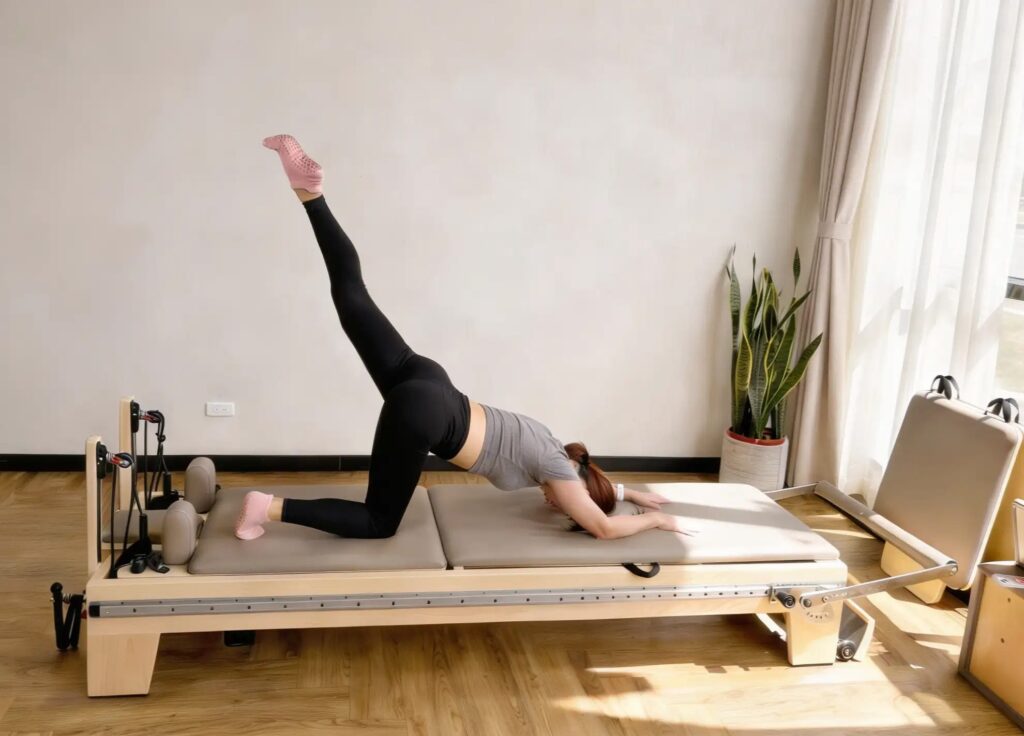
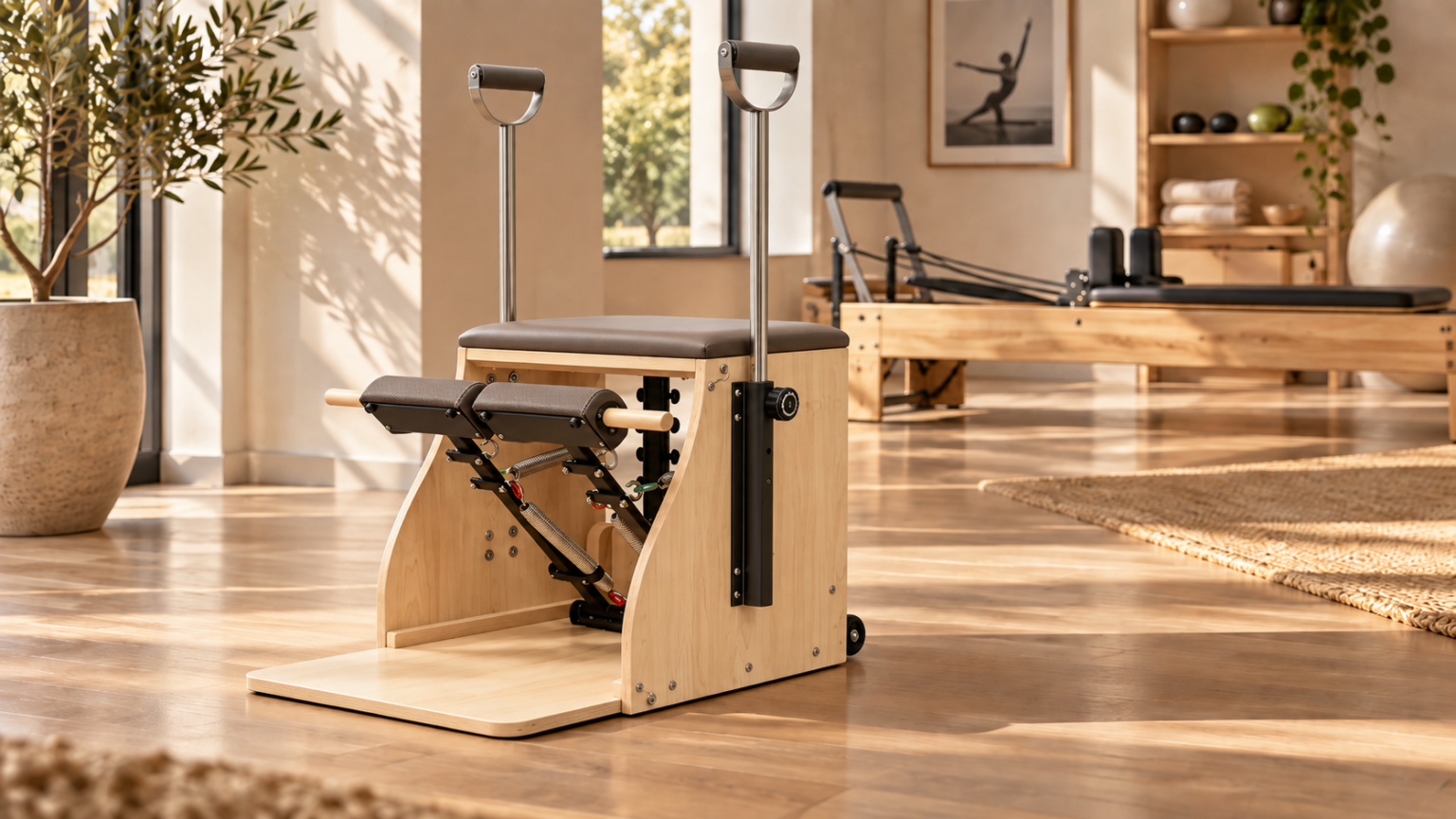
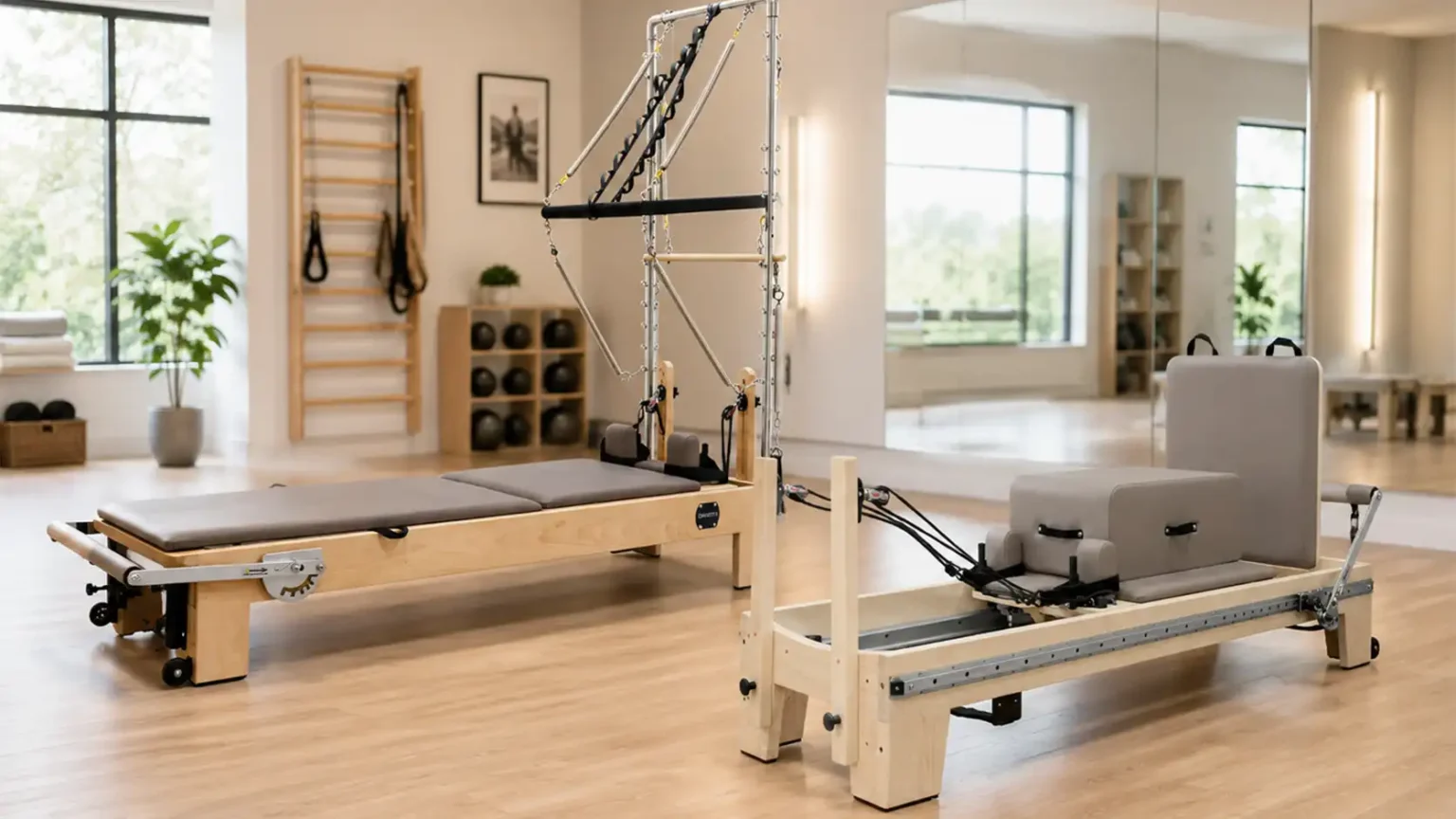
Because we manufacture reformers in both materials, our Axispila line serves as a useful case study in what the comparison looks like when one factory builds reformer frames in both materials and has to honor both columns of the table, and the disclosure comes first as always: these are our products, the reader should discount accordingly, and every claim is checkable against the published range on our Pilates equipment manufacturing page. The Axispila catalog spans the configurations this article has been describing in the abstract: aluminum deluxe full-rail reformers, offered with and without half towers for studios building tower and mat programming into one footprint, alongside wood-framed variants, with the line extending to the Cadillac trapeze table, combo stability chair, ladder barrels in iron-base, maple, and quick-adjust versions, and spine correctors in maple and polymer, so a studio can hold one design language across a complete apparatus set in either material direction, with the full range browsable under our Pilates equipment catalog. Building both disciplines the engineering in both directions. Our aluminum frames are specified against the failure modes this article attributed to the budget end of the category: full-rail extrusion profiles sized for torsional stiffness rather than price, damped interfaces at the noise-critical hardware points, and commercial-grade load specifications published rather than implied. Our maple-family apparatus answers wood’s environmental honesty the same way: kiln-dried hardwood, joinery designed for seasonal movement, and finishes chosen for studio cleaning reality rather than showroom gloss. Fleet consistency, the property franchise buyers ask about first, is a manufacturing-system property rather than a material property, and it is carried by the same quality discipline, certified under ISO 9001, that governs our strength equipment production, because reformer frames of either material are only as repeatable as the system that builds them.
The second half of the case study is commercial, because studios do not buy frames in isolation and neither do the franchise chains, rehabilitation centers, and physical therapy clinics the Axispila line supplies. Both frame materials arrive with the same commercial wrapper: customizable upholstery and configuration options, so the maple-versus-aluminum decision does not force a branding compromise in either direction; volume sourcing programs for multi-site operators, where the fleet-consistency argument becomes contractual rather than rhetorical; and OEM and ODM programs through our OEM and ODM services, for distributors and studio brands that want the comparison this article walks through embodied in equipment carrying their own name. For buyers using this case study the way it is intended, as a template for interrogating any manufacturer, the questions to carry forward are exactly the ones our own line is built to answer: which extrusion profiles or wood sections carry the load path, and are load specifications published; how are the noise-critical interfaces damped on the aluminum side, and how is seasonal movement engineered for on the wood side; can the factory show both materials running in comparable configurations, so the demo is a controlled comparison rather than a showroom impression; and does the same quality system govern both lines, because a manufacturer that holds one material to a different standard than the other has told you which one it actually believes in. Put those questions to us or to any builder, and the sample-evaluation disciplines in our guide to checking details before approving a sample apply to reformers exactly as they apply to free weights. For distributors and studio brands sourcing at volume, the supplier-verification sequence in our checklist for assessing an OEM manufacturer’s reliability completes the picture, because a reformer program is a decade-long relationship with a factory, and the factory’s behavior under demanding questions is the best preview of its behavior under a warranty claim, a colorway change, or a fleet expansion three years from now. The comparison this article has walked through is, in the end, a template for that conversation: a buyer who arrives asking about extrusion profiles, drying standards, damping interfaces, and fleet tolerances has already communicated the only thing that reliably improves what a factory delivers, which is the demonstrated ability to notice.
Choosing for Your Studio: A Format-First Framework
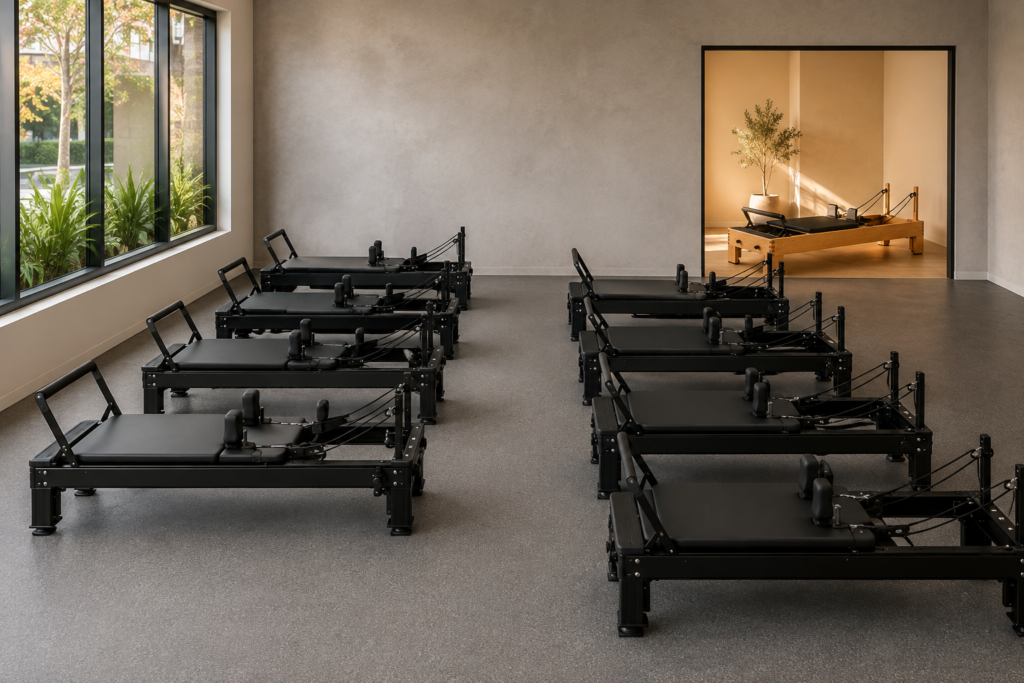
The comparison converts into a decision the moment it is weighted by studio format, because format determines which rows of the table bind and which are luxuries, and the patterns are consistent enough across the industry to state as a framework. Classical and heritage studios, teaching the traditional repertoire on a small fleet with hands-on instruction, weight ride feel, acoustics, and visual continuity heavily, and maple serves them so naturally that the aluminum case must be argued from operations, usually climate or relocation frequency, to displace it. Group-reformer and athletic-format studios, running large identical fleets at high throughput with music and daily reconfiguration, weight handling, stacking, surface durability, and fleet consistency, and aluminum serves them so directly that maple survives the shortlist only where brand positioning demands wood’s warmth badly enough to pay for it operationally. Clinical and rehabilitation settings split by their real constraint: their acoustic and trust-signal preferences often point to maple, while their cleaning-chemistry protocols and equipment-turnover practicalities often point to aluminum, and the deciding vote usually belongs to whichever constraint the facility’s accreditation and workflow make non-negotiable. Franchise and multi-site operators add a dimension the single studio never faces, specification stability across sites and years, which favors whichever material their manufacturer can hold most consistently at scale, an answer that is about the factory more than the material, and one worth converting into contract language about tooling stability and specification change notices before the first multi-site order is placed. Hospitality and residential amenities, buying one to three machines for unsupervised or lightly supervised use, weight surface durability and low maintenance, and usually land on aluminum unless the property’s design brief specifies wood. The table below states the framework as starting recommendations, with the same caveat as every table in this series: they are openings for your own weighting, not verdicts, and the demo room outranks the table wherever the two disagree. One pattern from the field deserves its own sentence before the table: the split fleet, maple in the private-session room and aluminum in the group room, has quietly become common in mixed-format boutiques, and it is not indecision but precision, each room’s frames matched to each room’s product, usually from one manufacturer so the upholstery, springs, and service relationship stay unified across the fleet, and so the two rooms read as one studio rather than two suppliers.
| Studio Format | Leading Frame Choice | Why, and When It Flips |
| Classical / heritage studio | Maple | Feel, acoustics, lineage; flips only under humid climate or frequent relocation |
| Group-reformer / athletic format | Aluminum | Handling, stacking, fleet consistency; flips only for wood-led brand positioning |
| Clinical / rehabilitation | Either, by binding constraint | Maple for acoustics and trust signals; aluminum for cleaning protocols and turnover |
| Franchise / multi-site | Aluminum, usually | Specification stability at scale; the factory matters more than the material |
| Hotel / residential amenity | Aluminum | Surface durability, low maintenance; flips when the design brief specifies wood |
| Mixed-format boutique | Split fleet | Maple in the private room, aluminum in the group room is a legitimate answer |
Budget mechanics close the framework, because the maple premium interacts with fleet size in a way single-machine thinking misses. On one machine, the difference between materials is a bounded sum a studio absorbs without noticing; across a twelve-machine group fleet it becomes a five-figure line that could alternatively fund flooring, towers, or a second apparatus category, which is a real argument for aluminum precisely where group formats already favor it. The inverse also holds: a classical studio running four machines pays the maple premium four times, not twelve, to acquire the exact ride, sound, and presence its positioning sells, which is among the cheapest brand investments available to it. Financing structure belongs in the same arithmetic, and the lease-versus-buy analysis published on our brand site applies to reformer fleets directly: reformers are long-lived, technologically stable equipment of exactly the kind that ownership economics favor, and both frame materials hold function far beyond any lease term. Finally, sequence the spend the way this series always recommends: complete apparatus coverage before duplicate depth, the demo before the deposit, and the manufacturer conversation before the brand attachment, because the factory behind the frame determines more of the fleet’s decade than the material in it, and the comparison this article has equipped you to run works only when it is pointed at real machines from real builders willing to stand behind both answers.
Frequently Asked Questions
Are wood or aluminum reformers better?
Neither is better; they optimize for different studios. Well-built maple reformers offer a damped, quiet ride, classical warmth, and strong resale value, suiting heritage, boutique, and clinical studios. Well-built aluminum reformers offer lighter handling, stacking, humidity immunity, easier cleaning, and tighter fleet consistency, suiting group formats, franchises, and high-throughput schedules. Build quality within each material matters more than the material itself, so evaluate the specific machine, loaded, in a quiet room.
How long do Pilates reformers last?
Quality commercial reformers of either frame material routinely serve ten to twenty years. Frames are rarely the limiting part: springs are replaced on schedule, typically every few years under commercial use, and wheels, ropes, and upholstery wear on their own cycles. Maple frames may want a refinish late in life; aluminum frames typically need only surface care. Longevity depends most on build quality, spring and wheel maintenance, and honest cleaning practices appropriate to the frame’s finish.
Why are maple reformers more expensive?
Because the inputs cost more. Kiln-dried hard maple is an expensive raw material, and a stable wooden frame requires machining, joinery, and finishing labor that extrusion-based aluminum construction replaces with tooling efficiency. The price difference buys maple’s damped feel, acoustics, and classical presence rather than extra structural capacity, so studios should pay it where those qualities are part of the product they sell, and decline it where throughput and handling matter more.
Do aluminum reformers feel different from wood reformers?
Yes, subtly but noticeably to experienced users. Maple damps vibration naturally, so the carriage feels planted and the machine runs quieter, a character many classical instructors prefer. Aluminum is stiffer and less damped, so the ride feels precise and slightly brighter, with modern designs closing the acoustic gap through wheel compounds and damped hardware interfaces. In blind tests the materials remain distinguishable, but a well-built machine of either kind outperforms a poorly built machine of the other.
What should I check before buying reformers for a studio?
Five things, loaded rather than empty: frame stability, pressing the rails and running a loaded carriage to both ends; acoustics at class tempo in a quiet room; spring quality, replacement schedule, and parts availability; carriage wheels and rail geometry across every machine in the order, since fleet consistency is where budget builders fail; and the commercial wrapper, published load specifications, warranty terms, upholstery options, and the manufacturer’s ability to support the fleet for a decade.
Key Takeaways: Match the Frame to the Studio
The maple-versus-aluminum question resolves the way this series keeps finding equipment questions resolve: into a fit decision that the studio’s own format answers, once the marketing is cleared away and the three real jobs of reformer frames, structure, sound, and presence, are weighed in the studio’s own proportions. Maple remains what it has always been, the frame whose damped ride, muted acoustics, and classical warmth are themselves part of what heritage, boutique, and clinical studios sell, purchased at the price of humidity awareness, heavier handling, and gentler cleaning. Aluminum has matured into the frame of the group-reformer era, holding tolerances across identical fleets, shrugging off commercial cleaning and relocation, and closing the acoustic gap through engineering, at the price of a brighter feel and a contemporary aesthetic that not every brand wants. The floor of both categories is occupied by machines that disgrace their material, which is why the loaded demo, the quiet-room listen, and the fleet-consistency check outrank every table in this guide, ours included. Weight the comparison by your format, test the actual machine the way this article describes, interrogate the manufacturer with the case-study questions, and reconnect the frame to the springs, wheels, and rails that complete the apparatus. And when your shortlist is ready for a factory conversation, the Axispila range stands on both sides of this comparison deliberately, built by a manufacturer with no stake in which column you choose and every stake in the machine being right; we are glad to walk through your studio’s requirements and put both frames in front of you, loaded, which is where this decision was always going to be made. A studio that chooses its frames this way, deliberately, in its own proportions, with its own ears and hands, ends up with something better than the right material: it ends up with a fleet it can explain, to instructors, to clients, and to itself, for the entire decade the machines will spend earning back the afternoon this comparison took.