The Smallest Apparatus in the Room, and Why It Humbles Everyone
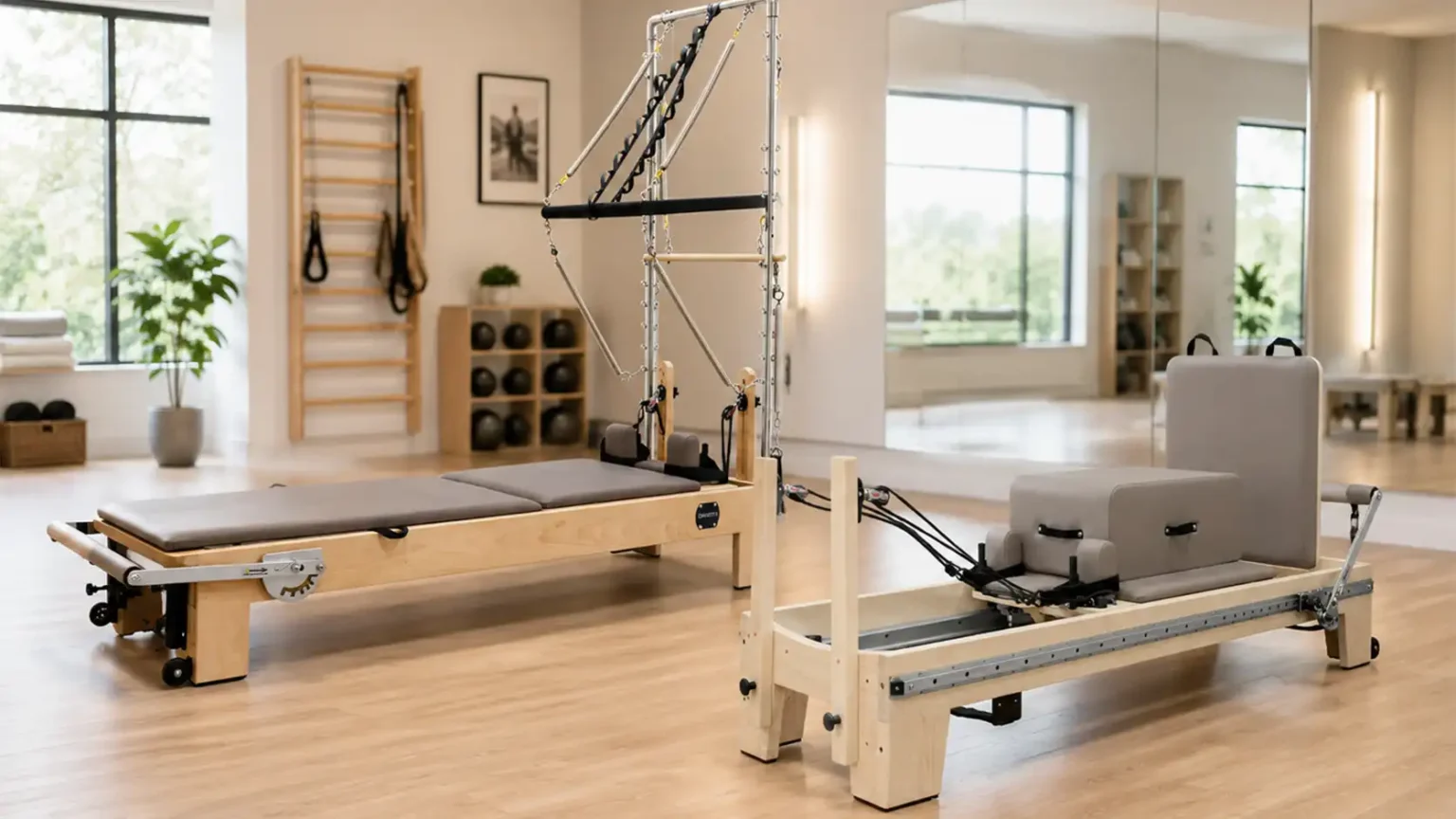
Every Pilates studio has a piece of equipment that newcomers underestimate on sight, and it is always the same one: the compact wooden box with a pedal, sitting quietly in the corner while the reformers get all the attention. The wunda chair, in its modern form the combo stability chair, occupies less than one square meter of floor, and it is, by broad consensus among instructors, one of the most demanding pieces of equipment in the method. The reasons are mechanical and worth understanding before you ever step on one. On a reformer, the body lies or kneels on a supported carriage while springs assist and resist; on the chair, the body is up in space, balancing its own weight against gravity while the limbs drive a spring-loaded pedal, which means the deep stabilizing musculature never gets a moment off. That inversion, support removed, stability demanded, is the chair’s entire identity, and it explains both the apparatus’s century-long survival and its current renaissance in athletic conditioning, where coaches have rediscovered what Joseph Pilates built into it from the start: a machine that trains strength and balance as a single quality rather than two separate ones. This guide covers the chair completely: where it came from and how it evolved into today’s combo configuration, the anatomy of the modern machine component by component, the exercise repertoire by body region, who the chair serves best and who should approach it carefully, how it compares with the rest of the apparatus family, and the buying checklist, because we manufacture this equipment and the difference between a chair that lasts a decade and one that wobbles by spring is decided at the factory, not the studio.
The disclosures that frame everything we publish apply here with full force. We are Alexandave Industries, a Taiwan fitness equipment manufacturer since 1980, and the chair this article uses as its worked example is our own: the Combo Stability Chair in our Axispila commercial Pilates line, so we profit when this guide convinces a studio, clinic, or home practitioner that the chair deserves floor space. Two correctives keep the analysis honest. First, mechanism over marketing: every claim about what the chair does is argued from observable mechanics, spring behavior, base of support, lever lengths, so the reasoning holds for any manufacturer’s chair, and the buying section is written to let you inspect ours as skeptically as anyone else’s. Second, scope honesty: this article is an equipment and training guide, not a clinical protocol; where the chair’s rehabilitation uses come up, the text says plainly that programming for injury, osteoporosis, or neurological conditions belongs to qualified professionals, and the evidence standards are the same we apply across this site, public health authorities and published standards rather than studio folklore. The guide serves four readers: the curious practitioner who has been avoiding the chair in class, the home user drawn to the apparatus with the smallest footprint and wondering what it can really do, the studio owner deciding whether chairs earn group-class floor space, and the clinic equipping for seated and standing functional work, and because those four share one machine, the article moves from understanding it to using it to buying it in that order.
What Is a Wunda Chair, and Why Did Joseph Pilates Build It?
The wunda chair is the Pilates method’s compact apparatus: a box-shaped frame with a padded top surface and a spring-resisted pedal at its base, on which the practitioner sits, stands, kneels, or lies while pressing the pedal with feet or hands against adjustable spring tension. Joseph Pilates designed it in the New York years of his method’s development, and the origin story explains the form: conceived for small city apartments, the original design famously doubled as actual furniture, a chair a client could keep in a living room and convert for exercise, which is why the apparatus inherited a domestic name and a footprint measured in centimeters rather than meters. The design brief, a complete training tool in minimal space, forced the concentration that makes the chair unique: where the reformer distributes work across a sliding carriage, straps, and a frame the length of a bed, the chair compresses everything into one pedal and one small elevated surface, so the body itself must supply the stability the equipment declines to provide. Pilates used it extensively for strength work, for clients who needed standing and functional patterns, and reportedly with dancers and athletes whose sports demanded power in unstable positions, a lineage that continues today. For practitioners of equipment-based training generally, the chair is best understood as the reformer’s inversion, a point our broader guide to what reformer Pilates is develops from the reformer’s side: the same springs, the same control philosophy, the same breath-led precision, applied with the support taken away. The name itself, wunda, has accumulated several folk etymologies over the decades, from German wordplay to the simple wonder of what the little machine demands; what is documented beyond dispute is the design intent, a complete apparatus disguised as household furniture, and the repertoire Pilates built for it, much of which survives in modern chair classes nearly unchanged.
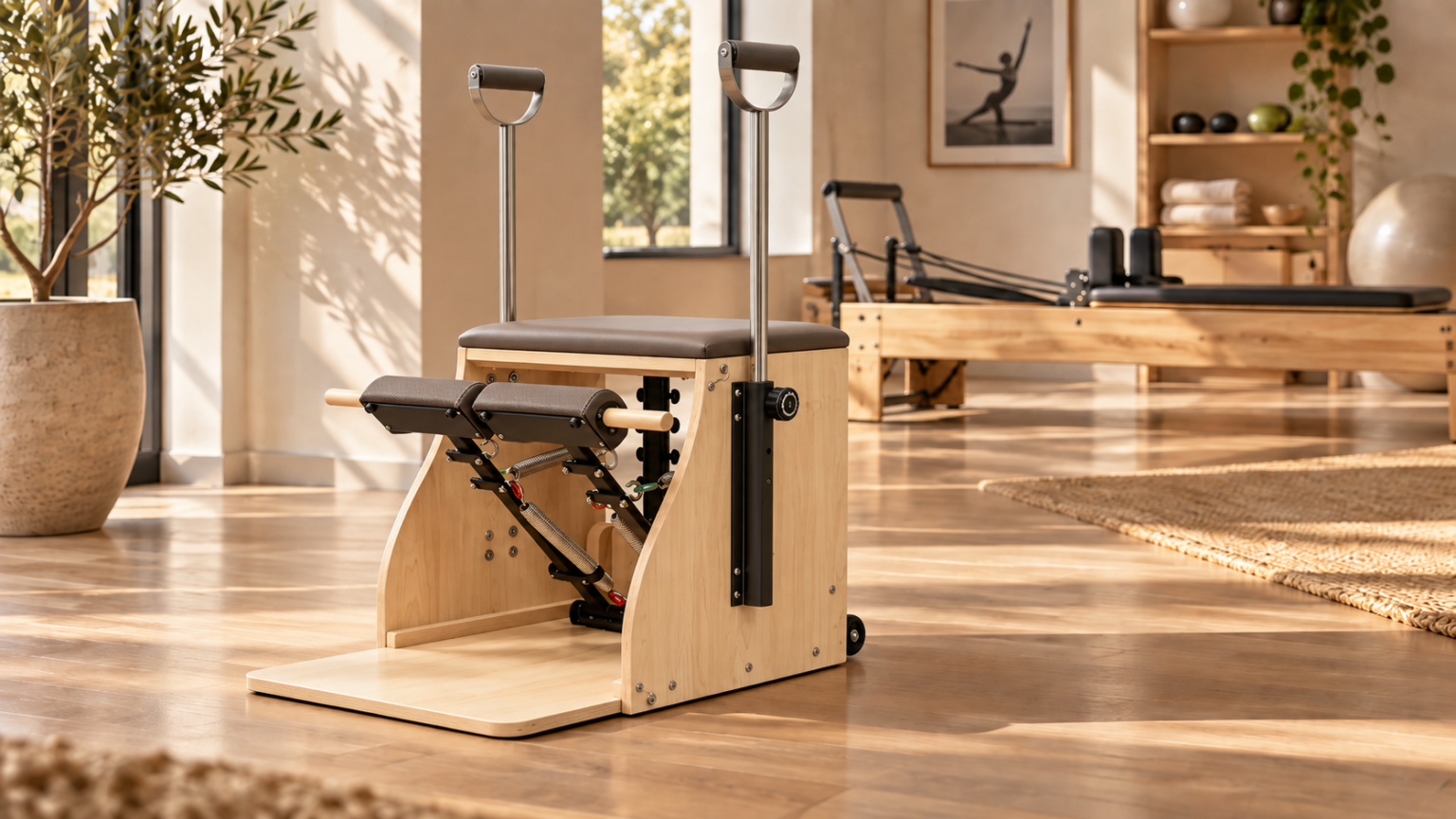
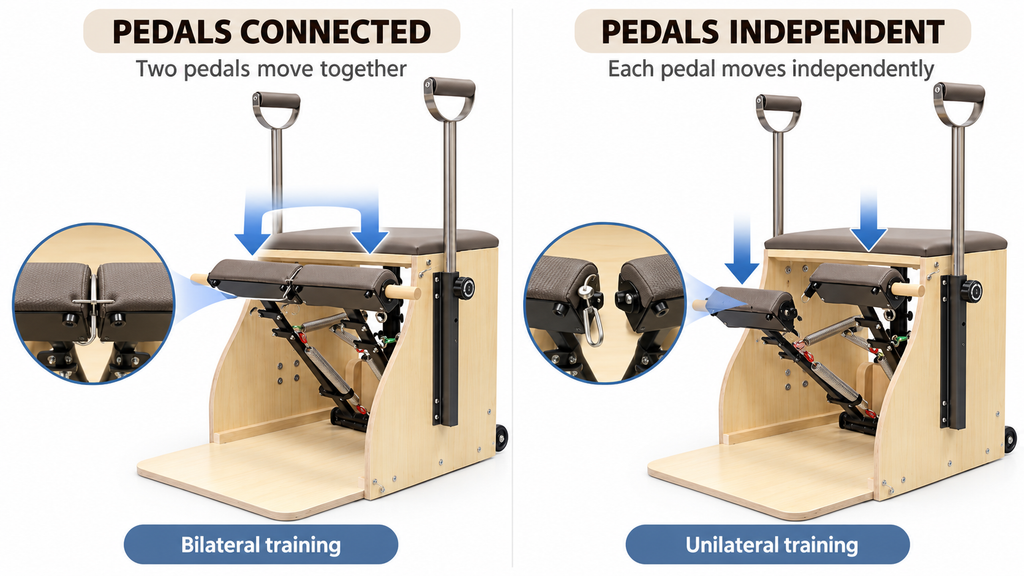
The modern combo chair, the configuration this guide covers and our factory builds, is the wunda chair’s professional evolution, and the word combo denotes the features that turned a single-exercise seat into a studio workhorse. The defining upgrade is the split pedal: where the original pedal was one piece driven by both limbs together, the combo configuration lets the pedal operate as a single unit or divide into two independent halves, so each leg or arm works against its own spring resistance with no partner to hide behind, the same unilateral honesty that iso-lateral strength machines brought to the gym floor, delivered here in maple and springs. Around the pedal, the professional configuration adds adjustable spring positions for graded resistance, side handles for supported standing and pressing work, adjustable in quality builds, and the structural weight and base dimensions that let an adult balance on top of the machine safely, which the furniture-sized original was never asked to do at modern loads. What has not changed is the footprint philosophy: a modern combo stability chair still occupies well under one square meter, still stores and moves more easily than any other apparatus, and still represents the method’s highest ratio of training stimulus to floor space, which is why the chair anchors the small-space conversation in every studio layout plan and every apartment gym, a planning context our guide to studio space and layout quantifies at room scale.
Anatomy of the Modern Combo Chair
The Pedal and the Split-Pedal System
The pedal is the chair’s moving part and its entire user interface, so its engineering decides the machine. Mechanically it is a lever: hinged at the frame’s base, driven by the practitioner’s feet or hands through an arc, and resisted by springs whose attachment position sets the load curve, and because it is a lever, foot placement changes everything, standing on the pedal’s outer edge lengthens the effective arm and eases the load, while working near the hinge demands more force through a shorter range, a graded difficulty dial that instructors use constantly and beginners discover by surprise. The split function converts this lever into a diagnostic instrument. Joined, the two halves move as one and the strong side can quietly subsidize the weak one, exactly as it does in any bilateral movement; separated, each half answers only to its own limb, and the asymmetries that bilateral work conceals, a left leg that presses late, a right arm that caves inward under load, become visible within one session and trainable within one program. This is the feature that moved the chair from specialty item to essential apparatus in athletic and rehabilitation settings, because unilateral deficits are precisely what sports injuries create and what return-to-play programs must find and fix. On our own unit, the pedal halves link and separate without tools, and the inspection standard a buyer should apply to any chair is the one we build to: the pedal hinge should move silently through its full arc with zero lateral play, the halves should sit flush and level when joined, and the linking mechanism should engage positively enough that a standing practitioner never has to wonder which mode the pedal is in.
Springs, Resistance Settings, and the Load Curve
The chair’s resistance comes from steel extension springs connecting the pedal to the frame, and understanding three properties of that system separates informed users from nervous ones. First, spring rating: chairs ship with springs of different tensions, our Combo Stability Chair carries four German-imported springs, two red and two green in our rating system, and combinations of heavier and lighter springs set the base resistance the way plates load a bar. Second, attachment position: the frame offers multiple anchor positions, and moving a spring’s hook changes the pre-tension and effective load through the pedal’s arc, so the same four springs produce a wide spectrum of resistance, from assistance-light settings for controlled mobility work to loaded settings that challenge strong athletes. Third, and least intuitive for newcomers: on the chair, lighter springs frequently make an exercise harder, not easier, because when the pedal supports part of your body weight, as in pike presses and standing pumps, the spring is holding you up, and reducing its tension removes support that your trunk must then supply, the exact inversion of gym-machine logic and the single most important concept for safe chair progression. Springs are also the chair’s consumable safety components: they live under tension for thousands of cycles, and their fatigue life, tension consistency, and attachment security are engineering subjects we treat at depth in our analysis of spring tension testing and detachment risk, which is why serious manufacturers batch-test springs and specify replacement intervals, and why a buyer’s first question about any chair’s springs should be where they come from and how they were tested.
Frame, Handles, and the Platform You Balance On
Everything else about the chair exists to hold still while a human balances on it, which makes the frame’s job simple to state and demanding to engineer. Mass and geometry do the stabilizing: our unit weighs 37 kilograms on a 760 by 600 millimeter base, built from solid North American maple, and that mass-to-footprint ratio is deliberate, a chair light enough to slide across the studio is a chair that shifts under a standing practitioner, so the professional standard is a machine that plants and stays planted, with transport solved separately, in our design through wheels that engage only when the chair tilts, leaving the working stance immovable. The top surface is the apparatus’s second working zone: a padded platform sized for sitting, kneeling, standing, and prone work, whose upholstery takes the same daily sweat-and-cleaning load as any bench and should be specified and replaceable accordingly. Side handles complete the professional configuration, providing support for standing pedal work, balance-assisted mounting, and pressing patterns, and their adjustability matters more than beginners expect, handles fixed at one height fit one body, while handles adjustable vertically and horizontally, as on our unit, fit the range of humans a studio actually serves, from a short dancer doing supported standing pumps to a tall athlete who needs the handles out of the movement’s way entirely. The load rating consolidates all of this into one number a buyer can verify: our chair is rated to 150 kilograms of user load, and any chair intended for standing adult work should publish an equivalent figure and the testing philosophy behind it, the general safety expectations for stationary training equipment being codified in ISO 20957-1, the standard this entire equipment class is designed and tested against in serious factories.
What the Chair Trains: The Repertoire by Body Region
Lower Body: Footwork, Pumps, and Single-Leg Honesty
The chair’s lower-body repertoire starts where the reformer’s footwork ends and adds verticality. Seated footwork, pressing the pedal from a tall seated position on the platform, trains the same knee and hip extension as reformer footwork but demands an upright, unsupported spine throughout, which converts a leg exercise into a posture exercise at no extra charge. Standing pumps are the chair’s signature: one foot on the floor or platform, the other driving the pedal through controlled arcs, and the working leg’s strength is only half the exercise, because the standing leg and trunk are balancing the whole structure while the pedal leg moves, a single-leg stability demand with obvious transfer to gait, stairs, and sport. The split pedal then doubles the repertoire’s diagnostic value: pumping both halves together reveals nothing a leg press would not, but pumping them independently, alternating, or with one leg holding depth while the other moves exposes timing and force asymmetries with a clarity that impresses physical therapists and humbles athletes, and correcting those asymmetries is among the best-evidenced uses of unilateral training generally. Progressions run from supported to free, handles first, then hands off, and from heavy springs to light, remembering the chair’s inverted logic that lighter support means harder stabilization. For older adults, the standing work connects directly to the balance-and-strength combination that mainstream guidance emphasizes for healthy aging, the strength-training case summarized in the Mayo Clinic’s overview of strength training, delivered here with a support handle in reach, which is exactly the configuration balance-confidence work wants.
Upper Body and Trunk: Presses, Pikes, and the Famous Burn
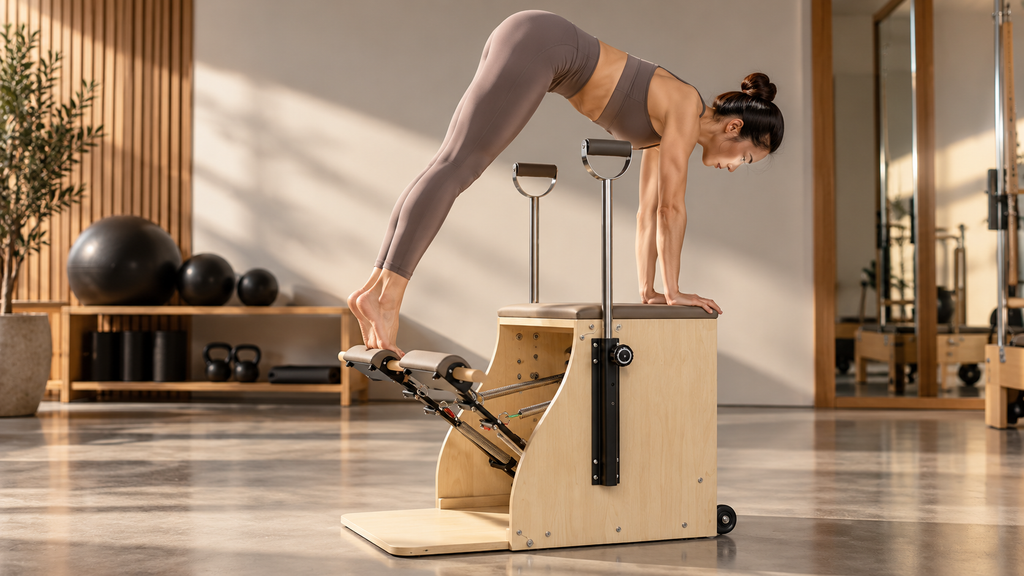
Flip the orientation, hands on the pedal instead of feet, and the chair becomes an upper-body and trunk apparatus of unusual severity. Pedal push-downs from standing or seated positions train the lats, triceps, and shoulder girdle through a pressing arc the body must stabilize at both ends, since neither the pedal nor the practitioner is braced against anything. The pike family is the chair’s crown and its rite of passage: hands on the platform or pedal, feet on the opposite element, hips lifted toward a folded position, with the pedal’s spring the only moving support, an exercise that integrates shoulder stability, deep abdominal control, and hip flexor strength so completely that a single honest repetition tells an instructor most of what they need to know about a client’s trunk. The mechanism behind the famous difficulty is the one described in the anatomy section: in pike and press positions the spring is partially holding the body up, so the trunk musculature works continuously against a support that is actively moving, the training stimulus that mainstream core-conditioning guidance, summarized in the Mayo Clinic’s primer on core exercises, identifies as the point of core work, delivered at an intensity mat exercises cannot reach. Prone and side-lying patterns, chest openers, lateral presses, complete the region, and across all of it one programming note keeps the enthusiasm honest: the chair’s upper-body repertoire is intense precisely because it is unsupported, so it belongs after fundamentals are learned on mat or reformer, not before, and instructors who sequence it that way produce the converts while those who lead with it produce the avoiders.
Balance, Standing Work, and Athletic Transfer
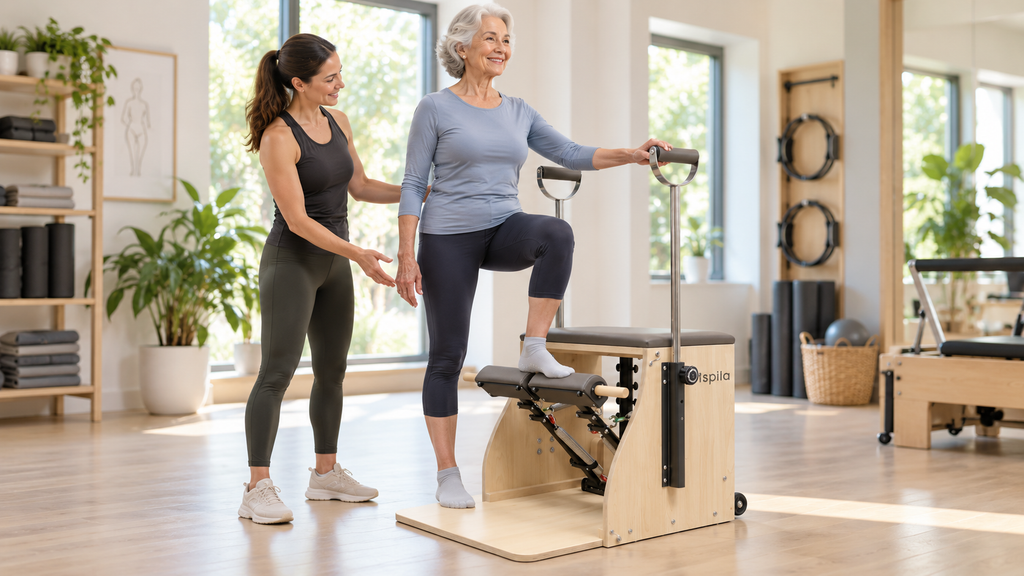
The chair’s third repertoire region is the one no other apparatus serves as well: loaded work in standing, the position in which humans actually live, walk, and play sport. Step-ups onto the platform against pedal resistance, standing single-leg pumps, lunging patterns with the rear foot driving the pedal, and the advanced standing-on-pedal family, where the practitioner balances on the moving element itself, all train the ankle, hip, and trunk strategies that balance research cares about, with resistance attached, and this is the content that has carried the chair out of Pilates studios and into athletic facilities. The transfer argument is straightforward: sports deliver force through one leg at a time, in standing, under instability, and the chair is the apparatus that reproduces exactly that demand at adjustable intensity, which is why dancers have used it for a century and why conditioning coaches now program chair work for field and court athletes, the audience our product page addresses directly with its balance and explosive-power positioning. For general populations the same content serves quieter goals: confident single-leg stance is a daily-life skill, standing work with handle support meets older adults where fall-resistant strength actually lives, and the World Health Organization’s physical activity guidance explicitly includes functional balance and strength training among its recommendations for adults over sixty-five, a target the chair’s supported standing repertoire fits with unusual precision. The honest boundary: standing-on-pedal work is advanced, falls from equipment are real injuries, and progression to unsupported standing variations should be earned through the supported versions, supervised in a class or clinical setting, and skipped entirely by anyone whose balance confidence or bone health makes a fall unacceptable, a judgment that belongs to qualified professionals rather than enthusiasm.
Who the Chair Serves Best, and Who Should Be Careful
Matching the chair to its users is easy once its character is clear: it rewards anyone who needs strength and stability trained together, and it challenges anyone who arrives without baseline control. Studios get the apparatus with the method’s best stimulus-per-square-meter ratio, chairs turn dead corners into stations, group chair classes program well, and a row of chairs costs a fraction of a row of reformers in both money and floor, the arithmetic behind the boutique-studio positioning on our product page. Clinics and physical therapy practices get the split pedal’s unilateral honesty plus standing functional patterns with built-in hand support, the combination post-injury and older-adult programming actually needs, and the broader credibility context helps here too: national health systems treat appropriately delivered Pilates-based exercise as suitable for sensitive populations, with the United Kingdom’s National Health Service publishing adapted Pilates exercise programs for back pain, arthritis, and osteoporosis, though equipment-specific clinical programming remains, as always, a professional’s call, with the standing proviso repeated: clinical populations progress under clinical judgment. Home practitioners get the apparatus that actually fits, under one square meter standing, light enough to reposition with tilt-engaged wheels, complete enough to train legs, trunk, and upper body, which makes the chair the strongest single-apparatus answer for apartment-scale equipment-based training, ahead of the reformer it cannot fully replace but meaningfully substitutes. Athletes and dancers get the balance-under-load repertoire described above. The caution list mirrors the feature list: the chair’s unsupported character makes it the wrong first apparatus for absolute beginners, who should build fundamentals on mat or reformer first; its elevated balancing surfaces demand respect from anyone with fall risk, vertigo, or low bone density; its intense trunk flexion content needs modification in pregnancy and after abdominal surgery; and all of those populations can still use chairs productively, with the right supervision, which is the recurring sentence this site’s training content refuses to cut. The two tables below condense the chair’s profile: first its core specifications as a buying reference, then its position against the rest of the apparatus family.
| Specification | Combo Stability Chair (Axispila) | Why It Matters |
| Footprint | 760 x 600 mm, under one square meter | Smallest major apparatus; fits apartments and studio corners |
| Height | 1,260 mm overall | Clears standard ceilings everywhere, including basements |
| Frame material | Solid North American maple | Mass and stiffness for standing stability; furniture-grade longevity |
| Machine weight | 37 kg | Plants under standing work; moves only on tilt-engaged wheels |
| Load rating | 150 kg max user load | Published figure for standing adult work; ask any maker for theirs |
| Springs | 4 German-imported (2 red, 2 green), multi-position | Graded resistance both directions; batch-tested consumables |
| Pedal | Split: single unit or two independent halves | Bilateral strength plus unilateral diagnosis and correction |
| Handles | Adjustable vertically and horizontally | Supported standing work for every user height |
The Chair in the Apparatus Family
No apparatus is an island, and the chair’s value is clearest when its role in the full equipment family is stated plainly. Against the reformer: the reformer is the method’s versatile backbone, supporting the body while teaching control, and it remains the right first apparatus and the right centerpiece; the chair is its complement and near-inverse, removing support to demand stability, which is why mature studios program both and why the chair makes a poor sole introduction but a superb second station. Against the Cadillac: the trapeze table is the clinical and one-on-one platform, surrounding a supported body with spring attachments from every direction, the opposite philosophy from the chair’s minimalism, and the two bracket the method’s support spectrum from maximum assistance to maximum challenge. Against the barrels: ladder barrels and spine correctors own spinal extension and mobility over curved surfaces, content the flat-surfaced chair simply does not address, which is why barrel and chair quarrel over no territory at all. The practical consequence for buyers is sequencing, not either-or: a studio builds reformers first, adds chairs for density and challenge, a Cadillac for private and clinical work, and barrels for mobility; a home practitioner starts with mat work plus either a reformer where space allows or a chair where it does not; and a clinic weights toward Cadillac and chair, the supported and the functional ends. The full family, reformers through chairs, barrels, and spine correctors, is what our Axispila Pilates equipment line exists to supply as a coherent fleet, and the comparison table below compresses this section for the equipment decision.
| Dimension | Combo Chair | Reformer | Cadillac | Barrels |
| Footprint | Under 1 m², smallest | ~2.4 m long plus envelope | ~3 x 1.8 m zone | About 1 m of wall depth |
| Body support | Minimal: you stabilize | High: carriage supports | Maximum: table plus frame | Curved surface support |
| Signature content | Standing work, pikes, unilateral pumps | Full-body repertoire on sliding carriage | Assisted, suspended, clinical work | Spinal extension and mobility |
| Best first apparatus? | No: second station | Yes: the backbone | For clinical settings | Supplementary |
| Difficulty character | Hardest per exercise | Scales gentlest to hard | Gentlest entry | Mobility-focused |
| Relative cost and density | Lowest cost, highest density | Core investment | Highest single unit | Modest |
Buying a Combo Chair: The Inspection Checklist
Build Quality: What to Check Before You Sign
The chair is the apparatus a human balances on top of, which promotes its build inspection from prudence to obligation, and the checks compress into five minutes with your hands. Frame first: the chair should stand dead flat with zero rock, the joinery, in a quality maple build, should show tight, even seams with no gap lines or filler, and a firm lateral shove at the platform’s top edge should move nothing, because that shove is a standing practitioner’s balance correction in disguise. Pedal mechanics second: cycle the pedal slowly through its full arc listening for clicks or scraping, check lateral play at the pedal’s edge, zero is the standard, split and rejoin the halves repeatedly to feel whether the linkage engages positively, and confirm the halves sit level when joined. Springs third: ask where the springs are sourced, how they are tested, and what the replacement interval and price are, a manufacturer who answers all three in numbers is telling you about their whole factory, and inspect the attachment hardware for positive capture, because a spring that can walk off its hook under load is the failure mode that matters. Surfaces fourth: upholstery seams tight, padding firm, platform edges finished, handle adjustments smooth and lockable at every position. And documentation last but decisive: a published load rating, a stated design standard, the ISO 20957-1 reference the anatomy section explained, a parts list with prices, and a warranty itemized by component, the paper trail that separates equipment manufacturers from furniture importers, and the same documentation discipline our guide to Pilates reformer structural design argues for across the apparatus family from the engineering side.
Configuration, Fleets, and Private-Label Programs
Beyond the single unit, three buying contexts change the specification conversation. Studios buying chair fleets for group programming should prioritize consistency and serviceability over any individual feature: identical spring ratings and attachment layouts across units so instructors cue one setup for the whole class, replaceable pads and springs held in a small parts stock, and a maintenance schedule from day one, because six chairs cycling through group classes accumulate pedal-hinge mileage faster than any single-studio reformer, and the fastener-and-spring checks belong on the same calendar as the rest of the equipment’s care. Clinics add configuration questions: handle adjustability ranges that fit their population, upholstery specified for clinical cleaning chemistry, and, often, a preference for the heaviest stable base available, since their users’ balance challenges arrive unannounced. And brands and franchise chains enter a different conversation entirely: the chair’s compact, furniture-adjacent form makes it a natural private-label product, and the OEM considerations, finish options, upholstery colors, branding placement, minimums, and the tooling and consistency questions every custom program carries, run through the same manufacturing logic our broader equipment content documents, with the practical entry point being our OEM and ODM program, which builds the Axispila chair platform under customer brands for studios and distributors scaling a consistent fleet. Across all three contexts, one recommendation repeats from everything this site publishes: buy the chair as commercial equipment with a service life, documentation, and a parts pipeline, not as a wooden object with a pleasant finish, because ten years of daily balancing work is the design brief, and only one of those two purchasing postures reliably gets it.
Frequently Asked Questions
What is a wunda chair used for?
It is used for strength and stability training with feet or hands pressing a spring-resisted pedal: seated and standing leg work, upper-body presses, pike variations for the trunk, and balance exercises in standing. Its split pedal also trains each side independently, exposing and correcting left-right imbalances, which makes it valuable in athletic conditioning and rehabilitation settings alike.
Is the Pilates chair harder than the reformer?
Exercise for exercise, usually yes. The reformer supports the body on a sliding carriage while the chair removes most support, so your trunk must stabilize your own body weight while the limbs drive the pedal. Beginners should build fundamentals on the mat or reformer first; the chair rewards existing control and punishes its absence, which is exactly its training value.
Is the Pilates chair good for beginners?
Yes, with supervision and the right entry points. Seated footwork, supported standing pumps using the handles, and heavier-spring settings give beginners safe, scalable starts. What beginners should not do is start with pikes or unsupported standing work. A fundamentals class or an instructor’s progression plan turns the chair from intimidating to addictive within a few sessions.
Can you get a full-body workout on a Pilates chair?
Yes. The repertoire covers lower body through seated and standing pedal work, upper body through presses and push-downs, and the trunk through pikes and balance content, all adjustable through spring settings and pedal configuration. What the chair lacks is the reformer’s lying, fully supported repertoire, so most programs treat it as a complete but intense station within a broader practice.
How much space does a Pilates chair need?
Barely more than its base: a quality combo chair stands on roughly 0.76 by 0.6 meters, under one square meter, with about 1.3 meters of height. Allow a working margin around it for standing exercises and instructor access, and it remains the smallest major apparatus by far, which is why it anchors apartment setups and converts studio corners into stations.
Key Takeaways: Small Machine, Complete Argument
The wunda chair earned a century of continuous use by solving a problem that never went away: how to train strength and stability as one quality, in almost no space, and the modern combo stability chair is that solution professionally matured, split pedal for unilateral honesty, multi-position German springs for graded resistance both directions, adjustable handles for supported standing work, and a maple frame heavy and stiff enough to be balanced upon. Understand it as the reformer’s inversion, support removed, stability demanded, and both its difficulty and its value explain themselves: legs, trunk, and upper body all train on one pedal, the famous pike earns its reputation, and the standing repertoire delivers balance-under-load work no other apparatus matches, with handles in reach for the populations that need them. Respect its character in sequencing, fundamentals first, supported before unsupported, professional judgment for clinical populations, and buy it like the safety-bearing equipment it is: flat-standing frame, silent zero-play pedal, positively captured and batch-tested springs, published load rating, stated standard, itemized warranty. We build ours, the Combo Stability Chair in the Axispila line, to exactly that specification because we supply the studios, clinics, and homes this guide was written for, and the closing advice costs nothing whichever chair you choose: the smallest apparatus in the catalog is the densest training investment in it, and the corner of floor it asks for, less than one square meter, is the cheapest real estate in fitness for what it returns.
References
The sources cited in this article are listed below in order of first appearance, following academic citation conventions. Health-authority and manufacturer pages are living documents, so retrieval dates are given; the standard is cited by its published edition. Product specifications are stated from the author’s published page as the equipment’s manufacturer; training guidance is general education rather than medical advice, and readers with health conditions, injuries, or fall risk should consult qualified professionals before beginning chair work.
[1] Alexandave Industries. (n.d.). Combo Stability Chair (Model No. F07CA003-BN-AA) [Product specifications]. Retrieved October 1, 2026, from https://alexandave.com/combo-stability-chair/
[2] International Organization for Standardization. (2024). Stationary training equipment — Part 1: General safety requirements and test methods (ISO Standard No. 20957-1:2024). https://www.iso.org/standard/81908.html
[3] Mayo Clinic. (2026, June 5). Strength training: Get stronger, leaner, healthier. Retrieved October 1, 2026, from https://www.mayoclinic.org/healthy-lifestyle/fitness/in-depth/strength-training/art-20046670
[4] Mayo Clinic. (2025, March 25). Core exercises: Why you should strengthen your core muscles. Retrieved October 1, 2026, from https://www.mayoclinic.org/healthy-lifestyle/fitness/in-depth/core-exercises/art-20044751
[5] World Health Organization. (2024, June 26). Physical activity [Fact sheet]. Retrieved October 1, 2026, from https://www.who.int/news-room/fact-sheets/detail/physical-activity
[6] National Health Service. (n.d.). Pilates and yoga exercise videos. Retrieved October 1, 2026, from https://www.nhs.uk/live-well/exercise/pilates-and-yoga/