Why a Spec Sheet Beats a Product Photo
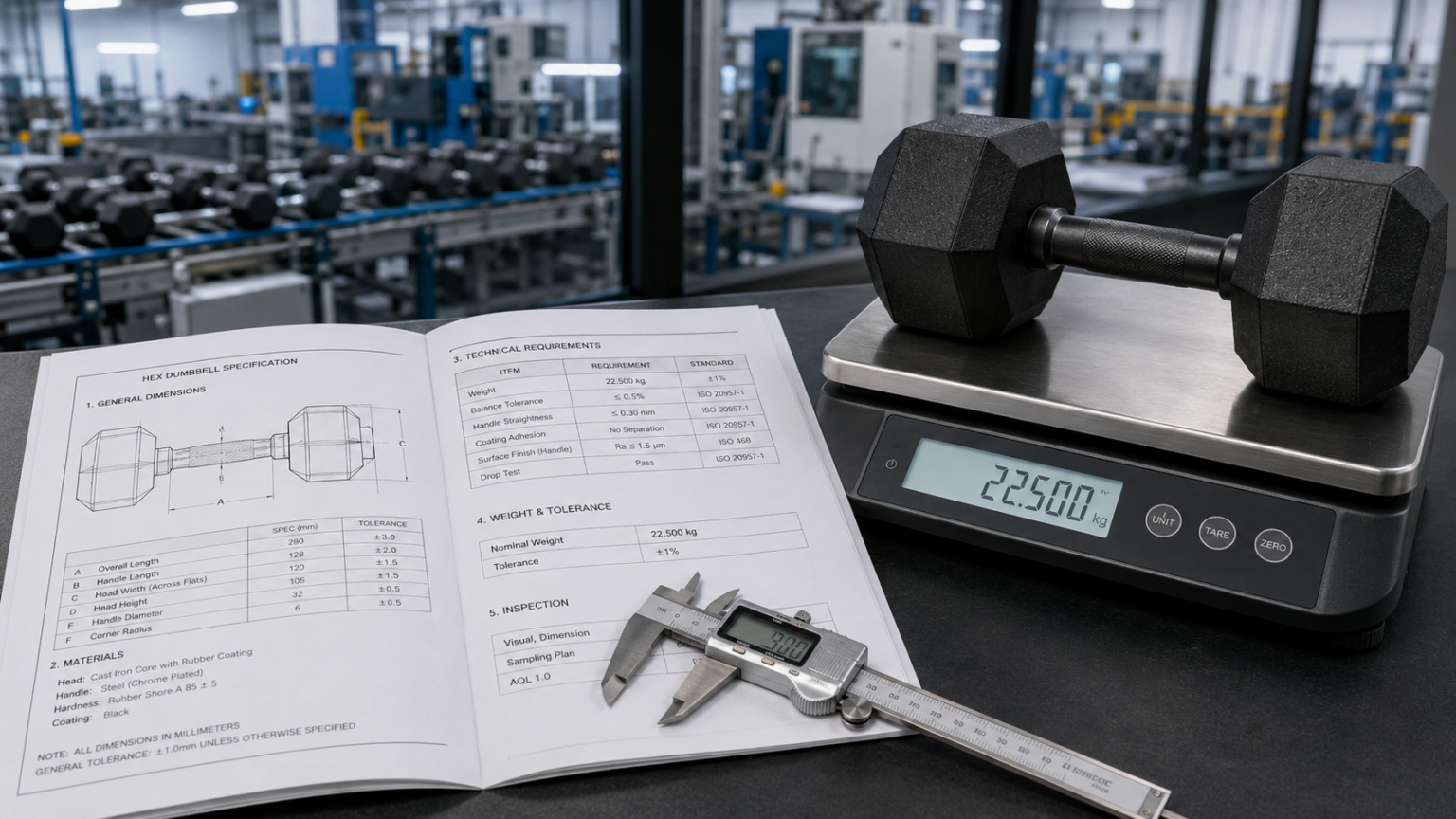
Most dumbbell purchase orders in this industry are, functionally, photographs with quantities attached: the buyer approves a render or a catalog image, negotiates a price per kilogram, and trusts that everything between the picture and the pallet will take care of itself. As a Taiwan-based manufacturer that has been producing dumbbells for commercial brands since 1980, we can report what that trust purchases: it purchases the factory’s defaults. Every dimension the buyer does not specify, the factory decides, and the factory’s incentives point every unspecified decision toward cost, because unspecified quality is quality the buyer has announced they will not check. The result is the familiar catalog of dumbbell disappointments, pairs that differ by half a kilogram, handles that vary between production runs, knurling that arrives slick or savage, coating that fades or peels in the first year, and none of it is fraud in any actionable sense, because the buyer never wrote down what they wanted. A dumbbell spec sheet is the instrument that reverses this dynamic. One or two pages of numbers, tolerances, and named standards convert the purchase from an act of hope into an enforceable agreement, force competing quotations onto identical ground so prices finally mean something, and, most usefully, teach the buyer what they actually want before any factory is asked to provide it. This guide walks through the document line by line, in the order the title promises: weight tolerance first, because accuracy is a brand’s credibility on a scale; handle geometry second, because the handle is the entire user interface of the product; coatings third, because surface treatment carries most of the visible quality difference; and then the remaining clauses, assembly, branding, packaging, and quality control, that complete a sheet a serious factory can quote against and be held to.
A scoping note keeps the guide honest and useful. Dumbbells span several distinct product families, fixed rubber or urethane hex dumbbells, fixed round pro-style dumbbells, cast iron hex, and adjustable systems, and while this article’s framework applies to all of them, its numeric examples center on the fixed commercial dumbbell, the workhorse of gym floors and the product most often bought by photograph. Adjustable dumbbells add mechanism specifications, locking systems, plate interfaces, drop ratings, that deserve their own document and are noted where relevant rather than detailed. The framework also assumes a business-to-business context: a brand, distributor, or facility group buying at container or pallet scale from a manufacturer, where the spec sheet becomes part of the commercial agreement, samples are approved against it, and production is inspected to it. If you are buying a few pairs at retail, the same knowledge simply turns you into a sharper reader of other people’s specifications. Finally, a disclosure consistent with this series: we manufacture the products this document describes, our own dumbbell lines are built to sheets exactly like the one this article constructs, and the template we provide is the one we wish every incoming buyer carried, because a specified order is easier to build, easier to quote honestly, and vastly easier to deliver to a happy customer than a photograph with quantities attached.
Weight Tolerance: Accuracy as a Specification
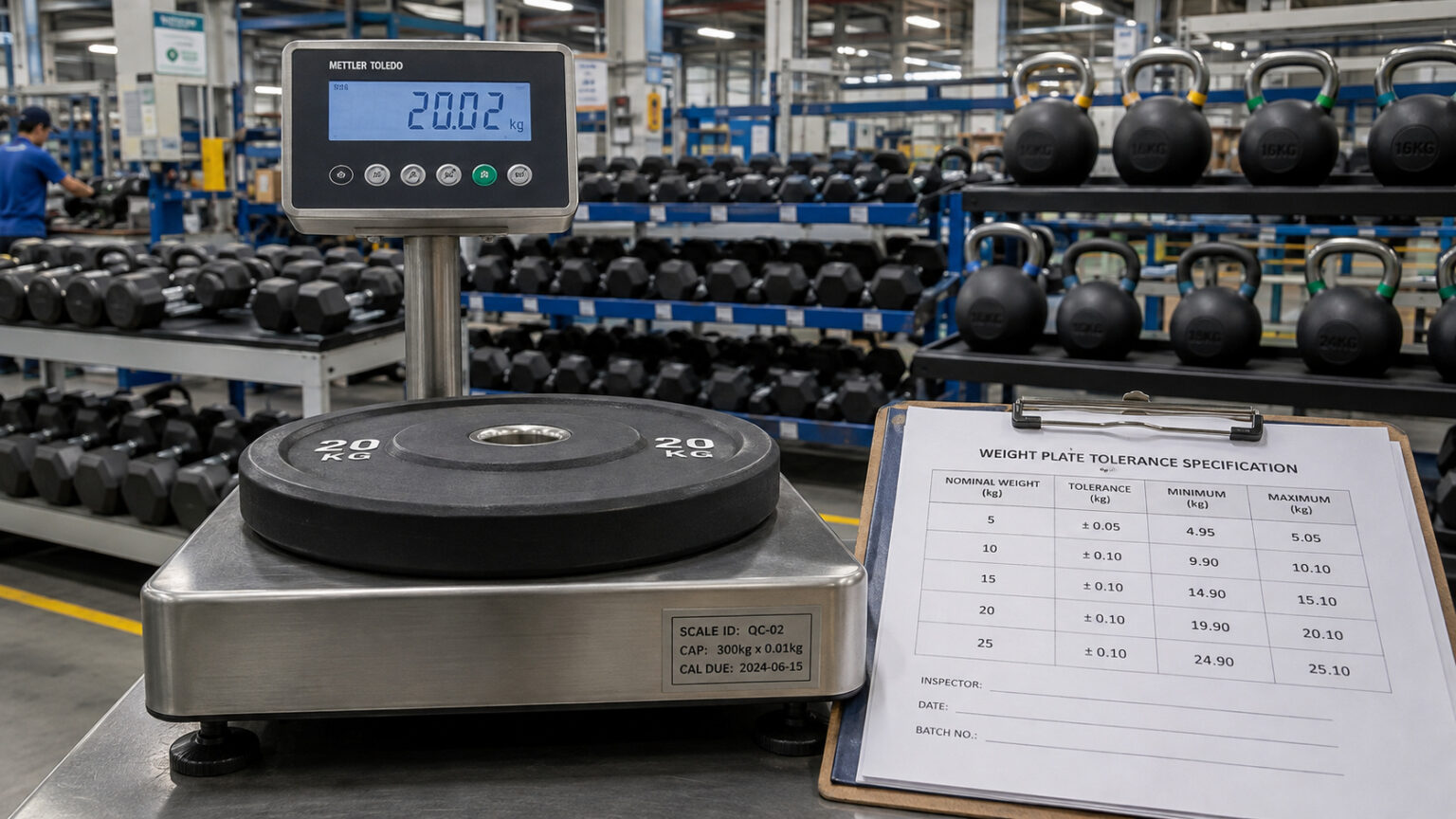
Weight tolerance is the first line of the sheet because it is the specification most tightly coupled to your brand’s credibility: the number is printed on the product, the customer owns a scale, and the gap between the two is a review waiting to be written. Tolerance is also the specification that most exposes whether a buyer understands manufacturing, because the correct request is neither perfection, which is unbuildable, nor silence, which is unenforceable, but a stated band with a stated measurement method, the combination that engineering practice calls a tolerance in the full sense. Cast products vary because casting varies: molten iron shrinks unevenly, molds wear, and coating thickness adds its own grams, so the honest question is never whether dumbbells vary but how much variance your market accepts and how the factory proves compliance. The three subsections below give the working answers: how to set the tolerance number for different product tiers and markets, how to specify the pair-matching and batch-weighing protocols that make the number verifiable, and how construction choices upstream, casting quality, head-to-handle assembly, coating control, determine whether the factory can actually hit the band it quotes. Together they convert the vaguest line on most purchase orders, accurate weight, into the most enforceable one on yours.
Setting the Tolerance Number
The market’s working bands are narrower than buyers fear and wider than marketing implies. For fixed commercial dumbbells, a total tolerance of plus or minus two percent of nominal is a defensible baseline for general fitness product, plus or minus one point five percent is a solid commercial standard worth specifying for branded lines, and plus or minus one percent is achievable premium territory that costs real money in casting control and rejection rates; tighter than that belongs to machined or calibrated products and prices accordingly. The number you choose should follow your customer rather than your pride. General gym members never weigh their dumbbells and feel differences only when pairs mismatch; strength athletes and coaches do weigh them, talk about it publicly, and reward brands whose ten-kilogram dumbbell weighs ten kilograms; rehabilitation and medical channels care most at the light end, where a five percent error on a two-kilogram dumbbell is a clinically meaningful hundred grams. This last point argues for what we recommend to most brands: a stepped tolerance, tighter in absolute grams at light weights where percentages mislead, expressed as whichever is smaller of a percentage or a gram cap, for example plus or minus one point five percent or one hundred fifty grams. Write the band per size in the sheet’s weight table rather than as one sentence, state explicitly whether the tolerance applies before or after coating, it must be after, because the customer weighs the finished product, and resist the temptation to specify a heroic band you will not pay to verify, because an unverified tolerance is marketing wearing engineering’s clothes, and the factory knows it.
Pair Matching and Weighing Protocols
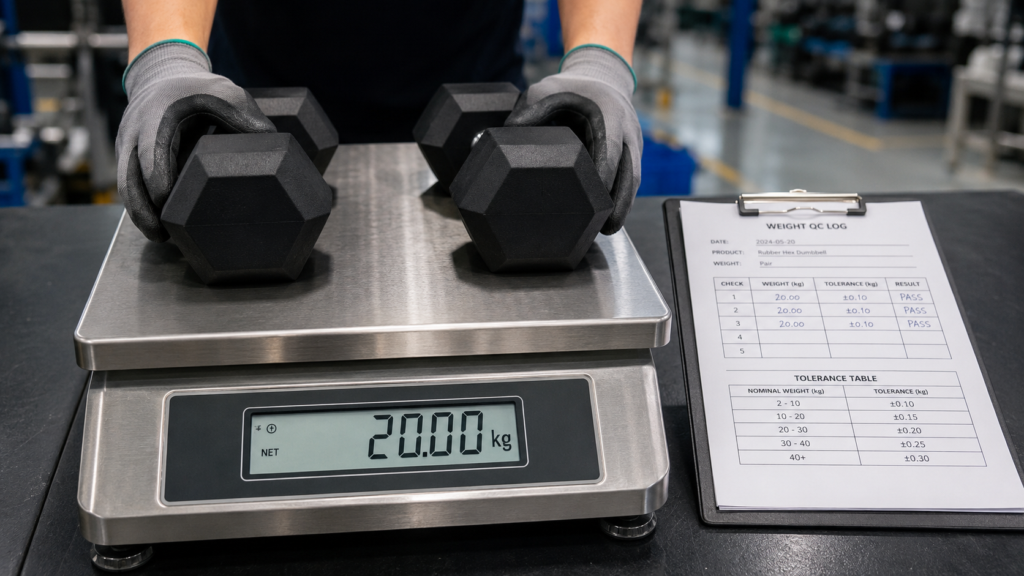
A tolerance without a measurement method is a wish, so the second block of the weight section specifies how compliance is demonstrated, and here the industry’s practical wisdom is that pair matching matters more than absolute accuracy. A member pressing dumbbells feels a hundred-gram difference between hands long before they notice a hundred-gram deviation from nominal, which is why your sheet should carry two bands: the absolute band from the previous subsection, and a pair-match band, typically half the absolute band or tighter, applied to the two units boxed and sold together. Specifying pair matching obligates the factory to pair at packing, weighing units and boxing near-matches together, a cheap process step that eliminates the complaint customers actually make. The weighing protocol itself should name four things: the sampling rate, one hundred percent weighing for premium lines, statistical sampling at a stated level for volume lines; the instrument, a calibrated scale with calibration records available; the record, weights logged by batch and retained for a stated period, with reports delivered on request or with each shipment; and the disposition rule, what happens to out-of-band units, because a tolerance is only as real as the reject pile it creates. Buyers placing early orders with a new factory should also specify third-party or buyer-witnessed weighing for the first shipments, stepping down as history accumulates, a discipline consistent with the sample and production gates we describe in our guide to checking details before approving a sample. None of this paperwork is exotic; a factory running a certified quality system under ISO 9001 already has the record-keeping structure these clauses plug into, and hesitation about weighing records is a screening result in itself.
How Construction Drives Accuracy
The tolerance band you can specify depends on construction decisions upstream of the scale, and a buyer who understands the chain negotiates it intelligently instead of adversarially. Accuracy begins in the casting: dense, well-controlled gray iron castings from maintained molds vary less than porous castings from tired molds, which is why the melt-control and mold-cycle questions from our kettlebell sourcing guide apply to dumbbell heads verbatim, and why the properties of cast iron as a material reward factories that manage it seriously. Assembly adds its increment: in a quality fixed dumbbell the heads are matched, weighed as a set with the handle before final assembly, and corrected with the small adjustments good factories build into their process, while budget assembly bolts whatever heads are nearest onto whatever handle is next, stacking variances that were each individually acceptable into finished units that are not. Coating adds the final grams: rubber and urethane encasements are molded onto the head, and their thickness variation lands directly on the scale, which is why the tolerance must be specified on the finished, coated product and why coating-process control is a weight specification in disguise. The practical use of this chain is diagnostic: when a factory resists a reasonable band, ask which link is the constraint, casting, assembly, or coating, because the answer tells you whether you are negotiating with a process limitation, which respect and price can address, or with indifference, which nothing can. And when a factory hits tight bands effortlessly, you have learned something about every other line on your sheet, because weight accuracy is the most visible output of the same process discipline that produces straight handles and durable coatings.
Handle Geometry: Specifying the User Interface
The handle is where your customer meets the product, several times a week, for years, and it is the section of the sheet where small numbers produce the largest experiential differences. Handle specification divides into three families of decisions: the diameter and its progression across the weight run, which governs grip fatigue and training feel; the knurling, which governs security, comfort, and the product’s tactile signature; and the geometric details, length, taper, and the handle-to-head junction, that separate a handle that disappears in the hand from one the user renegotiates every set. These are also the specifications where market conventions diverge most, between fitness and pro-style products, between markets that train with chalk and markets that forbid it, between brands positioning on comfort and brands positioning on performance, which means the factory’s default is least likely to match your customer here, and the unspecified handle is the most commonly regretted omission we see on incoming purchase orders. The three subsections below give the numbers, the vocabulary, and the specification method for each family, and the same principle governs all three: every value should be written per size where it varies, toleranced where it is critical, and anchored to a golden sample where words run out, because handles are felt rather than read, and the sample is the only specification a fingertip can audit.
Diameter and the Per-Size Schedule
Handle diameter is the single number your customer’s hand knows best, and the specification is a schedule rather than a value: commercial fixed dumbbells conventionally scale diameter with weight, running from roughly 28 to 30 millimeters at the light end, through 32 to 34 millimeters in the middle weights, to 35 millimeters and occasionally beyond at the heavy end, so the handle fills the hand proportionally as loads and hand forces grow. Your sheet should state the diameter per size with a tolerance of about plus or minus half a millimeter, because half a millimeter is genuinely perceptible to a repeat user and because a stated tolerance obligates the factory’s machining and coating processes to hold it. Three refinements earn their lines. First, decide the progression deliberately rather than inheriting it: a rehabilitation-oriented line may hold slimmer diameters higher up the run for smaller and older hands, while a performance line may step up earlier for strength athletes, and either choice is correct only by reference to your customer. Second, state where the diameter is measured, on the bare steel or over any coating, and whether the handle is cylindrical or subtly contoured, because an ergonomic taper changes the effective grip diameter along the hand. Third, coordinate the schedule with your other products: if your brand also sells barbells and kettlebells, handle feel across the catalog is a brand signature worth aligning, an argument developed in our hex dumbbell buying guide and applicable to every graded product we build. The schedule takes ten minutes to write and saves years of the subtle wrongness that unspecified handles produce, one production run at a time.
Knurling: Pattern, Depth, and Feel
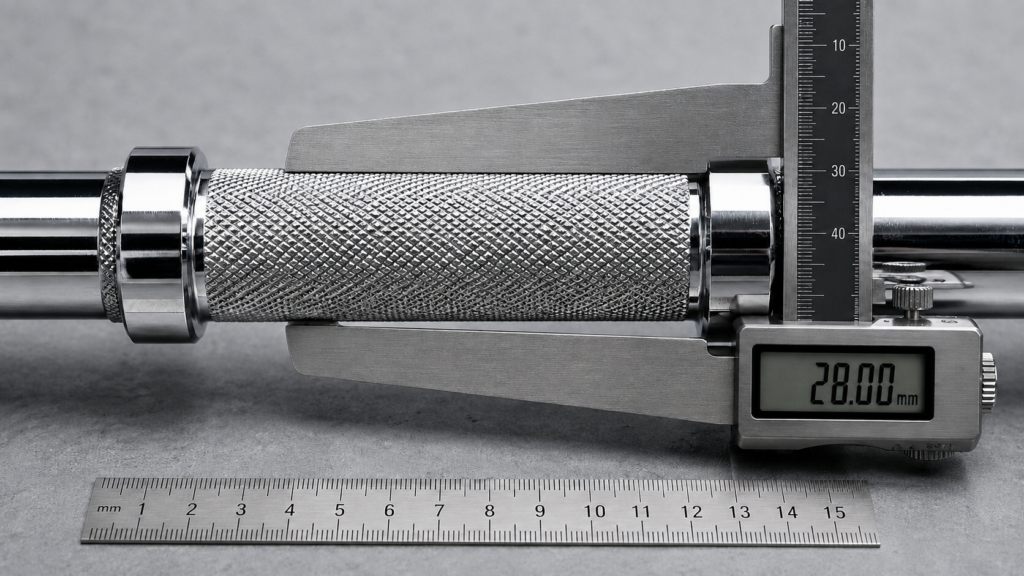
Knurling is the crosshatched texture machined or rolled into the handle, the process summarized in the reference on knurling, and it is the specification buyers find hardest to write because its language is tactile: aggressive, medium, passive are the industry’s working adjectives, and adjectives do not machine. The sheet makes knurl enforceable through four lines and a sample. Specify the pattern, diamond crosshatch being the commercial standard, with the pitch, the spacing of the diamonds, stated in millimeters or teeth per inch; specify the depth class, because depth is what separates a grippy handle from a bloody one, and high-repetition commercial use argues for medium depth with the diamond points slightly flattened, sharp points being appropriate only for chalk-using performance niches; specify the coverage, full-handle knurl versus a plain center band, and whether the knurl runs to the head junction or stops short; and specify the finish over the knurl, since chrome plating slightly softens knurl edges while bare or thin-coated steel preserves them, an interaction that changes feel more than either choice alone. Then anchor everything to a golden sample, signed by both sides, referenced in the purchase order, and kept as the arbiter, because knurl feel drifts as cutting tools wear, and the sample is what makes drift a defect rather than a discussion. One risk disclosure belongs here: knurl is irreversible in a way most specifications are not, since a handle knurled too aggressively cannot be softened after casting into product, so err toward the comfortable side for general commercial lines and let your performance sub-line carry the sharp option deliberately.
Length, Taper, and the Junction
The remaining geometry lines are less famous than diameter and knurl and cause their share of returns anyway. Handle length, the clear grip space between heads, must accommodate the market’s hands and training styles: too short and large-handed users feel pinched against the heads, too long and the dumbbell wanders in one-hand movements; commercial fixed dumbbells conventionally run grip lengths around 120 to 140 millimeters, and the sheet should state the value per size with the measurement method, because heads with different inner profiles make length ambiguous unless defined. The handle-to-head junction deserves its own line twice over: geometrically, specify the fillet or relief where handle meets head, because an abrupt junction concentrates both stress and knuckle contact, while a generous fillet spreads both; structurally, specify the assembly method, and here the sheet should simply adopt the standard this series has argued for across products, heads joined to handles by robust press-fit with welding or equivalent permanent engagement, never adhesive alone, with the drop-test evidence named, the same failure-mode logic detailed for hex products in our hexagon dumbbell design article. Straightness and concentricity close the geometry section: a bent or off-center handle announces itself in the user’s wrist before their eye, so specify a straightness tolerance and a simple spin test at final inspection. None of these lines is difficult; all of them are invisible in a photograph, which returns to this article’s founding point, and together they occupy perhaps six rows of the template this guide assembles, six rows that decide whether the product feels engineered or merely assembled.
Coating Options: Heads, Handles, and the Finish System
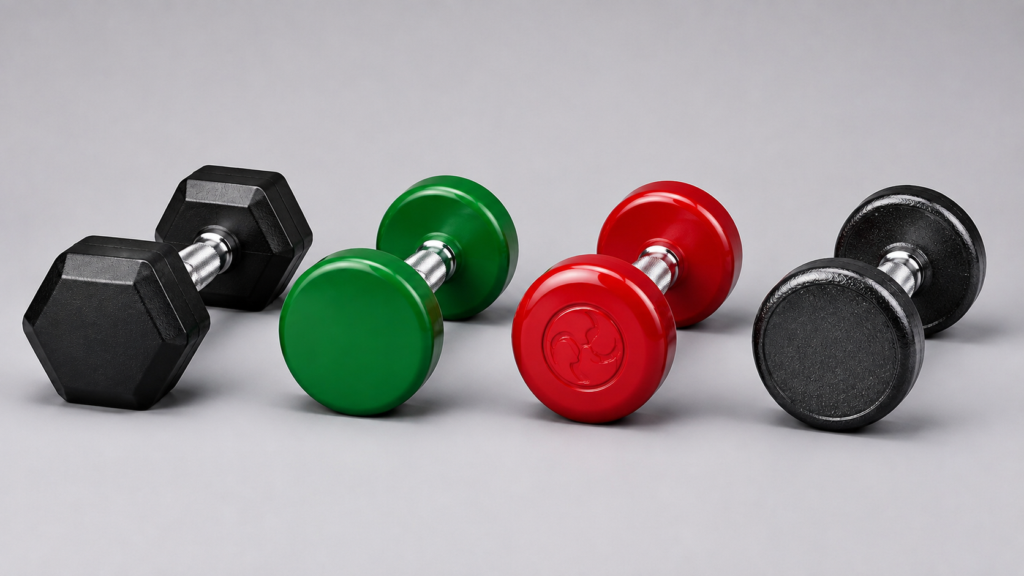
Coating is where the dumbbell spec sheet does most of its visible work, because surface treatment carries the product’s durability, its floor manners, its color and branding, and most of what a customer can photograph in a review. The specification divides naturally into the head system and the handle finish. Heads on commercial fixed dumbbells arrive in four mainstream systems: rubber encasement, the industry workhorse, whose quality turns on compound and virgin content exactly as described in our bumper plate and kettlebell guides; polyurethane, the premium encasement whose abrasion resistance, colorfastness, and low odor are documented in the material overview of polyurethane; CPU and similar cast-urethane systems, which push hardness and print quality further for boutique positioning; and painted or bare cast iron, the budget classic whose place is honest, garage and low-traffic settings, and whose commercial limitations are equally honest. Handles are almost universally hard chrome over steel, with the plating-quality checks, uniformity, salt-spray evidence, junction coverage, that our earlier guides detail. The comparison table below summarizes the head systems on the axes that matter commercially, and the second subsection converts the choice into specification lines, because naming a system is a quarter of the work: the sheet must also pin the preparation, thickness, texture, and color that make two rubber dumbbells from two factories different products wearing the same word.
| Head System | Durability | Odor and Cosmetics | Relative Cost | Best Fit |
| Rubber encasement | Good to very good with quality compound | Some odor if recycled-heavy; limited colors | $$ | Commercial floors and value-led branded lines |
| Polyurethane (PU) | Excellent abrasion and chip resistance | Minimal odor; vivid, colorfast, print-friendly | $$$ | Premium commercial and boutique brands |
| CPU / cast urethane | Excellent; hardest wearing surface | Odor-free; sharpest branding reproduction | $$$$ | Flagship lines and design-led facilities |
| Painted / bare cast iron | Fair; chips and rusts without care | No odor; classic look, limited palette | $ | Budget, garage, and low-traffic settings |
Handle Finish: Specifying the Chrome
The handle finish deserves its own subsection because it is the surface the customer touches rather than the one they photograph, and because the industry’s near-universal answer, hard chrome plating over machined steel, hides a wide quality range behind one shared name. The specification lines are familiar from this series’ barbell and kettlebell coverage and transfer to dumbbell handles almost unchanged. First, name the plating system and its build: hard chrome, with a minimum plating thickness stated in microns, because thin, decorative-grade chrome on a gym-floor handle wears through at the knurl peaks within a year while a proper hard-chrome build survives a decade of daily contact. Second, require corrosion evidence: a salt-spray test result to a stated hour rating, or at minimum the factory’s standard test certificate, because handles live in the most corrosive microclimate in the gym, sweat, chalk, and skin oils applied daily and wiped irregularly, and rust that starts in the knurl valleys is both invisible early and irreversible late. Third, specify coverage at the junctions: plating must run cleanly to the head interface with no bare witness lines where masking sat during processing, since exposed steel at the junction is where corrosion begins its quiet work. Fourth, state the visual standard, gloss level and permissible defect counts per handle, anchored to the golden sample like every tactile line before it. Alternatives exist and belong in the sheet when they are deliberate choices rather than factory substitutions: matte or satin chrome variants that hide wear on high-traffic floors, and premium stainless options at the pro-style end where buyers pay for bare-metal feel. What the sheet should never permit is the unnamed default, because plating is precisely the specification where two quotations that read identically can describe products with five-year differences in service life.
Writing the Coating Lines
Whichever system the table points you toward, the specification is five lines, and factories can game any of them that you leave blank. Line one names the material honestly: for rubber, the compound family and minimum virgin content in writing, because recycled-heavy compounds are where odor complaints and early cracking originate; for urethanes, the system and hardness, using the Shore scales summarized under the Shore durometer, because urethane is a family of materials, not a single promise. Line two specifies preparation, the shot-blasting and priming of the cast head before encasement or paint, because adhesion failures blamed on coatings are usually preparation failures underneath, a lesson this series repeats because factories repeat the shortcut. Line three specifies thickness and coverage, minimum encasement thickness at the head face and edges, where thin spots chip first, and full coverage of any exposed iron. Line four specifies texture and gloss, matte to satin being the commercial preference for heads as for handles, stated as a gloss level and anchored to the golden sample. Line five specifies color and branding together, color by code rather than by name, and the branding method, molded-in relief, pad print, or laser, with molded-in branding preferred for longevity on encased heads, print reserved for surfaces that will not take mold work, and the interaction between coating choice and branding durability decided now rather than discovered at the first faded logo. Five lines, one sample, and the coating section is closed, which is five lines more than most purchase orders carry and the difference between a surface that survives its warranty and a surface that becomes it.
The Rest of the Sheet: Assembly, Packaging, and QC
The remaining clauses are shorter and no less binding, and experienced buyers write them with the same numeric discipline as the headline sections. Assembly repeats its one non-negotiable from the geometry section, permanent head-to-handle engagement with drop-test evidence, and adds the torque and thread-locking specification for any bolted designs the line includes, with the bolt heads’ finish and recess named so wrenches fit and rust does not start there. Markings get a line: nominal weight displayed on both heads, in units matching the destination market, with digit size and contrast specified for across-the-gym legibility, and any regulatory or origin markings the destination requires. Packaging earns three lines that pay for themselves in claims avoided: interior protection specified by drop-survival rather than by materials, so the factory owns the outcome; pair packing per the weighing section, with the pair-match band restated; and export details, carton weights within handling limits, palletization, and desiccant or rust protection for ocean freight, the humidity lessons of this series applying to chromed handles verbatim. Quality control closes the document by naming the gates: incoming sample approval against this sheet and the golden samples, in-production checks at stated frequencies for weight, diameter, and coating thickness, a final inspection standard defined by photographs of acceptable and rejectable units, and the record set, weighing logs, inspection reports, delivered with each shipment. Finally, the sheet itself gets versioned, dated, numbered, referenced in every quotation and purchase order, because six months into a program the operative question is never what was agreed but which version agreed it, a habit this series has recommended for every product and repeats here because it costs nothing and settles everything.
Two practical refinements make the QC clauses work at real-world scale rather than merely reading well. The first is to state inspection levels in the industry’s own language: sampling plans referenced to a named standard and an acceptance quality limit appropriate to the defect class, tighter for the critical defects, loose heads, out-of-band weights, missing markings, than for minor cosmetic ones, because a single undifferentiated pass rate invites the factory to trade a loose head against ten clean logos and call the lot conforming. Pair that with an explicit defect classification list, ten lines that sort the plausible failures into critical, major, and minor with examples, and the final inspection stops being a negotiation conducted over a pallet. The second refinement is to decide, in the sheet, who inspects and who pays when inspection fails: early orders justify third-party inspection at the buyer’s cost, with the sheet stating that a failed inspection converts re-inspection costs to the factory’s account, a clause that costs nothing when production is good and concentrates the factory’s attention wonderfully when it is not. Buyers should also state the claim window and evidence standard for defects discovered after delivery, photographs, batch numbers, and weighing records against the retained logs, because a claims process defined before the first container is a commercial disagreement with a procedure, while one defined after is an argument with a relationship attached. None of these clauses is adversarial; they are the grammar of a professional order, and factories that welcome them are telling you something as valuable as any sample.
The Complete Dumbbell Spec Sheet Template
The table below assembles the guide into the template itself, the ten blocks a complete dumbbell spec sheet carries, what each block states, and why it exists, and three operating notes make it work in practice. First, fill it in before sending it out, even where you must guess: a sheet carrying your target numbers invites correction and counter-proposal from competent factories, while a blank sheet invites defaults, and the difference in the returned quotations is the difference between comparing offers against your standard and comparing factories’ habits against each other; where you genuinely cannot set a value, mark it open and ask each candidate to propose with reasoning, because the reasoning is free diligence. Second, use the sheet as the screening instrument it secretly is: send it to candidate suppliers and watch which cells they push back on, because pushback on tolerances and QC clauses from one factory and easy acceptance from another is more informative than any price difference, and the vetting sequence in our guide to assessing an OEM manufacturer’s reliability pairs with this template as the relationship half of the same discipline. Third, keep the sheet alive after the first order: reorders reference the same version, changes go through a revision with both signatures, and the golden samples stay under both parties’ control, because the sheet’s deepest value is not the first shipment it disciplines but the fifth, the one produced two years later, by different line workers, for a customer who expects it to match the first. A dumbbell spec sheet operated this way stops being paperwork and becomes what this guide promised at the outset, the instrument that converts a photograph with quantities into a product with a standard.
| Spec Block | What to State | Why It Exists |
| Product definition | Type, sizes, quantities per size, destination market | Scopes everything below; units and markings follow the market |
| Weight tolerance | Band per size, after coating; stepped gram caps at light weights | Printed accuracy is brand credibility on a scale |
| Pair matching | Pair band (≤ half the absolute band); pairing at packing | Users feel mismatch between hands before deviation from nominal |
| Weighing protocol | Sampling rate, calibrated scale, records, disposition of rejects | A tolerance without a method is a wish |
| Handle diameter | Per-size schedule, ±0.5 mm, measurement point stated | The number the customer’s hand knows best |
| Knurling | Pattern, pitch, depth class, coverage, finish; golden sample | Adjectives do not machine; samples arbitrate feel |
| Geometry details | Grip length, junction fillet, straightness, spin test | Invisible in photos, felt in every set |
| Head system and coating | Material, virgin content or hardness, prep, thickness, gloss, color code | The five lines factories game when blank |
| Assembly and branding | Permanent engagement, drop-test evidence; branding method and placement | The failure mode that ends brands; the logo that outlives the coating |
| Packaging and QC | Drop-survival packing, pair boxing, rust protection; inspection gates and records | The spec only exists if it is checked and survives transit |
The template flexes by product family, and stating the variations explicitly prevents the most common template mistake, which is sending a fixed-dumbbell sheet to quote an adjustable system and wondering why the quotations scatter. For rubber and urethane hex products, the geometry block adds the hex head’s across-flats dimension and the anti-roll flatness that is the product’s reason for existing, and the coating block carries the head encasement lines at full weight. For round pro-style dumbbells, the assembly block grows: specify whether the design is welded fixed or bolted with serviceable ends, the torque and thread-locker standard if bolted, and the sleeve or handle rotation behavior, because pro-style buyers have strong and divergent expectations about whether a handle should spin. For cast iron hex without encasement, the coating block shifts entirely to paint system, surface preparation, film thickness, and rust protection in transit, the humidity clauses working hardest here. For adjustable systems, this template is the starting point and honestly not the finish: mechanism specification, locking security under drop, plate-interface tolerances, and cycle-life testing deserve a dedicated document, and a buyer sourcing adjustables should say so in the request for quotation rather than stretching a fixed-dumbbell sheet over a mechanism it cannot describe. In every case the ten blocks above remain the spine, and the family-specific lines hang from them, which is the practical advantage of writing the template once and versioning it per product rather than reinventing the document with every request for quotation your program sends.
From Sheet to Shipment: Using the Document
A finished sheet earns its keep in three episodes. The first is the request for quotation: send the identical sheet to every candidate factory with quantities and the destination market, and require quotations against it line by line, because this is the moment the document forces prices to mean the same thing everywhere, and the moment supplier quality becomes visible in the texture of the responses, the competent factory quoting with occasional reasoned exceptions, the trading company quoting instantly and unconditionally, a difference our guide to the common mistakes when sourcing from OEM factories teaches buyers to read. The second episode is sampling: samples are ordered across the size run, light, middle, heavy, inspected against the sheet with a calibrated scale, calipers, and hands, and the approved units become the golden samples that anchor every tactile and visual line the sheet cannot fully verbalize; sample approval is also the last cheap moment to change your mind, because after tooling and production, the sheet hardens from a proposal into a contract. The third episode is production and beyond: the purchase order references the sheet’s version, the QC gates run as written, the records arrive with the shipment, and the sheet governs reorders until both parties revise it, which is how a one-time specification becomes a multi-year product identity. Buyers who want the process compressed can start from the manufacturer’s side of the table: our own OEM and ODM services exist to co-author exactly this document with brands, bringing the factory’s process knowledge to the buyer’s market knowledge, and our dumbbell lines are the visible output of sheets built this way. However the document is authored, the discipline is identical, and it is the cheapest quality instrument in this industry: a dumbbell spec sheet costs an afternoon, and it is the only purchase document whose value compounds with every container that follows.
The sheet’s least celebrated episode is the one where something goes wrong, and it is worth rehearsing because the document changes the script entirely. Without a specification, a shipment of mismatched pairs produces the industry’s oldest argument, the buyer’s disappointment against the factory’s this-is-normal, with no referee and the relationship as the stakes. With the sheet, the same shipment produces a procedure: the weighing records are pulled against the stated protocol, the units are checked against the stated bands, the defect classification sorts the findings, and the conversation moves in one meeting from whether there is a problem to what the corrective action is, replacement, rework, credit, or process change, per the clauses both parties signed. The same mechanics run in the friendlier direction when the program matures and costs need engineering: a buyer who wants a sharper price negotiates it against the sheet, loosening the lines that customers demonstrably do not feel, perhaps the pair band at the heaviest sizes, never the ones they do, rather than accepting an opaque discount that the factory funds by quietly widening whatever the document left soft. And when a program changes factories, the sheet is the entire transfer package: the new supplier quotes the identical document, samples are approved against the same golden standards, and the customer never learns the manufacturing changed, which is the quiet definition of a specification doing its job. A photograph with quantities can do none of this, and that asymmetry, invisible on order day, is the whole argument of this guide compounded over the life of a product line.
Frequently Asked Questions
What is an acceptable weight tolerance for dumbbells?
Plus or minus 1.5 to 2 percent of nominal weight, measured after coating, is the commercial standard for fixed dumbbells, with premium lines holding 1 percent. At light weights, specify a gram cap instead, for example 150 grams, because percentages mislead below 5 kilograms. Pair matching matters more than absolute accuracy: specify that the two units sold together match within half the absolute band, since users feel mismatch between hands before deviation from the printed number.
What diameter should a dumbbell handle be?
Commercial fixed dumbbells scale handle diameter with weight: roughly 28 to 30 millimeters at light weights, 32 to 34 millimeters through the middle of the run, and about 35 millimeters at the heavy end, each with a tolerance near half a millimeter. The progression should match your customers, slimmer for rehabilitation and smaller hands, earlier step-ups for strength athletes, and the spec sheet should state the diameter per size and where it is measured, over coating or on bare steel.
What is the best coating for dumbbells?
It depends on tier and setting. Quality rubber encasement is the commercial workhorse, durable and cost-efficient but odor-prone if recycled content is high. Polyurethane costs more and resists abrasion, fading, and odor, suiting premium and boutique lines. CPU urethane leads durability and branding sharpness at flagship prices. Painted cast iron remains the budget classic for low-traffic settings. Whichever you choose, specify preparation, thickness, gloss, and color code, not just the material name.
Why do dumbbells from the same set weigh differently?
Because casting, assembly, and coating each add variance. Molten iron shrinks unevenly and molds wear, so heads vary; budget assembly pairs unmatched heads onto handles, stacking tolerances; and rubber or urethane encasement thickness adds grams of its own. Quality factories control each step and weigh finished pairs together at packing. A spec sheet that states a tolerance band, a pair-match band, and a weighing protocol converts this variance from a surprise into a controlled, verified number.
What should a dumbbell spec sheet include?
Ten blocks: product definition and sizes; weight tolerance per size after coating; pair-matching band; weighing protocol with records; handle diameter schedule; knurling pattern, depth, and coverage anchored to a golden sample; geometry details including grip length and junction; head system and coating with preparation, thickness, and color codes; assembly method with drop-test evidence plus branding; and packaging plus QC gates. State each as a number or named standard, version the document, and lock golden samples before production.
Key Takeaways: The Cheapest Quality Instrument You Will Ever Write
Everything this guide covers fits on two pages, and that is the point: the distance between the dumbbells that disappoint and the dumbbells that reorder themselves for a decade is not a secret process or a premium price, it is a document most buyers never write. Weight tolerance, stated per size, after coating, with a pair-match band and a weighing protocol, turns the number printed on the product into a promise the factory can be held to. Handle geometry, a diameter schedule, a knurl specification anchored to a golden sample, and the quiet lines for length, junction, and straightness, turns the product’s entire user interface from a factory default into a brand decision. Coating specification, material named honestly, preparation and thickness pinned, color coded, branding method chosen for longevity, turns the surface your customers photograph into the surface you chose. And the closing blocks, assembly evidence, packaging by outcome, QC gates with records, versioning, turn one good shipment into a repeatable identity. The sheet also does its quietest work before any factory sees it, because writing it forces the decisions, about your customer, your tier, your market, that photographs with quantities let buyers defer until the container arrives. Write the dumbbell spec sheet once, carefully, with the template above; send it to factories worth testing; approve samples against it; and let it govern every reorder after. It is an afternoon of work, it is enforceable everywhere words and numbers are, and it is the difference between buying pictures of dumbbells and specifying the product your brand actually promised, which is where this guide began and where every good sourcing story ends: bring us the sheet, filled in or full of open cells, and the conversation that follows will be the most productive one your dumbbell program has had.