Why Everyone Is Suddenly Asking About the Machine with Springs
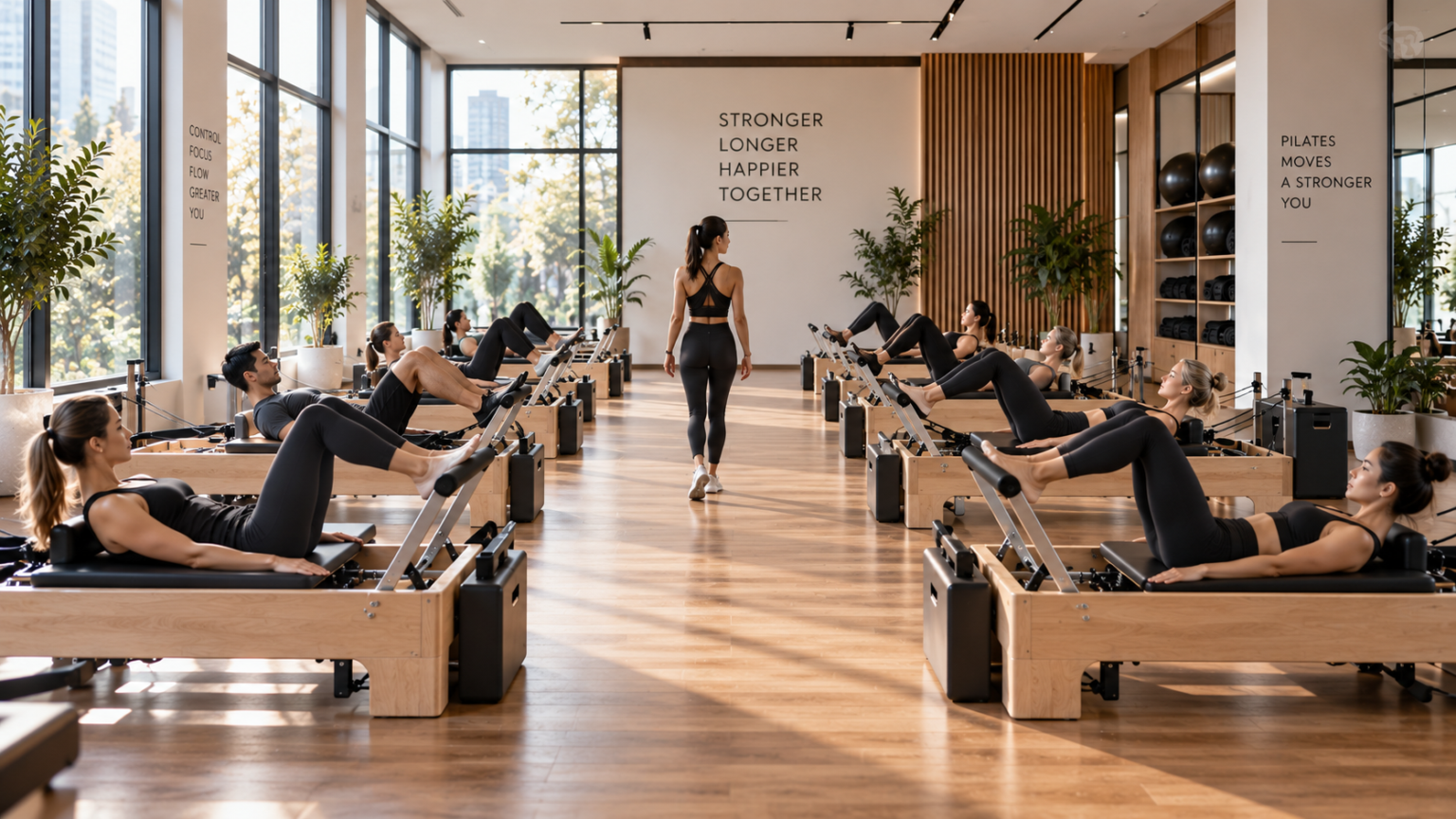
Walk past any boutique studio district in a major city and you will see it through the glass: rows of low, bed-like machines with sliding platforms, springs, ropes, and people moving through slow, controlled exercises that look somewhere between strength training and choreography. The machine is the reformer, the fastest-growing piece of equipment in the fitness industry, and the question this article answers, what is reformer pilates, actually, and is it right for me, has become one of the most searched fitness questions in the world. The answer deserves more than a studio’s marketing page, and it deserves an unusual point of view: ours. We are not a studio chain or an instructor certification body; we are an equipment manufacturer, Alexandave Industries, building fitness equipment in Taiwan since 1980, and our Axispila line supplies commercial-grade Pilates apparatus to studios, franchise chains, rehabilitation centers, and physical therapy clinics. That vantage point means we spend our days inside the machine itself, its springs, its frame, its geometry, and across the full spectrum of buyers who use it, from boutique studios to hospitals, which is precisely the knowledge a beginner needs to understand what this training method really is and is not. This guide covers the method and the machine, how the equipment actually works, what benefits the evidence supports, the honest pros and cons, a structured comparison against weight training and yoga, who the method suits and who should be careful, and what separates serious equipment from furniture with springs, because that last question, invisible to most beginners, quietly shapes every session they will ever take.
Two commitments frame everything below, consistent with how we publish. The first is disclosure: we manufacture the apparatus this article explains, from reformers to the Cadillac, chairs, and barrels, so we benefit when the method grows, and you should read our enthusiasm with that in mind; the correction we apply is to argue every claim from mechanics you can observe or sources you can check, none of them our own marketing. The second is honesty about evidence: exercise research is a field of modest effect sizes and imperfect studies, and equipment-based Pilates is no exception, so this article distinguishes plainly between what published health authorities support, what practitioners consistently report, and what remains believed-but-unproven, with the distinctions marked in the text rather than buried. A note on words before we start: the method’s founder, Joseph Pilates, developed his system, which he called Contrology, in the early twentieth century, famously beginning with spring-resisted exercises rigged to hospital beds while working with injured and immobilized patients, and the apparatus that grew from that idea now includes the reformer, the trapeze table or Cadillac, the stability chair, the ladder barrel, and the spine corrector. Reformer classes are the format most beginners meet first, which is why the reformer carries the popular name for the whole category, but the method is bigger than one machine, and this guide treats the full family.
Reformer Pilates, Defined: The Method and the Machine
Strip away the studio aesthetics and the definition is simple: it is the Pilates method, a system of low-impact, precision-focused exercises built around core control, spinal articulation, alignment, and breath, performed on a spring-resisted machine instead of a mat. That one change, springs instead of body weight alone, transforms the training in three ways. First, resistance becomes adjustable in both directions: springs can load a movement more heavily than body weight would, building genuine strength, or support a movement that would be too demanding on the mat, which is why the same machine serves a first-timer and an advanced athlete in consecutive hours. Second, the moving carriage turns stability itself into the exercise: because the platform slides under you as you push, pull, or hold, the deep stabilizing musculature of the trunk and hips must work continuously to control the movement, the training emphasis that health institutions describe when they recommend core conditioning, as the Mayo Clinic’s guidance on core exercises outlines for balance, posture, and everyday function. Third, the equipment enforces form in a way open space cannot: the carriage’s track, the straps’ length, and the springs’ resistance create guardrails that make correct movement easier to find and sloppy movement immediately perceptible, which is much of why the method has such a strong reputation in rehabilitation settings. Understood this way, the machine is not a gadget attached to an exercise trend; it is the delivery mechanism for a hundred-year-old training logic, and the rest of this article examines what that logic does for a body, and what it does not.
How the Machine Actually Works
Springs: Resistance That Behaves Differently from Weights
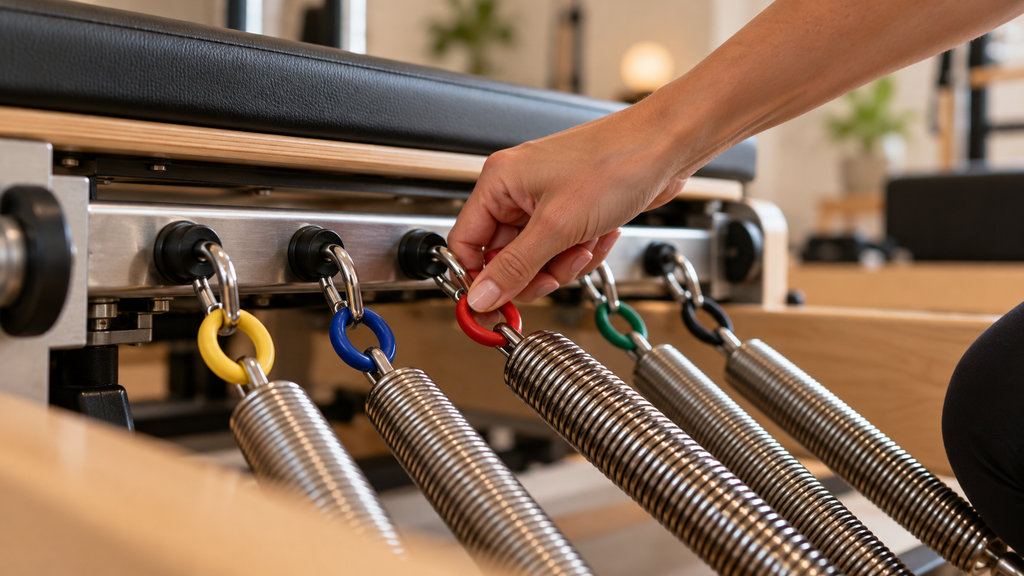
The reformer’s engine is its spring bank, typically four or five springs of different tensions that clip to the carriage and can be combined like weights on a bar, and the physics of springs is worth thirty seconds because it explains much of how sessions feel. A hanging weight resists with constant force through a whole movement; a spring resists progressively, light at the start of the stretch and heavier as it lengthens, which produces a smooth, jerk-free loading curve that is gentle on joints at the vulnerable start of a movement and demanding at the strong end. Springs also never rely on momentum: put slack in the movement and the resistance simply disappears, so the only way to keep tension is to move with control in both directions, loading the return phase of every exercise as deliberately as the push. This behavior is why spring training feels harder than its numbers suggest and why it teaches tempo discipline faster than free weights do. It is also why spring quality and safety are the least negotiable part of the machine: springs are consumable, safety-critical components that live under tension for thousands of cycles, their fatigue behavior and attachment security are engineering subjects in their own right, and the testing regime behind them, tension consistency, cycle life, detachment resistance, is one we have written about separately in our work on spring tension testing and detachment risk. A beginner does not need that engineering; a beginner only needs to know that it exists, and that reputable studios buy equipment where someone did it.
The Carriage, Straps, and Frame: A Moving Platform for the Whole Body
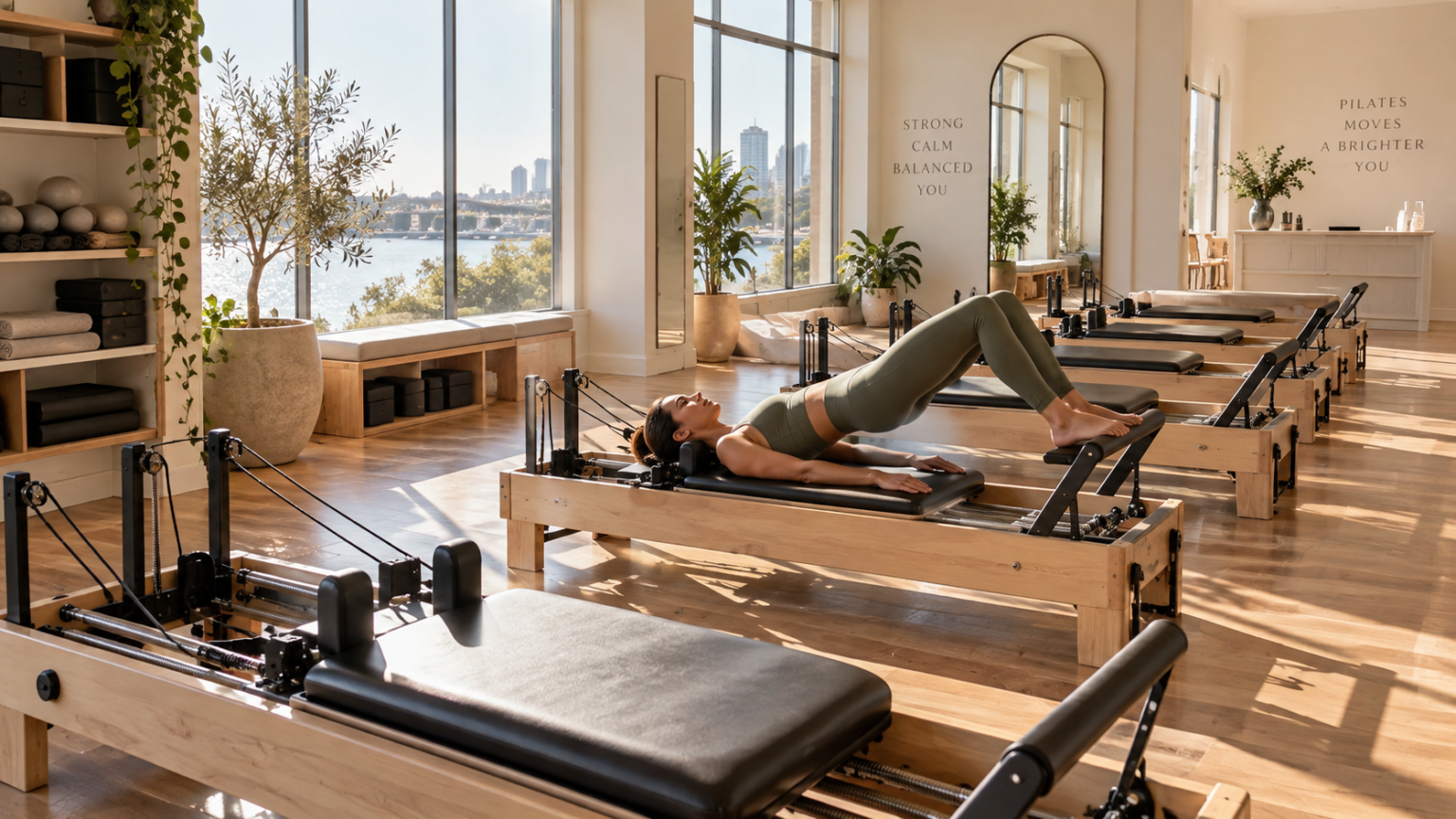
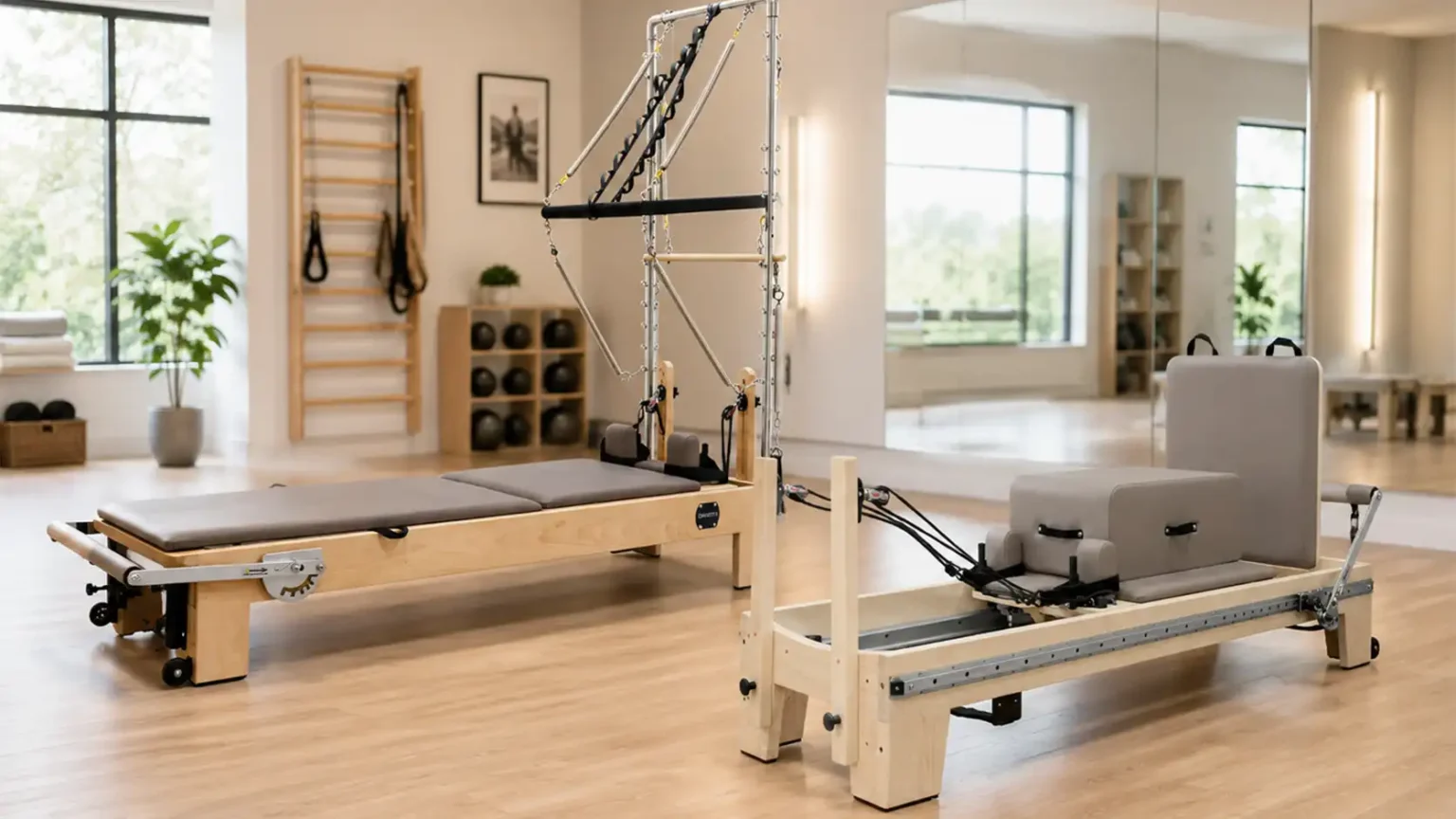
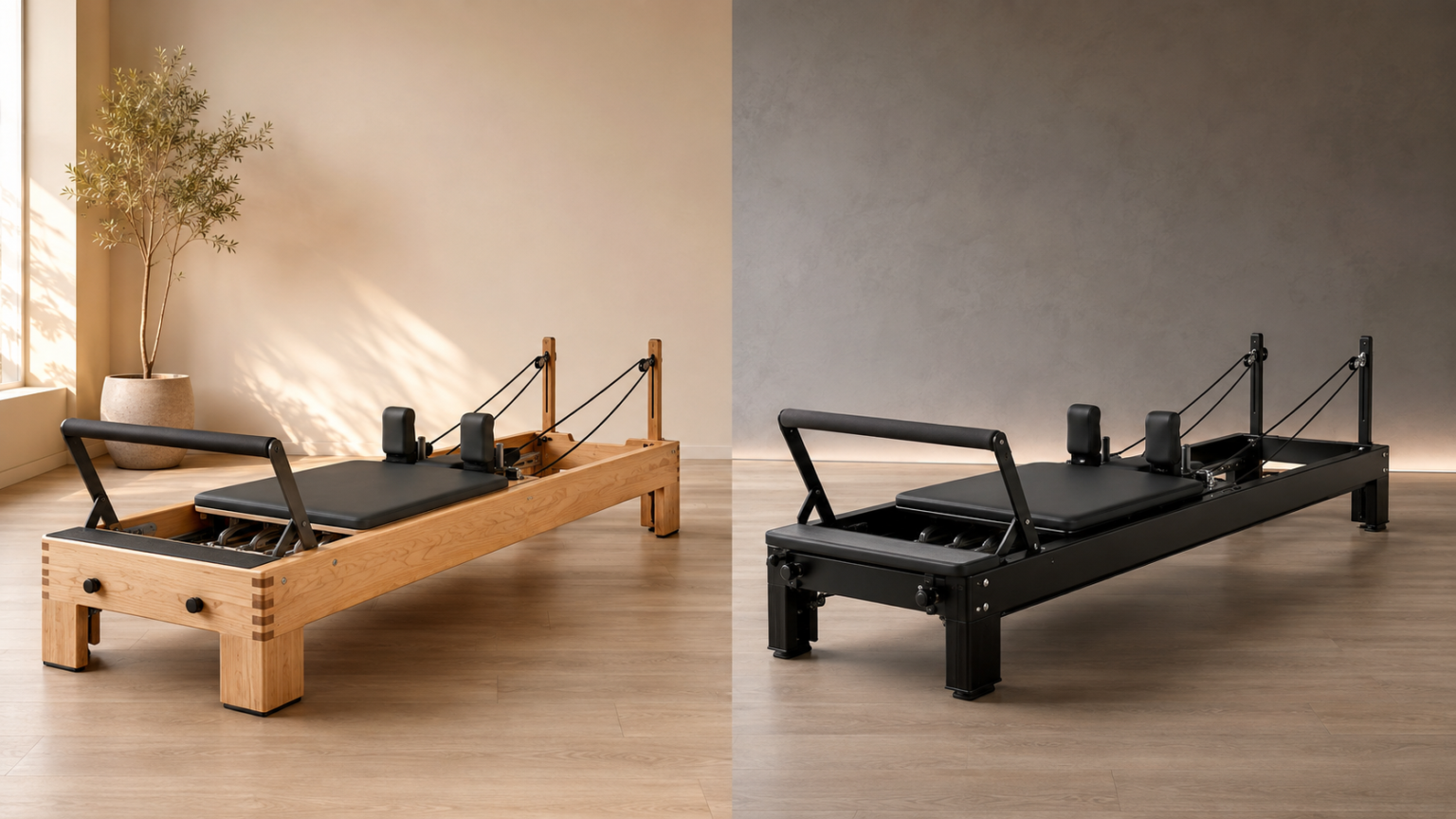
Around the springs sits the architecture. The carriage is the padded platform that glides along the frame’s rails on wheels, carrying the body through sliding lunges, presses, and pulls; the footbar at one end gives the legs and feet a pushing surface, adjustable through positions that change leverage and angle; and the straps or ropes at the other end let the arms and legs drive the carriage from above, turning the same machine into an upper-body and lower-body trainer without reconfiguration. Because exercises are performed lying, kneeling, sitting, standing, and side-lying, a single session can move through hundreds of positions, and instructors grade difficulty by changing spring load, lever length, and base of support rather than by adding impact, which is the mechanical reason the method stays joint-friendly at every level. Frame construction decides how all of this feels: rail straightness and carriage wheel quality determine whether the glide is silent and even or rattly and distracting, frame stiffness determines whether the machine stays planted under an athlete’s leg press, and the choice between timber and aluminum frames, a decision with real consequences for weight, feel, and studio logistics, is one we compare in depth in our guide to maple versus aluminum reformer frames. Our own range spans that spectrum, from the entry commercial Advanced Pilates Reformer to the Deluxe Full Rail Reformer platform, and across every tier the engineering brief is identical: the machine should disappear under the user, leaving only the exercise.
Beyond the Reformer: Towers, the Cadillac, Chairs, and Barrels
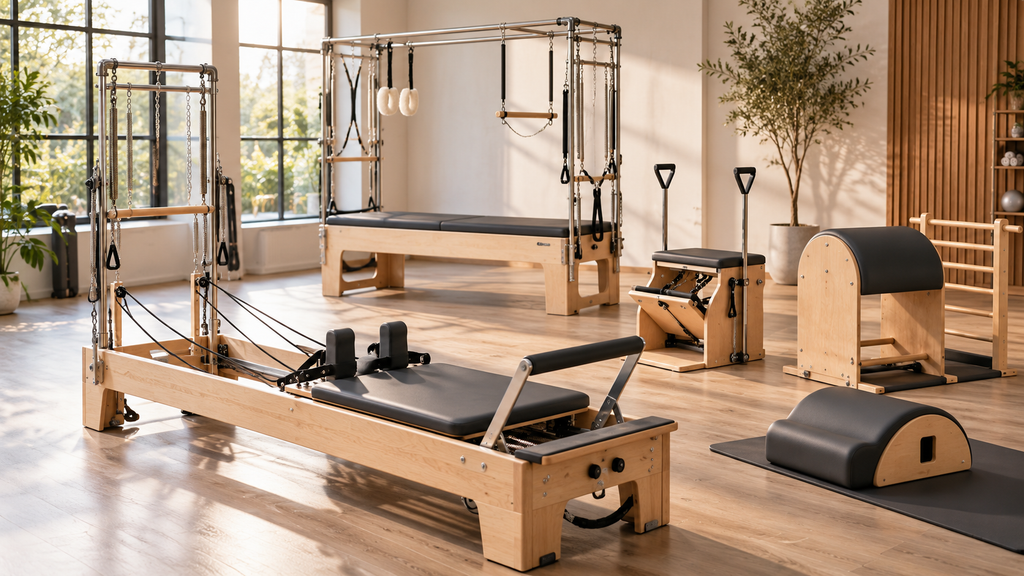
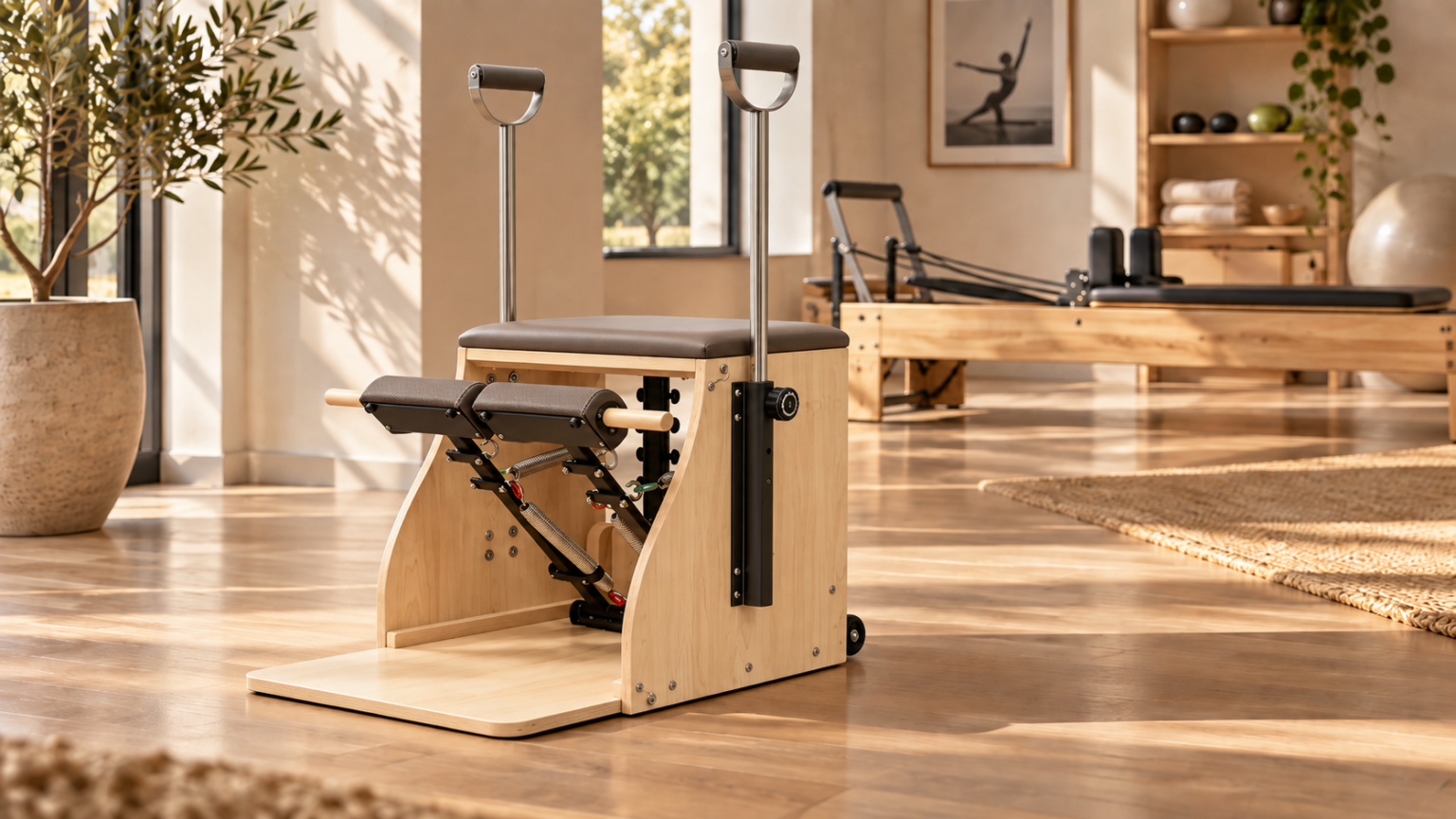
The machine most beginners meet is one member of a family, and knowing the rest explains what a fully equipped studio can actually do. Tower and half-tower additions mount a vertical frame with push-through bars, roll-back bars, and spring hangers to the reformer itself, expanding its exercise repertoire dramatically without a second footprint, a configuration decision we analyze in our comparison of full rail versus half tower reformers and build in models such as the Deluxe Full Rail Reformer with Half Tower and Mat. The Cadillac Trapeze Table is the method’s most versatile single apparatus, a raised table under a full overhead frame, descended directly from Joseph Pilates’s spring-rigged hospital beds, and the preferred platform for one-on-one and clinical work because the practitioner can support, assist, or resist a client from every direction. The Combo Stability Chair compresses spring-resisted pressing into a compact seated-and-standing station that challenges balance more than any other apparatus, and the barrels, including ladder barrels like our Maple Ladder Barrel and the smaller Spine Corrector, provide curved surfaces for spinal extension and mobility work that flat equipment cannot replicate. For a beginner the practical takeaway is simple: a studio equipped across this family, the range our Axispila line exists to supply, can individualize far beyond what a reformer-only room offers, which matters most for the rehabilitation and special-population use cases discussed later in this guide.
The Benefits: What the Evidence Supports
The claims made for equipment-based Pilates range from the well-supported to the wishful, and sorting them honestly is the most useful thing a manufacturer can publish. Start with the strongest ground: it is unambiguously muscle-strengthening physical activity, and the global health case for that category is settled, with the World Health Organization’s physical activity fact sheet recommending that adults perform muscle-strengthening activity involving all major muscle groups on two or more days per week alongside 150 to 300 minutes of moderate aerobic activity, targets a couple of weekly equipment sessions plus walking comfortably help meet. Core strength and postural control are the method’s signature emphasis, and the mainstream clinical view of core training, improved stability, better balance, easier daily movement, and a role in managing low back discomfort, is summarized in the Mayo Clinic’s core exercise guidance cited above; equipment-based Pilates is, mechanically, a systematic core-conditioning program with resistance attached. Flexibility and mobility gains follow from the method’s long, loaded ranges of motion, spring-supported stretching positions that are difficult to reproduce safely with free weights. And the credibility signal beginners should notice most: national health systems treat the method as appropriate exercise for sensitive populations, with the United Kingdom’s National Health Service publishing Pilates and yoga exercise programs that include routines adapted for back pain, arthritis, osteoporosis, and knee problems, which is not an endorsement of any studio or machine, but is strong evidence that the movement system itself is considered safe and useful when appropriately delivered.
Now the honest boundaries, because a benefits list without limits is advertising. The method is not a complete cardiovascular program: sessions raise heart rate modestly, but they do not replace the aerobic minutes in public health guidance, summarized in the NHS’s general exercise guidelines, and honest instructors program walking, cycling, or swimming alongside. It is also not the fastest route to maximal strength or muscle size: springs top out well below what a loaded barbell offers, so a strength athlete will outgrow the machine’s resistance ceiling for their biggest movements, which is why the comparison section below frames the methods as complements rather than rivals. Weight loss claims deserve particular caution: any activity contributes to energy expenditure, but session-for-session the method burns modestly, and body composition change remains overwhelmingly a nutrition-and-total-activity outcome; a studio selling the reformer as a fat-loss machine is selling. Finally, research quality across Pilates studies is mixed, with small samples and varied protocols common, so the responsible summary is this: the method reliably builds core strength, control, flexibility, and movement quality, plausibly helps posture and certain back complaints, meets muscle-strengthening activity guidelines, and is exceptionally adaptable across ages and conditions; it does not replace aerobic training, maximal strength work, or dietary change, and anyone promising otherwise, equipment makers included, has left the evidence behind.
Pros, Cons, and Honest Limitations
Summarized as a decision aid, the method’s advantages cluster around four themes. Accessibility with depth: the same machine scales from post-rehabilitation movement to athlete conditioning by changing springs and positions, so it is one of the few training modalities a person never outgrows in range, even if athletes outgrow its top-end load. Joint-friendliness: low impact, controlled tempo, and progressive spring resistance make it one of the gentlest ways to strength-train, which is why clinical settings adopted the apparatus decades before boutique fitness did. Movement quality: no mainstream modality teaches body awareness, alignment, and control as explicitly, and those qualities transfer to lifting, running, and daily life. And engagement: guided equipment, varied repertoire, and small-group formats produce adherence, and the exercise people actually keep doing beats the theoretically optimal exercise they quit. The limitations are equally real. Cost is the big one: equipment-based classes are among the most expensive group fitness formats, because a room of machines and small class sizes are built into the price, and a home machine is a serious purchase. Access depends on geography and studio quality, and instruction quality varies widely, a variance that matters more here than in most formats because the method’s value is precision. The resistance ceiling limits maximal strength development, the cardiovascular stimulus is modest, and progress can be hard to quantify compared with the satisfying arithmetic of a loaded bar. The table below condenses this ledger; read it as a matching exercise between what the method does best and what you actually want.
| Dimension | Where the Method Shines | Honest Limitation |
| Strength | Core and full-body strength through long, controlled ranges | Spring ceiling caps maximal loading; athletes need weights too |
| Joint impact | Very low impact; progressive spring loading is gentle on joints | Low impact does not mean risk-free; form still matters |
| Cardio | Flowing sessions raise heart rate modestly | Does not meet aerobic activity guidelines alone |
| Flexibility and control | Loaded mobility and body awareness few methods match | Gains depend heavily on instructor quality |
| Adaptability | Scales from rehabilitation to athletes; NHS-style adapted programs exist | Special populations need qualified, sometimes clinical, supervision |
| Cost and access | Small classes and guided equipment aid adherence | Among the priciest group formats; equipment-dependent by nature |
| Progress tracking | Skill and control milestones are motivating | Harder to quantify than weights on a bar |
Reformer Pilates vs Weight Training vs Yoga
Against Weight Training: Complements Wearing Different Uniforms
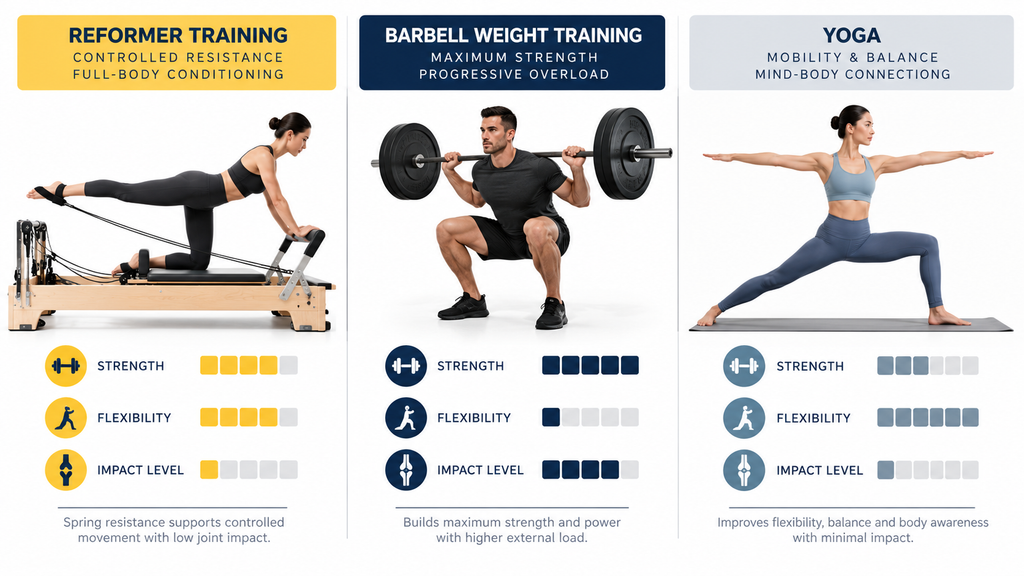
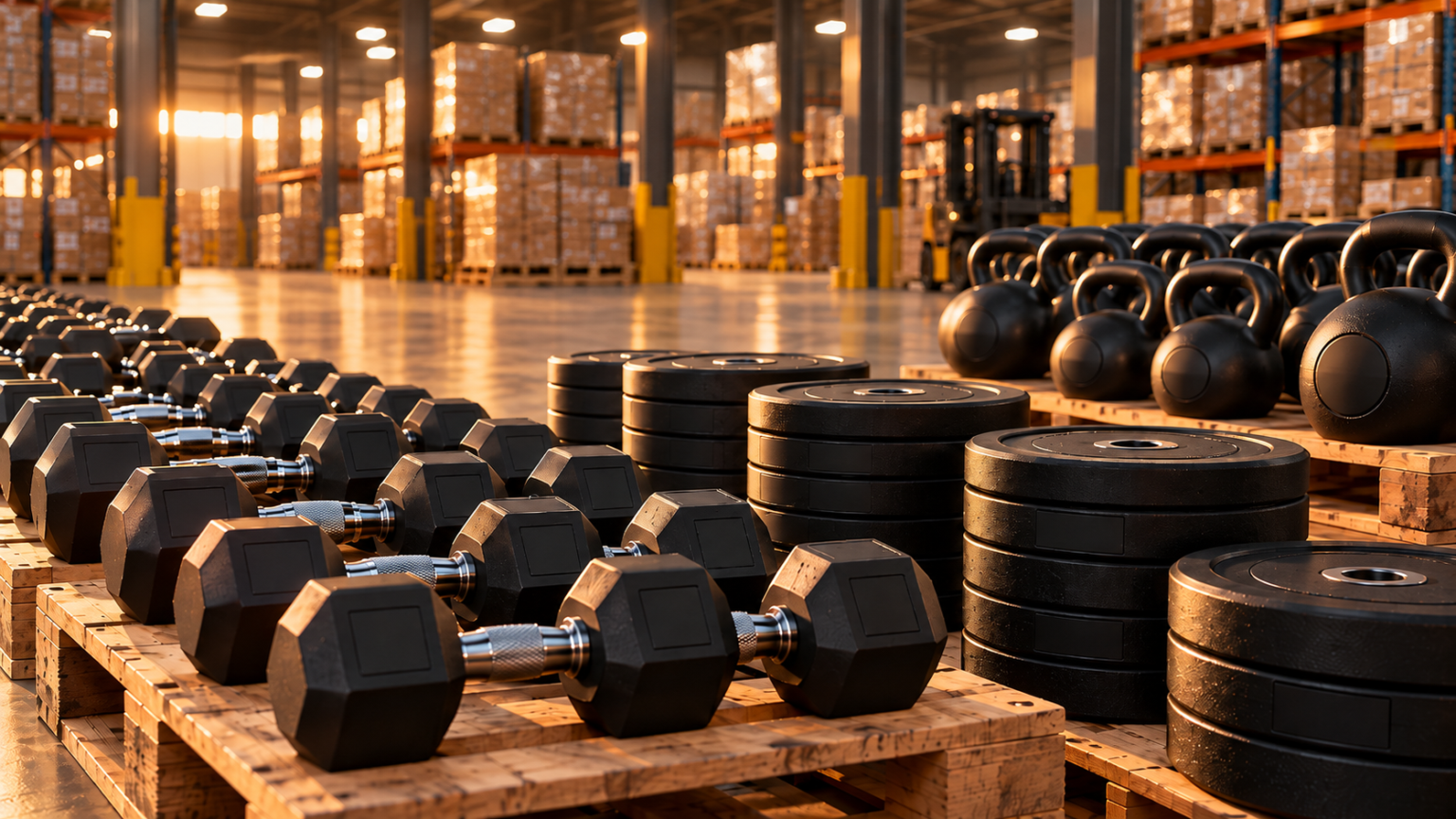
The comparison beginners most often ask for is the one with the clearest answer: these two methods are allies that specialize differently. Weight training’s superpower is progressive overload without a ceiling, barbells and dumbbells scale to any human’s strength, build muscle and bone density with unmatched efficiency, and quantify progress in kilograms, which the spring-based machine cannot match at the top end. The machine’s superpower is everything around that strength: the deep stabilizer conditioning that free weights assume rather than teach, the controlled eccentric emphasis springs enforce, the joint-friendly loading that lets people train hard on days or in decades when heavy barbells are unwise, and the movement quality, alignment, tempo, body awareness, that transfers directly back to the weight room. In practice the methods layer beautifully: lifters use equipment sessions as active recovery and as targeted work for the trunk control their big lifts depend on, while dedicated method practitioners who add two weight sessions weekly cover the bone-density and maximal-strength ground the springs cannot. For a beginner choosing one first, the honest sorting question is starting condition and goal: someone deconditioned, post-rehabilitation, or intimidated by gym floors usually builds a better foundation on the guided machine first; someone whose explicit goal is visible muscle or maximal strength should start under the bar and add the machine for what the bar misses. Either way it is a sequencing decision, not a lifetime allegiance, and the strongest bodies we equip, in both senses, train both.
Against Yoga: Cousins with Different Centers of Gravity
The yoga comparison is subtler because the disciplines share real DNA, breath-led movement, flexibility, body awareness, low impact, mats, and the NHS groups them together in its adapted exercise programming for good reason. The differences are of center of gravity. Yoga is, at root, a mind-body practice with physical postures as one limb: sessions emphasize held positions, breath regulation, and, in many traditions, meditative and philosophical dimensions, with strength built isometrically through body weight alone. The equipment-based method is, at root, a physical conditioning system with mindful execution as its style: movement is continuous rather than held, resistance is external and adjustable rather than fixed at body weight, and the organizing goal is strength through controlled range, particularly of the trunk, rather than stillness or spiritual practice. Practical consequences follow. For pure flexibility and stress-oriented practice, yoga’s held stretches and breath work go deeper; for building strength while gaining mobility, the springs’ adjustable resistance does what body weight cannot; for people who find yoga’s floor-based weight-bearing hard on wrists, shoulders, or knees, the machine’s supported positions often unlock similar movement goals with less joint complaint; and for those drawn to practice as contemplation, yoga offers a dimension the studio machine does not pretend to. The two coexist happily in a week, and many practitioners use exactly that pairing, springs for strength and control, yoga for depth of stretch and calm, which the comparison table below summarizes alongside the weights column.
Building a Week That Uses All Three
The most useful frame for a beginner is not which method wins but what a sensible week looks like, because public health guidance already sketches the answer: the WHO’s adult targets, 150 to 300 moderate aerobic minutes plus muscle-strengthening work on two or more days, are a budget, and the three methods are ways of spending it. A general-fitness template that works for most people: two equipment or weight sessions covering the strengthening requirement, two to four aerobic sessions of whatever kind will actually happen, walking counts, and one mobility-oriented session, yoga or an apparatus mobility class, as the week’s restoration. A desk worker chasing posture and back resilience might weight the mix toward the machine: two reformer classes, one yoga session, daily walking. A strength athlete inverts it: three or four barbell sessions, one equipment session for trunk control and tempo work, aerobic base maintained separately. An older adult or someone returning from injury starts where supervision and joint-friendliness are highest, guided equipment work, often one-on-one, plus walking, and adds intensity as capacity returns, ideally with clinical input on the rehabilitation side. Three planning rules keep any mix honest: cover the aerobic minutes somewhere, because no studio format replaces them; strength-train something twice weekly, on springs or under bars; and choose proportions you will sustain for years, because adherence, not method selection, is where most fitness outcomes are actually decided. The table below puts the three methods side by side for quick reference.
| Dimension | Equipment-Based Pilates | Weight Training | Yoga |
| Primary goal | Core strength, control, mobility | Maximal strength, muscle, bone density | Flexibility, balance, mind-body practice |
| Resistance | Adjustable springs, both assistive and loading | External weights, unlimited ceiling | Body weight, fixed |
| Impact on joints | Very low, guided | Low to moderate, technique-dependent | Low, some wrist/knee loading |
| Cardio stimulus | Modest | Modest | Low to modest, style-dependent |
| Skill entry barrier | Low with instructor and equipment guidance | Moderate; technique must be learned | Low to start, deep to master |
| Cost per session | Highest (equipment plus small classes) | Low to moderate (gym access) | Low to moderate |
| Progress measurement | Control, range, spring progression | Precise: load on the bar | Range, balance, practice depth |
| Best pairing | Add aerobic work and/or weights | Add mobility and core control work | Add strengthening activity |
Who It Suits, and Who Should Be Careful
Beginners, Desk Workers, and the Deconditioned
The method’s largest natural audience is the person modern life has quietly stiffened: the desk worker with a rounded upper back and grumbling lumbar spine, the returner who has not trained in a decade, the beginner who finds gym floors intimidating and mat classes surprisingly brutal on a weak core. For this population the machine is close to purpose-built. Springs assist before they resist, so early sessions can support body weight rather than add to it; the carriage and straps guide movement paths a beginner cannot yet find alone; the lying and kneeling positions unload the spine while the trunk musculature learns to work; and the small-group format puts an instructor’s eyes on form at a frequency big-box gyms never match. Progress in the first months is typically felt before it is seen, sitting taller without trying, lifting luggage without bracing, stairs and floors becoming uneventful, which is exactly the order rehabilitation professionals expect: control first, capacity second, appearance a distant third. Two pieces of honest guidance belong here. First, class quality matters more for this group than any other, because beginners cannot yet distinguish precise instruction from choreography, so choose studios that teach fundamentals and keep groups small over studios that sell sweat. Second, the method should be a gateway, not a terminus: as capacity returns, adding walking volume and, eventually, some heavier resistance work turns the foundation the machine built into the broader fitness the WHO guidelines describe, and instructors confident enough to say so are the ones worth keeping.
Rehabilitation Populations and Older Adults
The apparatus was born in rehabilitation, spring resistance rigged to hospital beds so injured patients could train before they could stand, and that lineage remains its most serious modern use. Physical therapy clinics and rehabilitation centers equip with reformers, Cadillacs, and chairs precisely because spring assistance, supported positions, and infinitely graded resistance let clinicians load tissue as gently or specifically as a recovery stage demands, and our Axispila line is specified for exactly these clinical environments alongside fitness studios. Public health systems have followed the same logic into general practice: the NHS’s adapted Pilates programming for back pain, arthritis, osteoporosis, and knee problems reflects a mainstream judgment that appropriately delivered equipment-and-mat work is suitable exercise for sensitive populations. The risk disclosure that must accompany this enthusiasm: appropriately delivered is the operative phrase. Anyone training around an injury, a surgical recovery, osteoporosis, pregnancy, or a cardiovascular condition should clear their plan with a qualified health professional first, seek instructors with recognized rehabilitation-adjacent training, and favor one-on-one or clinical settings over open group classes until cleared for them; a general fitness article, this one included, is not medical advice, and a spring is only as therapeutic as the judgment of the person selecting it. For healthy older adults the calculus is friendlier: low impact, balance emphasis, and strength maintenance line up directly with healthy-aging exercise priorities, and the method’s scalability means the same class can serve seventy alongside thirty-five, which few strength formats manage gracefully.
Athletes and Experienced Lifters
The stereotype says the machine is for people who cannot lift; the client lists of elite training centers say otherwise, and the mechanical reasons are specific. Athletes live on force produced through the trunk: a golf swing, a sprint stride, a heavy squat all transmit their power through the same corridor of deep trunk musculature the method conditions more systematically than any barbell program, and weaknesses there surface as leaked force, compensations, and eventually the overuse complaints that sideline seasons. Equipment sessions give athletes three things their primary training under-delivers: controlled eccentric and tempo work that springs enforce automatically; unilateral and rotational patterns, one leg pressing the carriage, one arm driving a strap, that expose the left-right and rotational asymmetries bilateral lifting hides; and genuinely restorative loading, training stimulus without impact or spinal compression, on days when recovery matters more than tonnage. For experienced lifters, the honest framing is the one this article has used throughout: the machine will not add kilograms to a deadlift by itself, but it conditions the platform the deadlift stands on, and the lifter who dismisses it after one novice class judged the wrong variable, because the springs were never trying to out-load the bar, they were loading what the bar cannot reach. The practical prescription mirrors the rehabilitation logic at the opposite end of the capacity spectrum: one to two sessions weekly, programmed around the sport calendar, heavier on control work in season and mobility work between, ideally with an instructor who understands athletic contexts rather than one teaching a boutique flow to a linebacker.
What Separates Serious Equipment from Furniture with Springs
Most beginners will never buy a reformer, but every beginner trains on someone’s purchasing decision, and knowing what quality means in this equipment changes how you choose studios, and eventually, perhaps, a home machine. The stakes are simple: this is apparatus a human loads with their body weight plus spring tension, thousands of times, so it is safety-critical equipment, and it is built accordingly or it is not. The engineering markers we build to, and that any buyer can ask about: frames engineered for commercial load and durability specifications rather than showroom stiffness; springs sourced and tested for tension consistency, cycle life, and detachment resistance, the failure mode that matters most; carriages that track straight and silent on quality wheels; upholstery and touch points specified for years of contact and cleaning; and design conformity with the general safety requirements for stationary training equipment codified in ISO 20957-1, the international standard that governs stability, loading, and entrapment risks for this equipment class. The structural logic behind these markers, how a reformer’s frame, rails, and spring anchors are actually engineered, is a subject we have documented in our analysis of Pilates reformer structural design, and the studio-planning arithmetic of equipping a space, how many machines a floor honestly holds, lives in our guide to studio space and layout planning. For a beginner choosing a studio, three observable proxies do most of the work: machines that operate silently and smoothly, upholstery and straps in visibly maintained condition, and instructors who adjust springs and positions individually rather than running every body through one setting, because a studio careful with its equipment is usually careful with its clients, and the reverse correlation is just as reliable.
Frequently Asked Questions
What is reformer pilates good for?
It is best for building core strength, postural control, flexibility, and overall movement quality with very low joint impact. It counts as muscle-strengthening activity under WHO guidelines, adapts from rehabilitation to athletic conditioning through adjustable spring resistance, and suits people who want guided, precise strength work. It does not replace aerobic exercise or maximal strength training.
Is reformer pilates harder than mat Pilates?
Not inherently, it is differently hard. Springs can make exercises easier than the mat by supporting body weight, or harder by adding resistance, so the machine spans a wider difficulty range in both directions. Beginners often find the machine more approachable because it guides movement, while advanced mat work demands exceptional body control with no assistance at all.
Can beginners start directly on the machine?
Yes, and many should. Spring assistance, guided movement paths, and supported positions make the machine one of the friendliest entries into strength exercise, provided the first sessions are taken in a beginner or fundamentals class with a qualified instructor. People with injuries, osteoporosis, or medical conditions should get professional clearance first and favor small or one-on-one sessions initially.
How many sessions a week do you need to see results?
Two sessions weekly is the practical minimum for measurable strength and control gains, and it conveniently satisfies the muscle-strengthening frequency in public health guidelines. Most regular practitioners settle at two to three, paired with walking or other aerobic work on remaining days. Noticeable postural and control changes typically arrive within eight to twelve weeks of consistent practice.
Can it replace weight training or yoga?
It overlaps both but replaces neither completely. Against weights, it cannot match maximal loading for muscle and bone density; against yoga, it does not offer the same held-stretch depth or meditative dimension. It delivers a distinct middle ground, resistance-based movement quality training, and the strongest weekly programs pair it with aerobic work plus one of the other two.
Key Takeaways: A Hundred-Year-Old Method Having Its Moment
Reformer pilates is the Pilates method delivered through a spring-resisted machine, and the machine is the point: adjustable springs that assist or load, a moving carriage that makes stability the exercise, and guided paths that teach precise movement faster than open space ever could. The evidence-backed core of its value is real, muscle-strengthening activity that meets public health guidelines, systematic core and postural conditioning, loaded flexibility, and an adaptability across ages, injuries, and abilities that led national health systems to program it for sensitive populations, and the limits are just as real: modest cardio, a spring ceiling below the barbell’s, premium pricing, and outcomes that ride heavily on instructor quality. Against weight training it is a complement, conditioning the control the bar assumes; against yoga it is a cousin, trading meditative depth for adjustable resistance; and the best weekly program for most people spends the WHO’s activity budget across two or more of the three. It suits beginners, desk workers, older adults, rehabilitation populations with proper supervision, and athletes who understand what it is for; it disappoints anyone expecting maximal strength, rapid fat loss, or a substitute for aerobic minutes. And underneath every session sits an unglamorous truth this manufacturer exists to serve: the method is only as good as the machine and the instruction delivering it, which is why our Axispila apparatus is engineered to commercial and clinical grade, and why the smartest thing a beginner can do costs nothing, choose a studio whose equipment runs silent, whose classes run small, and whose instructors treat a hundred-year-old method with the precision it was built on.
References
The sources cited in this article are listed below in order of first appearance, following academic citation conventions. Health-authority pages and manufacturer pages are living documents, so retrieval dates are given; the standard is cited by its published edition. General fitness statements without a citation reflect the author’s equipment-manufacturing and facility-support practice since 1980; nothing in this article is medical advice, and readers with health conditions should consult a qualified professional before beginning any exercise program.
[1] Alexandave Industries. (n.d.). Axispila commercial Pilates equipment [Product line]. Retrieved September 24, 2026, from https://alexandave.com/products/pilates-equipment-manufacturer/
[2] Mayo Clinic. (2025, March 25). Core exercises: Why you should strengthen your core muscles. Retrieved September 24, 2026, from https://www.mayoclinic.org/healthy-lifestyle/fitness/in-depth/core-exercises/art-20044751
[3] World Health Organization. (2024, June 26). Physical activity [Fact sheet]. Retrieved September 24, 2026, from https://www.who.int/news-room/fact-sheets/detail/physical-activity
[4] National Health Service. (n.d.). Pilates and yoga exercise videos. Retrieved September 24, 2026, from https://www.nhs.uk/live-well/exercise/pilates-and-yoga/
[5] National Health Service. (n.d.). Exercise [Physical activity guidelines]. Retrieved September 24, 2026, from https://www.nhs.uk/live-well/exercise/
[6] International Organization for Standardization. (2024). Stationary training equipment — Part 1: General safety requirements and test methods (ISO Standard No. 20957-1:2024). https://www.iso.org/standard/81908.html