Why One PO Beats Three: The Case for Consolidated Sourcing
Most fitness brands assemble their free-weight range the way their catalog grew: dumbbells from the factory a trade-show contact introduced, plates from the supplier with the sharpest per-kilogram price, kettlebells from whoever answered the last request for quotation fastest. The result is three purchase orders, three specification formats, three quality standards, three inspection trips, three sets of shipping documents, and, invisibly but expensively, three different interpretations of what commercial grade means, arriving in three containers that are each partly empty. Free weight sourcing consolidated into a single purchase order, one factory building the dumbbells, plates, and kettlebells to one specification language and loading them into one container, is the alternative this guide examines, and we examine it from an openly declared position: we are a Taiwan-based manufacturer that has produced all three categories since 1980, consolidation is precisely the service our factory sells, and this article will therefore argue the case with its reasoning fully visible, disclose the real risks of putting three product families in one supplier’s hands, and describe honestly the situations where splitting the order remains the better decision. The structure follows the buying sequence. First the consolidation decision itself, benefits, risks, and the split-order alternative. Then the package specification, how one document governs three products without flattening their differences. Then the logistics, container mathematics that free weights make unusual, and the commercial terms that move the risk. Then supplier evaluation and a worked example that runs a representative package from specification to loaded container. A purchase order is the cheapest place in the supply chain to make decisions, and the whole argument of this guide is that making them once, coherently, beats making them three times, inconsistently.
Before the analysis, it is worth naming why this question matters more for free weights than for most product categories, because the argument is physical before it is commercial. Dumbbells, plates, and kettlebells are manufacturing cousins: all three begin as iron or steel castings, pass through the same foundry disciplines of melt control and mold maintenance, receive closely related coatings, rubber, urethane, powder, and paint, and are judged by the same quality dimensions, weight accuracy, coating adhesion, handle finishing, that this site’s specification guides treat at length. A factory competent in one is usually competent in the others for structural reasons, shared casting lines, shared coating plants, shared inspection instruments, which is what makes single-source packages feasible in this category in a way they are not for, say, treadmills and yoga mats. The physics also drives the logistics case: free weights are among the densest products in the fitness industry, so their containers hit weight limits long before they hit volume limits, and a mixed load of three categories fills the weight budget of one container far more efficiently than three partial loads fill three. And the commercial stakes concentrate accordingly: for most strength-focused brands, the free-weight range is the largest recurring tonnage they buy, which means the coherence, or incoherence, of its sourcing compounds across every reorder cycle for years. Those three facts, shared manufacturing, shared density, shared recurrence, are the foundation everything else in this guide builds on.
The Consolidation Decision: Benefits, Risks, and When to Split
Consolidation is a real decision with real trade-offs, not a default, so this section takes the three-part shape of any honest sourcing analysis: what the single PO genuinely buys, what new exposure it creates, and the circumstances in which the split order remains correct. The comparison table below summarizes the analysis for quick reference, and one framing point governs all three subsections: the unit of comparison is not price per product but total cost and total risk of the program, across specification, inspection, freight, customs, claims, and reorders, over the life of the supplier relationship. Sourcing decisions in this industry go wrong most often when a buyer optimizes one line of that ledger, almost always the unit price line, against the whole of it, a failure pattern our guide to common mistakes when sourcing from OEM factories documents in detail and this section applies to the consolidation question specifically. It is also worth saying that the decision is not binary forever: many mature programs run a hybrid, a consolidated core package from one factory plus specialist items split out where a category demands unique capability, and the framework below supports that middle path as naturally as either extreme. The goal is a deliberate architecture for free weight sourcing, chosen on visible reasoning, rather than the accidental architecture most catalogs inherit from their own history.
| Dimension | One Consolidated PO | Three Split Orders |
|---|---|---|
| Specification and QC | One spec language, one QC annex, one golden-sample set | Three formats; quality standards drift between suppliers |
| Container utilization | Mixed load fills one container’s weight budget efficiently | Partial loads or slow consolidation at a forwarder |
| Accountability | One party owns every defect and every delay | Cross-supplier finger-pointing on mixed-cause problems |
| Price leverage | Larger single order; package-level negotiation | Per-category price shopping; more quotes to compare |
| Supply risk | Concentrated: one factory’s failure hits the whole range | Distributed: one failure hits one category |
| Management load | One relationship, one audit, one inspection trip | Three of everything, forever |
| Best-in-class access | Bounded by one factory’s range | Free to chase the specialist in every category |
A practical way to convert the table into a decision is to score it against your own program rather than debate it in the abstract, and the scoring pass takes an afternoon. Write your free-weight range as it will exist in eighteen months, categories, sizes, annual tonnage per category, then walk the table’s rows against that list with numbers where numbers exist: what would one container versus three partial shipments cost on your actual route this year; how many inspection trips and audits does your team realistically have capacity to run; what did cross-supplier disputes cost you, in hours and concessions, over the last two years; and how exposed is your revenue if your largest category paused for a requalification cycle. Most programs discover the ledger is lopsided in one direction or the other within the hour: high-tonnage, operationally lean brands with coherent commercial ranges find consolidation wins nearly every row, while flagship-driven brands with one hero category and thin volumes elsewhere find the split architecture defensible on the rows that matter to them. The scoring pass also surfaces the question that actually decides most cases, which is not economics but management bandwidth: three supplier relationships run well beat one run badly, and one run well beats three run badly, so the honest inputs are your team’s hours as much as the freight quotes. Free weight sourcing architecture, in other words, should be chosen the way the rest of this site chooses everything, from a written comparison against your own numbers, and the table above is built to be marked up, not merely read.
What One PO Actually Buys: Cost, Logistics, and Accountability
The benefits of consolidation sort into three families, and each is worth stating precisely because each is frequently overclaimed by suppliers and underexamined by buyers. The cost family is real but subtler than the discount conversation suggests: a single larger order does earn package-level pricing, but the durable savings live in the overheads, one specification to author and maintain, one pre-shipment inspection trip instead of three, one set of documents through customs, one supplier audit per year, and, above all, one container instead of three partial ones, which for dense products is routinely the largest line in the whole comparison. The logistics family compounds that: a factory shipping all three categories can sequence production so the package lands in one loading window, pack the mixed load to the container’s weight limit with light goods cubing out the space heavy goods cannot use, and deliver the range as one customs entry, which matters to brands launching a line, where partial arrivals mean a catalog that cannot go live. The accountability family is the one experienced buyers rank first: when dumbbells, plates, and kettlebells share a factory, every quality dispute has exactly one responsible party, the pair-matching, the coating consistency, the color codes that must align across the range, and the claims conversation that follows a problem is a procedure with one counterparty rather than a triangulation among three, each pointing at the others’ components, the forwarder, or the buyer’s own spec. Free weight sourcing through one PO is, at bottom, the purchase of that single throat to choke, and buyers who have lived through a three-way claims dispute tend to price it very highly indeed.
The Risks: Single-Supplier Exposure and How to Cap It
The honest cost of consolidation is concentration, and a guide written by a factory that benefits from consolidation owes buyers the full version of it. The exposure has three faces. Operational: one factory’s fire, flood, labor dispute, or quality collapse now interrupts the entire free-weight range rather than one category, and the deeper the consolidation, the longer the recovery, because requalifying three categories at a new supplier takes three times the sampling and approval work. Commercial: a supplier who knows they hold the whole range has structural leverage at reorder and price-revision time, and a buyer with no live alternative negotiates from a weaker seat. Qualitative: no factory is equally excellent at everything, and consolidation accepts the package factory’s weakest category at whatever level it sits. Each face has a standard mitigation, and a professional consolidated program runs all three. Against operational risk: qualify a second source for at least the highest-volume category and keep the qualification warm with a small annual order, maintain safety stock sized to requalification time rather than to lead time, and write business-continuity disclosure, what happens to your molds and your golden samples if the factory cannot ship, into the agreement. Against commercial risk: keep the specification portable, the whole point of the written spec discipline this site teaches, because a fully documented package can be re-quoted elsewhere in weeks, and a supplier who knows that behaves accordingly. Against qualitative risk: audit the weakest category hardest before consolidating, and reserve the right, in the agreement, to split that category out without penalty if agreed quality gates fail twice. Concentration accepted deliberately, capped contractually, and reviewed annually is a strategy; concentration accepted by default is merely a hope with tonnage attached.
When Splitting Still Wins
The balanced framework requires naming the cases where three orders beat one, and there are four that recur. The first is the specialist-category case: if a brand’s identity hangs on one category, a competition kettlebell line certified for sport, a calibrated plate program at gram-level accuracy, the specialist supplier for that category may outperform any package factory’s version of it, and the correct architecture is a consolidated core with the flagship category split out, accepting the overhead for the capability. The second is the volume-mismatch case: consolidation assumes the categories order in loosely similar rhythms, and a brand selling ten times more plates than kettlebells may find the package cadence forces either overstocking the slow category or under-shipping the fast one; split orders let each category run its own reorder clock. The third is the risk-policy case: some buyers, particularly institutional and government-adjacent programs, operate under procurement rules or internal policies that mandate supplier diversification, and no efficiency argument overrides a fiduciary constraint. The fourth is the failed-audit case, and it is the one buyers most need permission to act on: if the package factory’s weakest category cannot pass the same quality gates as its strongest, the answer is not to consolidate anyway and hope, it is to consolidate what passed and split what did not, revisiting the decision at the next annual review. In all four cases the deciding instrument is the same one the rest of this guide builds, a written, portable specification per category, because a buyer who holds complete specs can recombine suppliers freely as the program evolves, while a buyer without them is locked into whatever architecture they started with, which is the quiet, structural argument for doing the specification work regardless of how many POs it ends up feeding.
Building the Package Specification
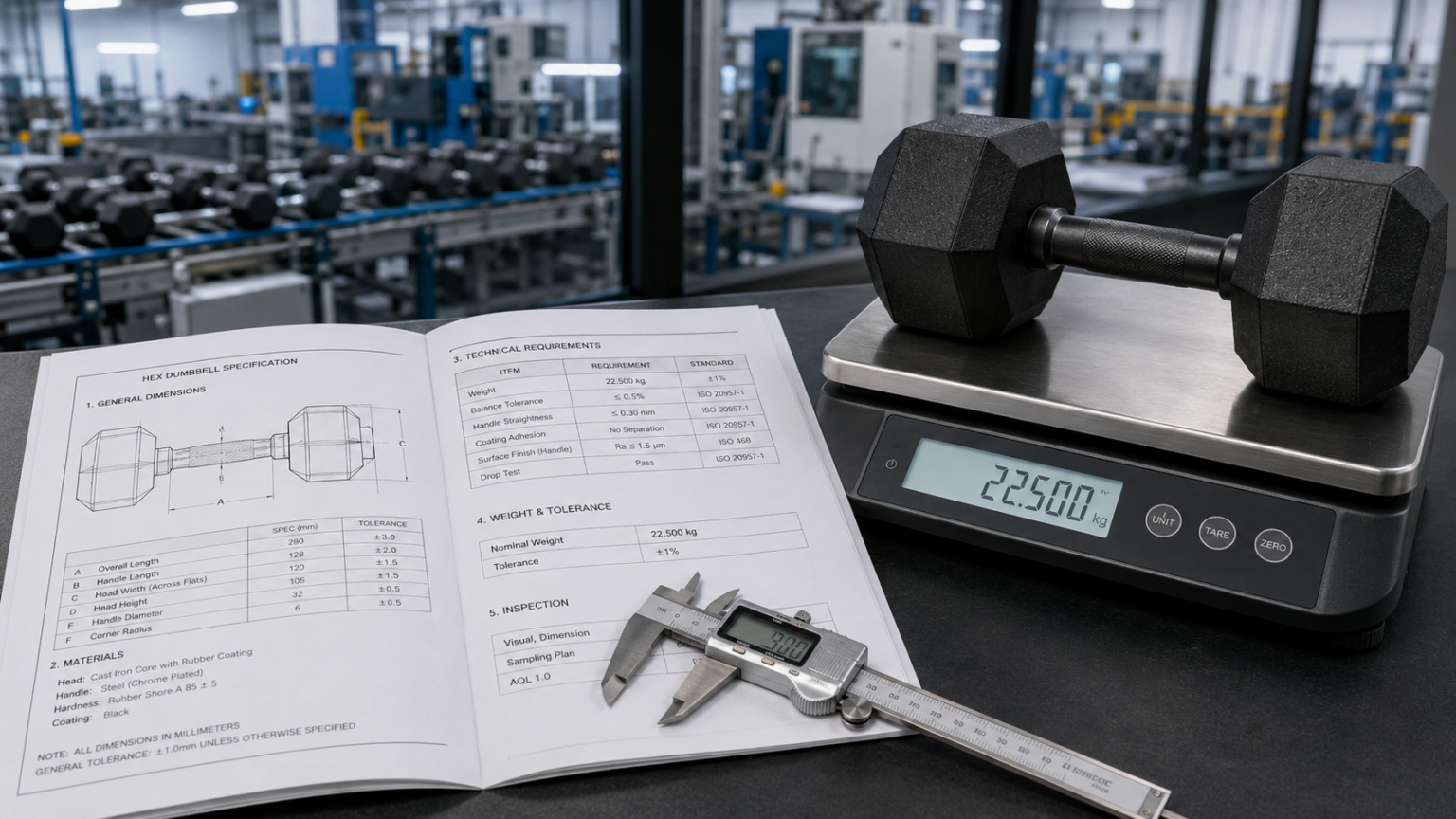
A consolidated order succeeds or fails on its specification, because one document now governs three product families, and the document must achieve two things in tension: a single shared language for the properties the whole package has in common, and per-category precision for the properties that differ. The resolution is an architecture rather than a compromise, a master specification carrying the shared clauses, tolerance structure and verification machinery, coating and color system, packaging and markings, QC gates and records, versioning and golden-sample governance, with product annexes carrying the per-category detail, the dumbbell pair-matching rules, the plate stacking and batch-mean controls, the kettlebell geometry and handle finishing. Built this way, the package spec is not three documents stapled together but one system with three applications, and every discipline it contains is one this site has already developed in category depth: the specification method of our dumbbell spec-sheet guide, the tolerance framework of our weight-tolerance article, the vetting sequence of our guide to assessing an OEM manufacturer’s reliability. The three subsections below cover what is genuinely new at package level: how to write one tolerance and accuracy language across three products, how to specify coating and color as a range-wide system rather than three separate finishes, and how to structure the QC annex so one inspection regime covers the whole PO. The effort is front-loaded and modest, a complete package specification runs perhaps six to ten pages, and it is the single asset that makes everything else in this guide, the accountability, the portability, the clean claims process, actually enforceable.

One Tolerance Language Across Three Products
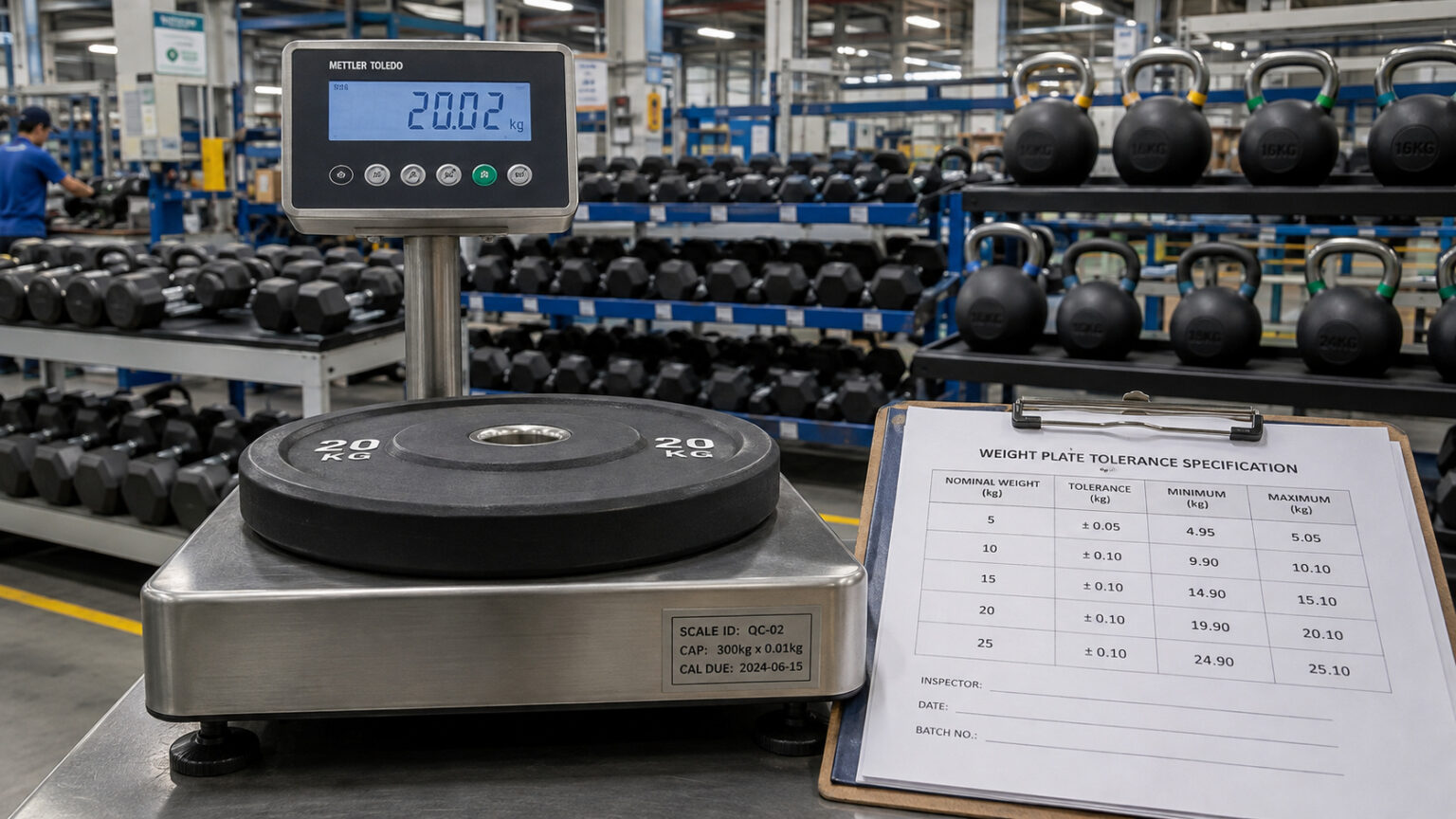
Weight accuracy is the property all three categories share and the place a package specification shows its quality first, and the method is the one our tolerance guide develops in full: state a band plus a measurement method per product, on the finished, coated item, with stepped absolute caps where percentages mislead. At package level the discipline is consistency of structure with honesty about difference. The structure is identical in every annex, a per-size weight table with its band, a verification clause naming instruments, sampling, records, and disposition, so the factory’s QC team runs one mental model across the whole order. The numbers differ by category for reasons the specification should not flatten: commercial plates carry the tightest band because they load in stacks and stacking arithmetic compounds error; dumbbells add the pair-match clause because users compare hands; kettlebells run a clean unit band with a stepped cap at light sizes. Where the package includes competition-adjacent product, anchor the numbers to the published rules rather than to adjectives, the International Weightlifting Federation’s equipment standards hold competition discs to plus 0.1 percent and minus 0.05 percent, per the IWF Sport Equipment Licensing Guidelines, and legal metrology’s OIML R 111-1 supplies the stepped-absolute-tolerance structure the light sizes borrow. One package-level clause is new and worth its line: cross-category consistency, requiring that the same nominal weight reads the same across products, a 20-kilogram plate pair and a 20-kilogram dumbbell from the same PO landing within each other’s bands, because a brand’s credibility is range-wide and customers with scales do not file their findings by category.
Coating and Color as a Range-Wide System
The second package-level opportunity is the finish system, and it is the one customers see: a consolidated order can specify coating and color as one visual and material language across dumbbells, plates, and kettlebells, which is difficult to the point of impossibility across three factories. The material side consolidates naturally because the coating families overlap, rubber and urethane encasement on plates and dumbbell heads, powder and enamel systems on kettlebells and iron, and a single factory sources compounds and pigments in package volume, which is what makes genuine color matching achievable: black that is the same black across the range, color codes that carry the same red and green from kettlebells to plates, logos reproduced by the same method at the same quality everywhere. The specification lines follow the finish discipline this site teaches per category, material named honestly with virgin content or hardness stated, preparation and thickness pinned, gloss stated, color by code with batch-consistency required across the whole PO and across reorders, and the package adds two clauses worth writing explicitly. First, a shared branding annex: one artwork file set, one placement drawing per product, one durability standard for the mark, molded where molds allow, printed or laser-marked where they do not, so the range reads as one brand rather than three vendors’ interpretations of one logo. Second, a shared cosmetic standard: one photographed definition of acceptable and rejectable surface quality applied across categories, because a package inspected under one cosmetic standard ships as one product line, while three standards ship as an assortment. Range coherence of this kind is quietly one of the strongest commercial arguments for consolidation: it is visible in every gym photo and dealer showroom, and it cannot be retrofitted across suppliers after the fact.
The QC Annex: One Inspection Regime for the Whole PO
The QC annex converts the package specification into events, and its package-level advantage is that one inspection regime, run once per order, covers the entire free-weight range. The gates are the standard ones this site’s guides develop, applied jointly: sample approval across all three categories before production, with the approved units becoming a single golden-sample library governing the whole package; in-production checks at stated frequencies, weighing, coating thickness, handle and finish inspection, with the factory’s records retained per batch; and a pre-shipment final inspection against the specification and the samples, run on a sampling plan with defect classes and acceptance limits stated per category but administered as one event, one inspector, one report, one decision. The infrastructure this plugs into is ordinary certified-quality-system practice of the kind maintained under ISO 9001, and the buyer-side disciplines are the ones our sample approval checklist details, extended with two package-specific habits. Inspect the weakest category hardest: the consolidation risk analysis already identified it, and the QC annex is where that analysis becomes sampling weight, more units pulled, tighter acceptance, third-party verification on early orders, for the category the factory is least proven in. And gate the package as a package: the annex should state whether a failed category blocks the whole shipment or ships partially, because discovering that question for the first time with a loaded container at the port is the single most expensive way to answer it. A one-page decision table in the annex, category fails X, consequence Y, costs nothing at signing and prevents the worst week the program will otherwise eventually have.
Container Math and Logistics: Weight-Limited Freight
Free-weight logistics runs on a fact that surprises every buyer coming from general merchandise: the container fills its weight allowance long before it fills its space. A standard twenty-foot container offers roughly 33 cubic meters of volume but a maximum payload in the neighborhood of 28 metric tons, with the exact figure varying by container and, critically, with road and rail weight limits at both ends of the journey frequently capping the practical load well below the container’s own rating, per the specifications summarized in the reference on the intermodal container. Cast iron and steel products reach that payload ceiling at a small fraction of the volume, which reshapes the entire planning conversation: the twenty-foot box, not the forty-foot, is the standard vessel for dense freight, because doubling the volume adds almost no usable payload; the loading plan is a weight distribution exercise, mass spread across the floor to keep axle loads legal and the container balanced, not a space-packing puzzle; and the package composition itself becomes a loading variable, since a mixed order of plates, dumbbells, and kettlebells can be sequenced so cartons of dense product form the base layer while lighter accessory items ride the otherwise-unusable upper volume. This is also where consolidation pays its most visible dividend: one factory loading one mixed container to its weight limit achieves the utilization that three partial shipments, or a forwarder consolidating three suppliers’ freight, can only approximate with extra handling, extra time, and extra cost. The two subsections that follow put numbers and terms to the picture: the payload arithmetic a buyer should run before ordering, and the commercial terms, Incoterms, insurance, landed cost, that decide who carries which risk from the factory gate to the warehouse door.
Running the Payload Numbers
The payload calculation is short enough to run on one page and valuable enough to run before every order, and it proceeds in four steps. Start with the practical payload: take the container’s rated maximum, then apply the binding constraint on your specific route, which is usually the road-legal gross vehicle weight at the destination, a limit that in many markets caps practical container payloads in the range of nineteen to twenty-five tons rather than the rated twenty-eight; your forwarder quotes this number in one email and it, not the container rating, is your budget. Second, weigh the order on paper: the package specification’s weight tables make this mechanical, product net weight plus packaging, per line, summed, with packaging for free weights typically adding several percent for cartons, pallets, and dunnage. Third, fit the order to the budget in weight first and volume second: dense lines, plates above all, consume the payload, and the volume they leave unused is free real estate for the package’s lighter members, which is the loading logic that makes mixed free-weight containers efficient. Fourth, iterate the order to the container rather than the container to the order: a package that computes to 1.3 containers is an invitation to either trim to one full box or grow to two, because a second container at half payload carries the worst freight economics in the whole plan, and reorder cadence can usually absorb the adjustment. Two operational notes complete the arithmetic: verify the shipment weight at loading, the same calibrated-scale discipline the QC annex already requires, because misdeclared container weight is a compliance issue at every modern port; and keep the loading plan with the shipping documents, because a weight-distribution diagram is the document that turns a customs or damage dispute from an argument into an exhibit.

Incoterms, Insurance, and Landed Cost
The commercial terms decide who owns the container’s risks and costs at each stage, and for a consolidated order they deserve explicit attention because a single large shipment concentrates in one vessel what three orders would have spread across three. The vocabulary is the International Chamber of Commerce’s Incoterms framework, the standardized trade terms summarized in the reference on Incoterms, and the practical choice for containerized free weights usually runs between FOB, where the buyer takes over at the origin port and controls ocean freight and insurance through their own forwarder, and CIF or its cousins, where the factory arranges carriage and minimum insurance to the destination port. Experienced import programs tend toward FOB for exactly the reasons a consolidated order amplifies: control of the forwarder relationship, visibility of the freight cost as a separate negotiated line, and insurance purchased at proper valuation rather than at the minimum the seller’s term requires, a point that matters when one container now carries the entire quarter’s free-weight inventory. Whatever the term, run the landed-cost model before comparing any quotes: unit price plus inland origin charges, ocean freight, insurance, destination handling, duties and taxes under the correct tariff classifications, and delivery, computed per product line, because per-kilogram products with different duty rates can reorder their apparent price ranking once the full column is summed, and the consolidated PO’s package price only means something at the landed line. One final consolidated-order habit: insure the shipment as a package with the specification attached to the policy schedule, because in the unhappy event of loss or damage, a claim documented by a versioned specification and a weight-verified loading plan settles in weeks, while an undocumented one settles in adjectives.
Evaluating the One-Stop Supplier
Consolidation concentrates everything on one factory, so the supplier evaluation carries the weight three evaluations used to share, and it differs from single-category vetting in one structural way: the buyer is auditing breadth as well as depth. The depth checks are the standard sequence this site teaches, factory audit, quality-system certification, weighing and coating records, sample quality, reference customers, run per category rather than once, because the whole consolidation case rests on the factory being genuinely competent in all three product families rather than excellent in one and adequate in two. The breadth checks are the new layer. Verify that the categories share real infrastructure: a factory that casts, coats, and finishes dumbbells, plates, and kettlebells on shared lines with shared instruments is a true package manufacturer, while one that quietly subcontracts a category is a hidden three-supplier architecture wearing one letterhead, and the buyer should know which they are buying, since subcontracting reintroduces exactly the accountability seams consolidation was meant to remove; the direct question, which of these products do you cast and coat in this building, is answerable in a plant tour and belongs in the audit script. Verify capacity concurrency: a package order needs all three categories in the same production window, so ask how the factory schedules mixed orders and what happens to the package when one line is congested. And verify range documentation: a factory accustomed to package orders will show package-level specifications, mixed-container loading plans, and cross-category golden-sample libraries from existing programs, the artifacts of the working method this guide describes, while a factory that has only ever quoted categories separately will be learning the method on your order. Our own manufacturing scope and equipment capabilities are documented on our manufacturing capabilities page, and we encourage buyers to put every factory, ours included, through exactly this two-layer audit, because the consolidation decision is only as sound as the breadth verification behind it.

The evaluation’s final instrument is the trial structure, because no audit substitutes for a factory’s behavior under a real order, and consolidated programs are best entered by stages rather than vows. The standard path runs three steps. Start with a pilot package, a single mixed container rather than a quarter’s volume, specified with the full master-document discipline this guide describes, because the pilot’s purpose is to test the method as much as the product: did the factory work naturally from the package specification, did all three categories arrive within their bands on your incoming scale, did the mixed loading plan match the manifest, did the records arrive without being chased. Score the pilot against those questions in writing, not impressions. Then scale by category confidence rather than all at once: move your highest-volume category to full consolidated cadence first, hold the weakest-audited category at pilot volume for one more cycle, and let the factory earn the full range with performance you have logged rather than promised. Finally, formalize the annual review the risk section already scheduled: once a year, re-run the landed-cost comparison against at least one outside quote per category, re-check the second source’s warmth, and re-read the quality log, because a consolidation that was right at signing stays right only as long as the numbers that justified it keep holding. Staged this way, free weight sourcing consolidation becomes a reversible experiment with a growing evidence file instead of a leap, which is the posture that keeps both parties honest, the buyer negotiating from data, and the factory, ourselves included, performing for a customer it knows is measuring.
A Worked Example: One PO from Specification to Container
The method becomes concrete in a representative order, so this section runs a mid-sized brand’s launch package through the sequence, with the standing disclosure that the product families named are ones we manufacture, the full ranges are visible under our dumbbells, plates, and kettlebells tags, and the arithmetic holds for any manufacturer’s equivalents. The brand plans a commercial launch range: rubber hex dumbbells from 2.5 to 40 kilograms in 2.5-kilogram steps, bumper plates in the standard five sizes, cast kettlebells from 8 to 32 kilograms. The specification phase produces the master document and three annexes described above, two weeks of desk work including one revision cycle with the factory, and sample approval across all three categories adds four to six weeks with the golden-sample library signed at the end. The composition phase runs the payload numbers: the table below shows one realistic single-container allocation, a package totaling roughly 21 tons net against a 24-ton practical payload budget, leaving margin for packaging mass and the pallet and dunnage weight the loading plan consumes. Production of a mixed package at this scale typically runs eight to twelve weeks depending on coating systems and season, the single pre-shipment inspection covers all three categories in one factory visit, and the container loads to the weight-distribution plan with dense plate cartons floored first. The numbers are illustrative rather than quoted, real allocations move with the brand’s sales mix, and the point of the exercise is the shape: one document, one sample library, one inspection, one container, one accountable party, which is the entire consolidation argument compressed into a shipping manifest.
Mapped onto our live catalog, the same package composes from named products, which is worth showing because a real consolidated quotation is written in product codes, not categories. The plate allocation draws on the Olympic Rubber Bumper Plate-T1 for the color-coded working sizes and its all-black sibling the Olympic Rubber Bumper Plate-T2 for value-tier volume, with the Calibrated Plate available where a brand wants a competition-accuracy line inside the same PO and the Cast Iron Plate covering the slim change-plate rows. The dumbbell run builds from the Rubber Dumbbell-C3 as the commercial workhorse, with the TPU Dumbbell as the odorless premium tier for brands positioning indoors. The kettlebell line runs on the CPU Coated Kettlebell for commercial floors, with the Competition Gloss Finish Kettlebell-C1 stepping in where the range needs a sport-specification tier. The point of naming products is not the catalog tour: it is that every substitution inside a consolidated package, C3 rubber against TPU, T2 black against T1 color, commercial bell against competition, changes price, coating system, and payload arithmetic together, and a package quotation that names the products lets the buyer see all three move at once, which category-level quotes never show.
The example’s second lesson appears at the reorder, because a package program’s rhythm is where its economics mature. The launch container carried the full range; the reorders will not, because categories sell at different speeds, and the working pattern for consolidated programs is a rolling mixed container on a steady cadence, quarterly for many mid-sized brands, whose composition flexes to the sales data while the container stays full: the fast movers, typically the middle dumbbell pairs and the working plate sizes, claim a standing share of every box, and the slow movers rotate through as stock positions require. This is the point at which the front-loaded specification work pays its recurring dividend: because the master document and golden samples govern every reorder, a repeat container is a one-page composition decision rather than a re-negotiation, versioned against the same specification, inspected under the same annex, and loaded to the same distribution logic, and the brand’s free-weight range stays consistent across production years, which customers experience as a twenty-kilogram plate bought in year three matching the pair bought at launch. Two habits protect the rhythm. Watch the weight budget drift: as the mix shifts toward lighter or denser lines the payload arithmetic moves, and the composition sheet should recompute it every order rather than assume last quarter’s fit. And feed the quality log forward: incoming-inspection results from each container adjust the next order’s sampling weights, the same graduated-trust logic the QC annex began, so that over the years the program inspects less where the record is clean and keeps its attention where the data says attention belongs.
| Package Line | Illustrative Quantity | Approx. Net Weight | Loading Role |
|---|---|---|---|
| Bumper plates: Olympic Rubber Bumper Plate-T1 / T2 (10-25 kg, five sizes) | ~140 pairs, mixed | ~9.5 t | Dense base layer, floored first, spread for balance |
| Dumbbells: Rubber Dumbbell-C3 or TPU Dumbbell (2.5-40 kg run) | ~8 full runs plus fast-mover extras | ~7.5 t | Mid-layer cartons on pallets |
| Kettlebells: CPU Coated Kettlebell (8-32 kg) | ~330 bells, weighted to sales mix | ~4 t | Distributed by weight class |
| Collars, storage, light accessories | To suit range | <1 t | Cube out the upper volume the dense lines leave |
| Package total (net) | One 20-ft container | ~21-22 t vs. ~24 t practical budget | Margin absorbs packaging, pallets, dunnage |
Sources cited in this guide, in full: the International Weightlifting Federation, Sport Equipment Licensing Guidelines, reproducing the tolerance chart of IWF Technical and Competition Rules Regulation 3.3.3; the International Organization of Legal Metrology, OIML R 111-1:2004, Weights of classes E1 to M3; the International Organization for Standardization, ISO 9001 Quality Management Systems; the Incoterms framework of the International Chamber of Commerce, as summarized in the linked reference; and the intermodal container specifications summarized in the linked reference. Commercial figures without a cited standard, package weights, lead times, and payload budgets, are stated from our own manufacturing and shipping practice and marked as illustrative.
Frequently Asked Questions
Is it cheaper to buy all gym free weights from one supplier?
Usually yes at the program level, though not always on every unit price. The durable savings come from overheads: one specification, one inspection trip, one supplier audit, one customs entry, and, above all, one fully loaded container instead of several partial ones. A specialist supplier may still beat the package factory on a single category’s unit price, which is why the comparison should be run on landed, program-level cost rather than per-item quotes.
How much weight fits in a shipping container of free weights?
A twenty-foot container is rated for a payload of roughly 28 metric tons, but road and rail limits on the actual route usually cap the practical load at about 19 to 25 tons, a number your freight forwarder can confirm for your destination. Free weights hit that weight ceiling long before filling the container’s 33 cubic meters, so plan the order by weight first and use the leftover volume for lighter items.
What should a free-weight purchase order include?
A master specification plus per-category annexes: weight tolerance tables with measurement methods, pair-matching for dumbbells, coating and color specified by code with batch consistency, branding artwork and placement, packaging and rust protection, QC gates with sampling plans and records, golden-sample governance, and a stated consequence if one category fails inspection. Add Incoterms, insurance valuation, and a weight-distribution loading plan for the container.
What are the risks of buying everything from one factory?
Concentration: one factory’s disruption now affects your whole free-weight range, its leverage grows at reorder time, and you inherit its weakest category. The standard mitigations are keeping a second source qualified for your highest-volume category, holding safety stock sized to requalification time, keeping the specification portable so the package can be re-quoted quickly, and auditing the factory’s weakest category hardest before consolidating.
What is the minimum order for a custom free-weight package?
It varies by factory and by how much customization the package carries, but a single twenty-foot container, roughly 19 to 24 tons of mixed product, is the practical floor at which consolidated sourcing makes economic sense, since it fills one container’s weight budget and justifies package-level pricing. Custom colors, logos, and molds may carry per-category minimums inside the package, which the factory should state per line at quotation.
Key Takeaways: One Document, One Container, One Accountable Party
Consolidated free weight sourcing is an architecture decision, and this guide’s framework reduces it to a sequence a buyer can run deliberately. Decide with the whole ledger: one PO buys package pricing, one container loaded to its weight budget, one inspection regime, and one accountable counterparty, and it costs concentration, which professional programs cap with a warm second source, portable specifications, and hard audits of the factory’s weakest category, while honest cases for splitting, specialist flagship categories, mismatched volumes, procurement rules, failed audits, keep their standing. Specify as a system: a master document for the shared language, tolerance structure, finish and color system, QC gates, golden samples, with per-category annexes for pair-matching, stacking control, and geometry, anchored to published standards where they exist and to explicit contract numbers where they do not. Plan the freight by weight: free weights exhaust a container’s payload long before its volume, so run the payload arithmetic against the route’s practical limit, compose the order to fill one box cleanly, and set the commercial terms and insurance to match a shipment that now carries the whole range in one vessel. Audit breadth as well as depth, confirming the categories genuinely share one factory’s lines rather than a subcontracting web. Run that sequence and the launch-package example’s shape becomes routine: one document, one sample library, one inspection, one container, and a free-weight range that arrives, and reorders, as a single coherent product line, which is what the phrase complete package was always supposed to mean, and what we build POs to deliver: our OEM and ODM services exist to co-author exactly this order, and the conversation starts with your range list.