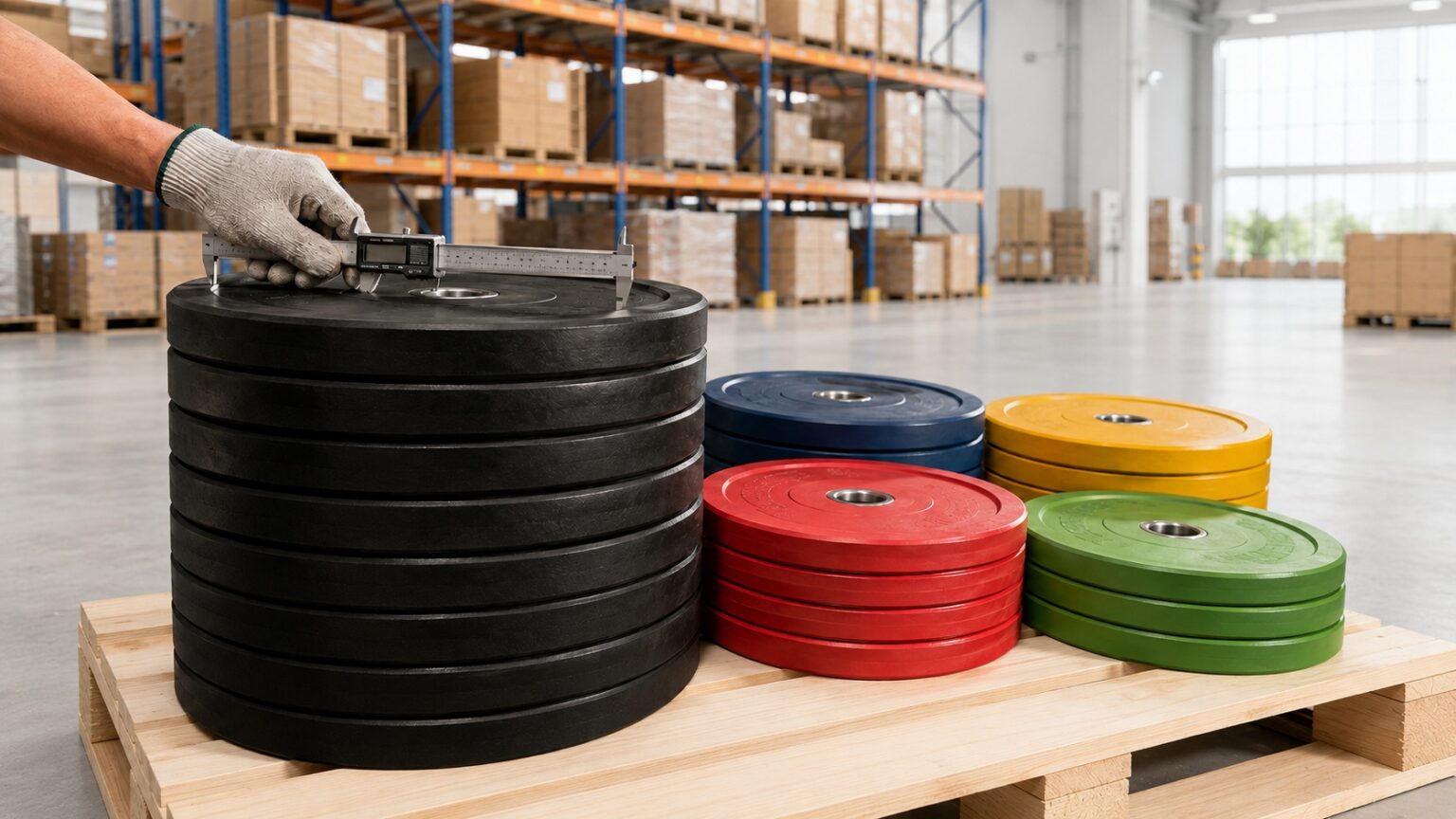
Why Sourcing Bumper Plates Is Harder Than It Looks
On paper, a bumper plate is one of the simplest products in a commercial gym: a disc of rubber with a steel or brass insert, sold by weight and color. That apparent simplicity is exactly why so many buyers underestimate it. As a Taiwan-based contract manufacturer that has produced free weights since 1980, we have watched brands and distributors sign purchase orders on the strength of a glossy photo and a low unit price, only to receive pallets of plates that crack at the insert, bounce unpredictably across the platform, or arrive stamped with a weight that a calibrated scale politely disagrees with. The disc is simple; the engineering, the material chemistry, and the quality control behind it are not. When you learn how to source bumper plates properly, you stop buying a picture and start buying a specification, and that shift is what separates a profitable, low-return product line from a warranty headache that erodes your margin one cracked plate at a time. We write this guide from the factory floor rather than the marketing department, because the details that decide whether a plate survives five years of daily abuse are set in the mold, the compound mixer, and the curing press long before anyone ever photographs the finished product. Two plates that look identical in a catalog can differ by nearly a third in true manufacturing cost, and that gap hides entirely in variables the buyer never sees unless they know exactly which questions to ask. Our aim throughout is to make you the kind of buyer who asks them, because an informed buyer changes how a factory quotes, samples, and produces from the very first email.
The purpose of this guide is to give commercial buyers, importers, and private-label brands a working framework for evaluating bumper plates before money changes hands. We will move through the anatomy of the plate, the meaning of durometer and why it is the single spec that most predicts real-world behavior, the difference between healthy bounce and the increasingly popular dead-bounce category, and the standards and tolerances you should be writing into your requests for quotation. Along the way we will be candid about trade-offs and risks, because no honest manufacturer will tell you there is one perfect plate for every use case. A competition weightlifting club, a CrossFit-style functional gym, and a hotel fitness room each need something different, and a supplier who recommends the same product to all three is selling convenience rather than fit. Our goal is that by the end you can read a spec sheet, interrogate a quotation, and place an order with the quiet confidence that comes from knowing exactly what you asked for and how you will verify that you received it. We will be explicit about verification at every stage, because a specification you cannot test is merely a wish, and the buyers who avoid painful surprises are invariably the ones who decide in advance how each requirement will be measured and who will measure it. Treat every claim in a quotation as a hypothesis to be checked rather than a promise to be trusted, and treat the rest of this guide as the practical toolkit for checking, from the compound in the mold to the pallet in the container.
Bumper Plate Anatomy: What You Are Actually Buying
Before you can compare quotations intelligently, you need a shared vocabulary for the object itself. A bumper plate is not a monolithic lump of rubber; it is an assembly of a rubber body, a metal insert or hub, and a bonding interface between them, each of which can be engineered well or cheaply. The differences that matter most for durability and performance are usually invisible in a product photo and only partially visible in a datasheet, which is why buyers who understand construction consistently negotiate better outcomes. When you request samples, you are not merely checking that the plate looks right; you are inspecting a small piece of manufacturing evidence that reveals how the factory approaches materials, tooling, and process control. The three subsections below break the plate into the components you should be asking about explicitly, and each one gives you a concrete question to raise with any prospective supplier. It is worth stressing that construction quality and price are not the same axis, and a higher unit price does not guarantee a better-built plate any more than a low price guarantees a poor one. What protects you is knowing which construction details actually drive real-world durability, so that you can judge whether a premium is buying genuine engineering or merely a wider margin for the seller. The buyer who can name the failure modes of a bumper plate, and point to the specific construction feature that prevents each one, negotiates from knowledge rather than hope, and experienced suppliers quickly calibrate their answers to match the sophistication of the questions they are being asked.
Rubber Compound and Core Construction
The rubber compound is the heart of the plate and the area where costs are most often quietly cut. Bumper plates are typically molded from either virgin rubber, a blend of virgin and recycled rubber, or predominantly recycled crumb rubber, and the choice cascades into nearly every performance attribute you care about. Virgin rubber, often a styrene-butadiene compound, delivers consistent density, controlled bounce, lower odor, and a longer fatigue life, but it costs more per kilogram. Heavily recycled compounds are cheaper and can be perfectly acceptable for budget training plates, yet they tend to smell stronger, vary more from batch to batch, and are more prone to developing surface cracks under repeated dropping. The curing process, known as vulcanization, cross-links the rubber and determines how well the finished plate resists tearing and permanent deformation; a rushed or under-controlled cure is a common hidden defect. When you evaluate a compound, ask the factory to state the virgin-to-recycled ratio in writing, request a Shore hardness reading, and confirm whether the same compound is used across the entire weight range, because some suppliers switch to a harder, cheaper mix on the heavier plates where buyers rarely test. Reputable manufacturers understand rubber chemistry deeply, and their willingness to discuss compound specifics is itself a useful signal. You can read more on the underlying process of vulcanization and the properties of a common styrene-butadiene rubber compound to sharpen your questions.
Insert Design and Collar Opening
The insert is the metal ring at the center of the plate that engages the barbell sleeve, and it does far more work than its modest size suggests. It must survive tens of thousands of loading cycles, absorb the shear forces of a dropped bar, and hold a collar opening that stays true to the international 50.4 millimeter Olympic standard so plates slide on and off cleanly without rattling or binding. Cheaper plates use a thin stamped steel insert with a minimal bonding surface, which is where failures concentrate: under repeated drops the rubber-to-metal bond fatigues, the insert loosens, and the plate develops the dreaded spin or wobble that ruins a competition lift and signals imminent failure. Better plates use a wider hub or a stainless insert with a knurled or textured bonding face that mechanically locks into the vulcanized rubber, dramatically increasing the interface area and the life of the plate. When inspecting samples, spin the plate on a bar and listen for looseness, measure the collar opening with calipers, and, if you can, examine a cutaway to see how deep the insert seats into the body. The insert is also where corrosion can begin if a factory uses uncoated mild steel and ships through humid ocean freight, so specifying a plated or stainless insert is a small cost that prevents rust complaints. For competition-grade behavior, our Competition Rubber Bumper Plate illustrates the wider stainless hub construction that longevity depends on.
Weight Tolerance and Calibration
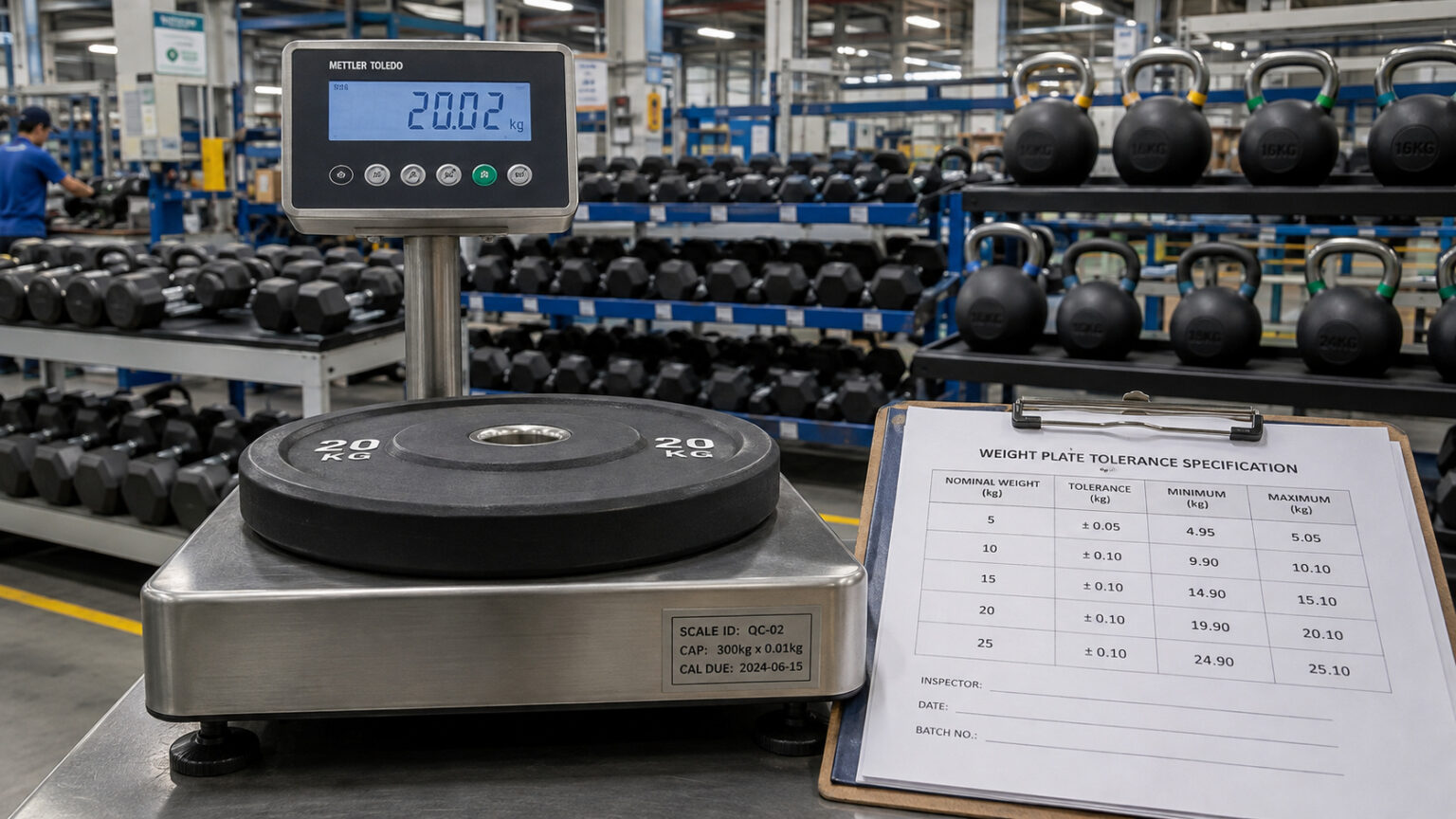
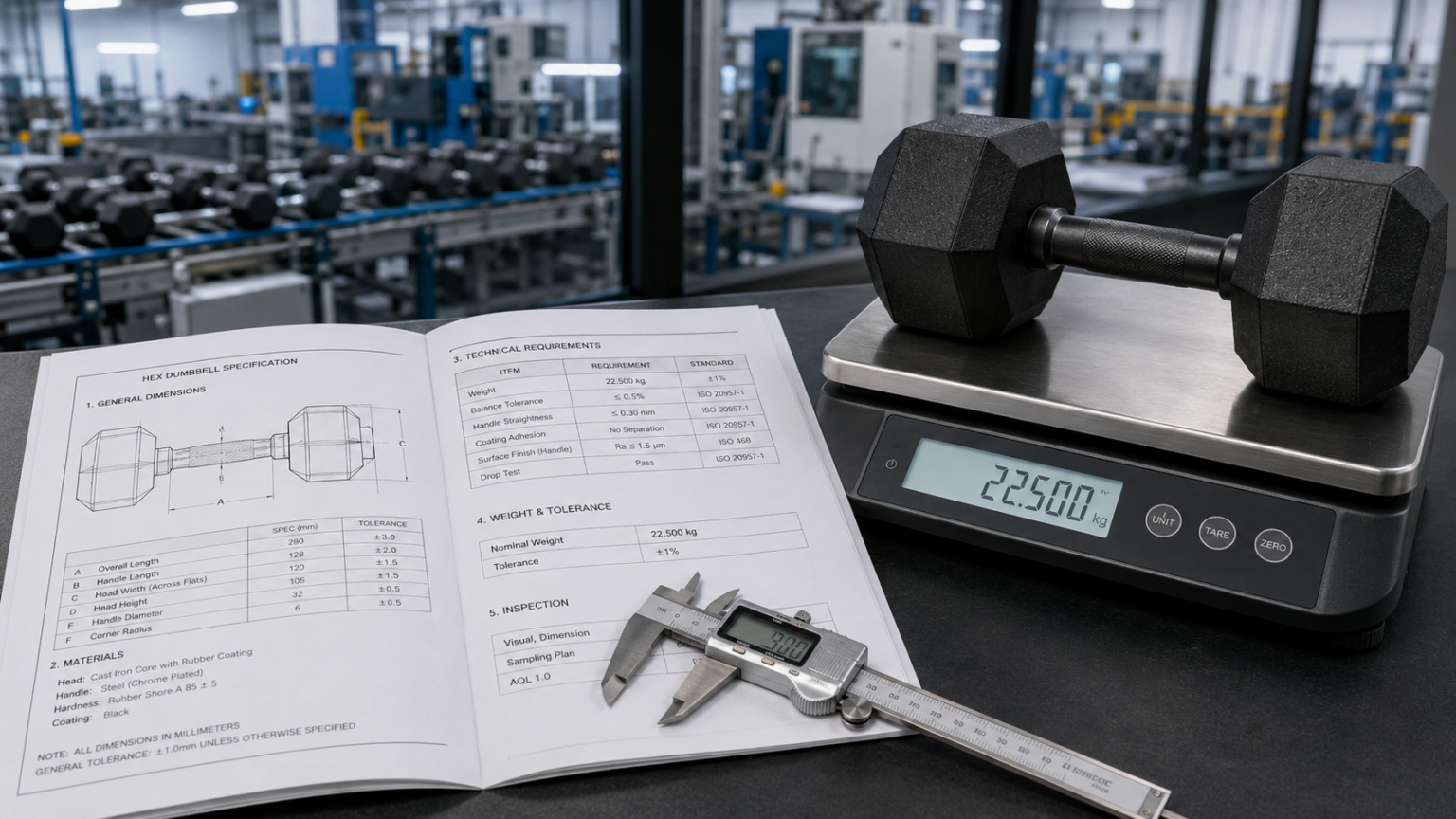
Weight tolerance is the specification that buyers most often assume and most rarely verify, and that gap is where disputes are born. Every bumper plate carries a nominal weight, but the actual mass varies because rubber is molded rather than machined, and the acceptable variance should be stated explicitly in your contract rather than left to the factory’s discretion. Training bumper plates commonly carry a tolerance of plus or minus one percent, while competition discs governed by the International Weightlifting Federation equipment standard are held much tighter, often within ten to thirty grams regardless of the plate’s nominal weight. That distinction matters commercially: a facility running sanctioned meets or selling to weightlifting clubs needs calibrated accuracy, whereas a functional-fitness box can accept looser training tolerances and pay less. The risk of ignoring tolerance is not merely academic; a set of plates that each run heavy by two percent turns a marketed 100 kilogram load into a 102 kilogram load, which matters to serious lifters and to your credibility. When you source bumper plates, insist that the supplier declare the tolerance in writing, ask for the actual measured weights of your sample batch, and consider requiring outgoing quality control weighing on a calibrated scale with a certificate. If you want a genuinely calibrated product, that is a different category with different economics, and our calibrated plate line exists precisely because competition buyers need certainty rather than approximation.
Understanding Durometer: The Single Most Important Spec
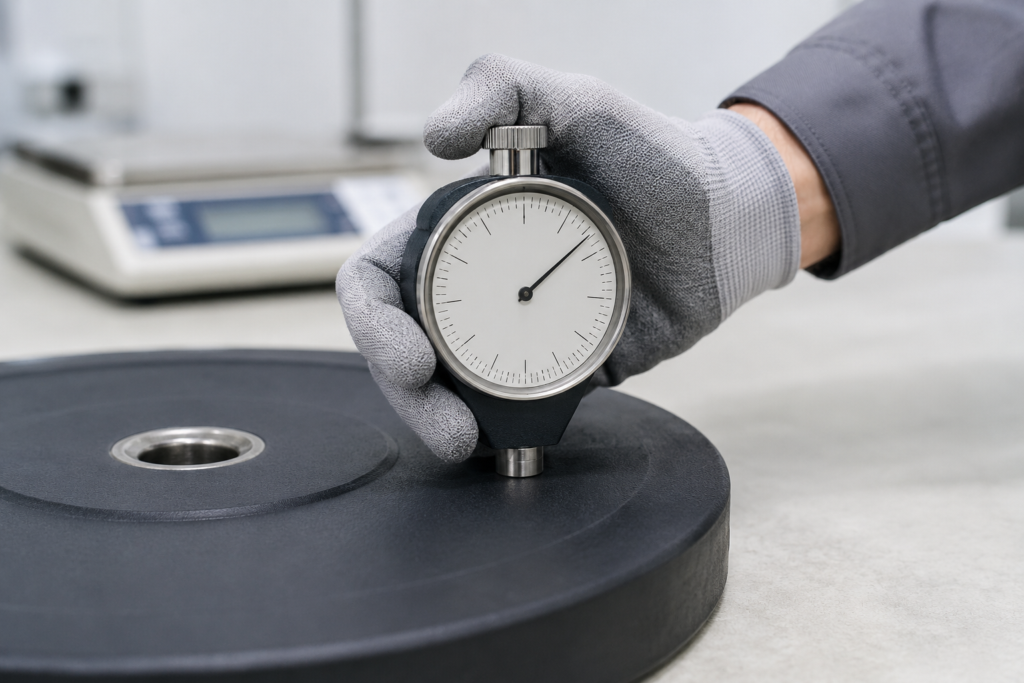
If you take only one technical concept away from this guide, make it durometer, because no other single number tells you more about how a bumper plate will actually behave on the floor. Durometer is a measure of the hardness of the rubber, and it quietly governs bounce, noise, feel, floor protection, and durability all at once. Two plates can share the same weight, diameter, color, and price while behaving completely differently in the gym because one is soft and one is firm, and the datasheet line that explains the difference is the Shore A durometer rating. Buyers who ignore durometer are effectively choosing bounce behavior at random, then wondering why their customers complain. The three subsections below define what durometer measures, trace how it drives the trade-offs you care about, and give you a practical framework for choosing a target hardness based on how the plates will be used rather than on which sample happened to feel nice in your hand. This distinction matters because feel in the hand is a poor proxy for behavior under a dropped bar, and a plate that seems pleasantly firm on a showroom table may prove punishingly bouncy on a live platform or, conversely, disappointingly soft after a year of heat and heavy use. Durometer replaces that unreliable tactile impression with a number you can specify, measure, and enforce, which is precisely why professional buyers anchor their conversations about bounce and durability to the Shore A reading rather than to subjective adjectives that mean different things to different people in different showrooms.
What Shore A Hardness Measures
Shore A durometer is a standardized scale, measured with an instrument that presses a calibrated indenter into the rubber and reads how far it penetrates, with higher numbers indicating a harder material. The method is codified in international test standards and produces a repeatable number that lets you compare compounds objectively across suppliers, which is exactly why it belongs in your specification. Most bumper plates fall somewhere between roughly 80 and 90 on the Shore A scale, and while that range sounds narrow, the difference between an 82 and an 88 is immediately noticeable in bounce height, sound, and how the plate ages. A softer plate deforms more on impact, dissipating energy as it flattens momentarily, whereas a firmer plate returns more of that energy as rebound. Crucially, the durometer number is only meaningful if it is measured consistently and honestly, and here buyers should be alert: some suppliers quote a durometer figure that reflects a best-case sample rather than production reality, or measure at a spot on the plate that reads favorably. When you evaluate quotations, ask which standard the reading follows, request the durometer of the specific compound you will receive, and if the stakes are high, verify it yourself with an inexpensive handheld gauge. A clear primer on the Shore durometer scale is worth reading before your next supplier call so you can ask questions that reveal whether the factory truly controls this variable.
How Durometer Affects Bounce and Durability
The relationship between hardness and performance is a genuine engineering trade-off, not a simple case of harder being better or softer being better. Softer plates, in the low 80s on the Shore A scale, bounce less and are quieter, which many facility owners prefer because excessive bounce is both a safety hazard and a source of noise complaints, but softer rubber also deforms more over time and can develop a permanent set or begin to sag around the insert under heavy repeated dropping. Firmer plates, in the upper 80s, are more dimensionally stable and often last longer against cracking, but they bounce more aggressively and transmit more shock to the bar, the platform, and the lifter’s joints. There is no universally correct answer, which is why the durometer target should follow the intended use rather than a marketing preference. It is also worth understanding that durometer interacts with plate thickness and diameter: a thin, dense competition plate and a thick training plate can be tuned to feel similar despite different hardness because geometry shares the load. The practical risk for buyers is treating durometer in isolation; a responsible manufacturer will discuss hardness alongside compound quality, thickness, and insert design as a system. This systems view is part of what we bring to strength equipment manufacturing, where the goal is a plate that balances bounce, longevity, and floor protection rather than optimizing one attribute at the expense of the others.
Choosing a Durometer Target by Use Case
The right way to specify durometer is to start from the customer and work backward to the number, and the table later in this guide translates common use cases into hardness ranges you can put into a request for quotation. A dedicated Olympic weightlifting club that performs controlled drops from overhead wants a firmer, competition-oriented plate with tightly controlled bounce and calibrated weight, because consistency of feel is part of training quality. A high-volume functional-fitness gym where members drop loaded bars frequently and sometimes carelessly is usually better served by a slightly softer, tougher training plate that tolerates abuse and reduces bounce-related injury risk, accepting that it may not meet competition tolerances. A hotel, corporate, or apartment gym prioritizes noise reduction and floor protection above all, pushing toward softer plates and thicker rubber, sometimes even toward specialized low-bounce designs. A commercial reseller stocking a broad range may deliberately carry two or three durometer tiers to serve different buyers, which is a sound merchandising strategy rather than an inconsistency. The disciplined approach is to define the use case, set a target durometer and an acceptable range, and then require the supplier to hit it and prove it, rather than accepting whatever the factory’s default mold produces. When you source bumper plates against a defined durometer target, you convert a vague quality conversation into a measurable acceptance criterion that protects both sides.
Bounce and Dead-Bounce: Reading a Plate’s Behavior
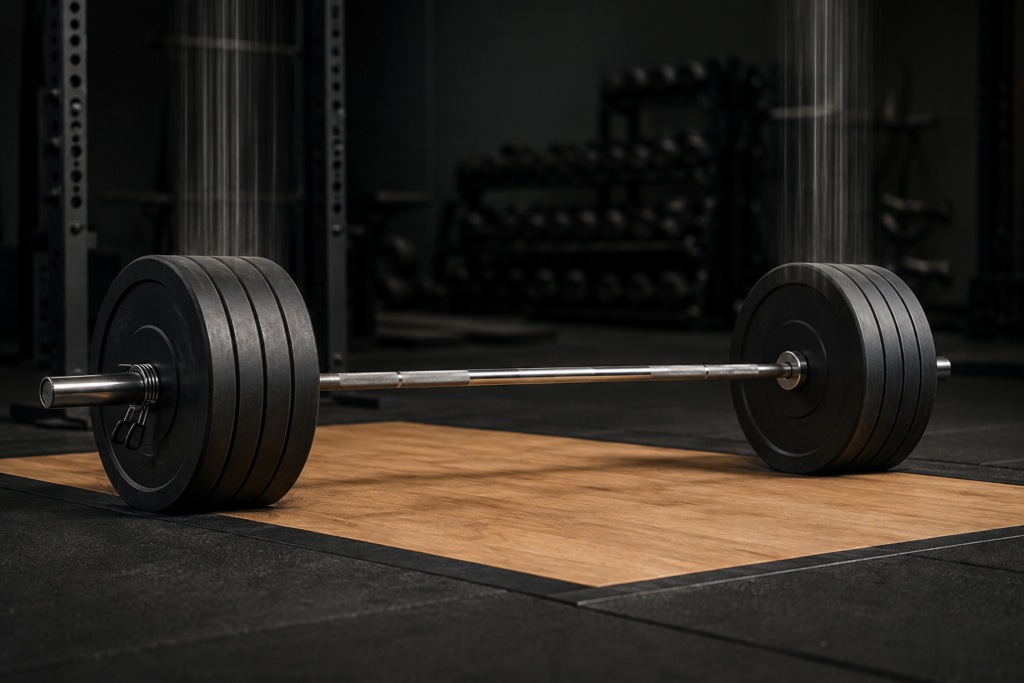
Bounce is the behavior buyers feel most viscerally and understand least precisely, and the vocabulary around it has grown more important as the dead-bounce category has moved from novelty to mainstream. When a loaded bar is dropped, the plates compress and then rebound, and how high and how predictably they rebound determines whether the platform is safe, whether the bar travels toward the lifter, and whether neighbors file noise complaints. Historically buyers accepted whatever bounce their chosen durometer produced, but the market has matured, and there is now a meaningful distinction between standard-bounce plates, low-bounce plates, and purpose-built dead-bounce designs that are engineered to kill rebound almost entirely. The three subsections below explain what physically causes bounce, define where dead-bounce plates genuinely add value versus where they are unnecessary cost, and give you a repeatable way to test bounce on samples so you are comparing evidence rather than adjectives. The reason this vocabulary is worth mastering is that bounce sits squarely at the intersection of safety, customer satisfaction, and liability, and getting it wrong is expensive in ways that unit price never captures. A platform where bars rebound unpredictably injures lifters and invites complaints, while a facility that eliminated bounce it never actually needed may have overpaid for a premium it cannot feel. Precision here is not pedantry; it is the difference between specifying the plate your customer genuinely needs and merely guessing, and guessing on bounce is one of the more consequential mistakes a buyer can make in an entire equipment order.
What Causes Bounce
Bounce is fundamentally a question of how much impact energy the plate stores elastically and returns versus how much it dissipates, and several design variables push that balance in different directions. Durometer is the dominant factor, since firmer rubber stores and returns more energy, but thickness, diameter, compound formulation, and even the plate’s internal structure all contribute. A thin, hard competition plate that meets the standard diameter will generally bounce more than a thick, softer training plate of the same weight, which is why competition platforms are built and lifters are coached to manage that rebound. Temperature matters too, a detail buyers rarely consider: rubber stiffens in cold environments, so a plate that behaves well in a warm showroom can bounce more aggressively in an unheated warehouse gym, and this is a legitimate risk to disclose to customers in certain climates. Uneven or poorly controlled bounce, where a plate kicks unpredictably to one side, is usually a manufacturing defect rooted in inconsistent density or a poorly bonded insert rather than an inherent property, and it is precisely the kind of flaw that sample testing exists to catch. Understanding these causes lets you interpret a bounce complaint correctly, distinguishing an inherent characteristic of the chosen specification from an actual quality failure that the supplier should remedy.
Dead-Bounce Plates and Where They Fit
Dead-bounce plates are engineered specifically to absorb impact energy rather than return it, so that a dropped bar lands and stays put instead of rebounding toward the lifter, and they have become a genuinely useful category rather than a gimmick. They are typically achieved through softer or specially formulated compounds, thicker rubber, or multi-density construction, and they excel in exactly the environments where rebound is most dangerous or disruptive: crowded functional-fitness classes, home and apartment gyms with thin floors and sensitive neighbors, and facilities training novices who have not yet learned to control a descending bar. The trade-off is honest and worth stating plainly to your customers: dead-bounce plates usually cost more, can be thicker and thus reduce the total loadable weight on a standard bar sleeve, and are not appropriate for sanctioned Olympic weightlifting where a degree of standardized bounce is expected. They are also not always necessary; a facility that already uses appropriately soft training plates and good platform design may not need a premium dead-bounce product at all, and a supplier who pushes them universally is upselling rather than advising. The right framing for a buyer is to treat dead-bounce as a targeted solution for specific noise, safety, or space constraints, priced and positioned accordingly, rather than as a blanket upgrade for the entire catalog.
How to Test Bounce Before You Commit
Bounce is testable, and any buyer placing a meaningful order should insist on a structured bounce test rather than relying on a factory’s descriptive claims. The simplest reliable method is a controlled drop test: load a representative plate on a standard bar to a fixed weight, drop it from a consistent height onto the actual flooring the customer will use, and measure or film the rebound height, repeating several times to check consistency. Comparing your candidate plates against a known reference plate, ideally one you already trust, converts a subjective impression into a relative measurement you can defend. You should test across the weight range, because bounce behavior can differ between light and heavy plates if the factory changes compound or thickness, and you should test at the temperature range your customers will actually experience if climate is a factor. Document the results with video and notes, because this evidence is invaluable if a quality dispute arises later. This kind of disciplined sample evaluation is part of a broader approach to approving production, and our detailed guide on the details to check before approving a sample walks through how to inspect free weights systematically. Skipping the bounce test to save a week is one of the most common and most expensive shortcuts a buyer can take, because bounce complaints surface only after the full container has shipped.
Standards, Tolerances, and Certifications to Specify
Once you understand construction, durometer, and bounce, the next step is to translate that understanding into contractual language, because a specification that lives only in a phone call is a specification you cannot enforce. Standards exist precisely so that buyer and supplier share an objective reference, and the discipline of citing them turns vague expectations into verifiable requirements. For competition-oriented plates, the International Weightlifting Federation publishes equipment specifications covering diameter, color coding by weight, collar opening, and tolerance, and referencing that standard in your purchase order immediately raises the quality conversation to a professional level. For quality-system assurance, a supplier certified to ISO 9001 has demonstrated that it operates documented processes and corrective-action procedures, which matters more for consistency across repeat orders than any single sample can prove. For buyers importing into the European Union, chemical compliance is a real and sometimes overlooked obligation: rubber compounds can contain polycyclic aromatic hydrocarbons and other restricted substances, and the REACH regulation restricts these in consumer articles, so requiring compliance documentation protects you from a customs or liability surprise. The table below summarizes the specification points that belong in a serious bumper plate purchase order, and writing them explicitly is the difference between hoping for quality and requiring it.
| Specification Point | What to State in Your PO | Why It Matters |
| Weight tolerance | Training: ±1%; Competition: ±10–30 g | Prevents disputes and protects credibility with serious lifters |
| Durometer (Shore A) | Target value and acceptable range (e.g. 84 ±3) | Governs bounce, noise, and durability; must be measurable |
| Rubber compound | Virgin / recycled ratio stated in writing | Drives odor, batch consistency, and fatigue life |
| Insert & collar | Stainless or plated insert; 50.4 mm opening | Prevents wobble, corrosion, and bar-fit problems |
| Reference standard | IWF equipment spec for competition discs | Objective, enforceable quality baseline |
| Quality system | ISO 9001 certification of the factory | Consistency across repeat production runs |
| Chemical compliance | REACH / PAH documentation for EU imports | Avoids customs holds and product-liability exposure |
Specifying standards on paper is necessary but not sufficient; you also need a plan for independent verification, because a certificate is only ever as good as the auditing behind it. For high-value orders it is prudent to commission a third-party inspection or an accredited laboratory test that measures durometer, verifies weight on a calibrated scale, and subjects a sample to a repeated drop-cycle test that simulates months of use in a few hours, since fatigue failures at the insert rarely reveal themselves in a single drop. It is equally important to weigh the alternatives to a standard rubber bumper plate before committing, because the best specification is sometimes a different product entirely. A urethane-encased plate costs more but resists odor, tearing, and color fade far better and suits premium boutique environments; a calibrated steel plate serves competition accuracy where precise loading matters more than drop tolerance; and a cast iron plate remains the economical choice in spaces where bars are never dropped. Presenting these options honestly to your own customers, rather than defaulting everyone to the same rubber disc, is a hallmark of an advisor rather than a mere seller. Our Olympic rubber bumper plate range sits alongside calibrated and cast iron alternatives precisely so that a buyer can match the product to the use case rather than forcing one compromise across an entire facility.
Branding and color are commercial specifications too, not merely cosmetic ones, and they carry their own quality risks that belong in your written agreement. Color on bumper plates can be integral to the rubber compound or applied as raised lettering and a colored ring, and integral coloring generally resists fading and wear better than surface application, which matters for plates that live under intense daily use. If your brand relies on a precise logo, specify the method, whether embossed, debossed, or printed, and require a pre-production sample that proves the branding survives repeated dropping without cracking or peeling, because a logo that flakes off after a month damages the very brand it was meant to build. Color coding by weight is also a functional safety feature, letting coaches and lifters identify loads at a glance, and aligning your scheme with recognized conventions reduces confusion in busy mixed facilities. For a distributor building a private label, consistent and durable branding across the full weight range is part of what makes a product line look professional on a showroom floor and photograph well online, so treat it with the same rigor you apply to durometer and tolerance rather than as an afterthought handled at the very end of the process.
How to Source Bumper Plates Without Costly Surprises

With specifications defined, sourcing becomes a disciplined process rather than a leap of faith, and the buyers who consistently get good outcomes are the ones who treat supplier selection as a structured evaluation with clear gates. The workflow that protects you begins long before a purchase order: it starts with a written request for quotation that states every specification discussed above, so that competing suppliers quote against identical requirements and you can compare price on a genuine like-for-like basis rather than being fooled by a cheap quotation that quietly assumes a lower-grade compound. From there you move to samples, then to a pre-production agreement on tolerances and testing, then to production with defined quality control, and finally to shipment against an inspection standard. At each gate you have the right to stop and correct course, and a supplier who resists reasonable verification at any stage is telling you something important about the relationship you would be entering. Many of the most damaging mistakes buyers make are not exotic; they are predictable lapses in this basic discipline, which is why we documented the common mistakes to avoid when sourcing from OEM factories in a companion article that pairs naturally with this one. The table that follows lays out the sourcing workflow as a sequence of gates, each with the action that protects you and the risk you are guarding against, so that when you source bumper plates you are managing a process rather than reacting to problems after they arrive.
| Stage | Buyer Action | Risk Mitigated |
| 1. RFQ | Issue a written spec: weight tolerance, durometer, compound, insert, standards | Apples-to-apples quotes; no hidden downgrades |
| 2. Supplier vetting | Verify factory certifications, references, and production capacity | Trading companies posing as factories; capacity shortfalls |
| 3. Samples | Weigh, measure durometer, and run a drop/bounce test | Gap between marketing claims and production reality |
| 4. Pre-production agreement | Lock tolerances, colors, branding, and OQC method in writing | Ambiguity that becomes a dispute after shipment |
| 5. Production & OQC | Require outgoing weighing and defect criteria; consider third-party inspection | Batch drift; cracked inserts; off-tolerance weights |
| 6. Logistics | Agree packaging, palletization, and Incoterms; plan container loading | Transit damage; corrosion; unexpected landed cost |
The most important mindset shift this workflow encodes is that quality is verified, not assumed, at every step. A confident supplier welcomes a factory audit, shares real production data, and agrees to a clear acceptance standard because it has nothing to hide and everything to gain from a long-term relationship built on delivered results. If you are building or expanding a private-label line, this same rigor extends into branding, packaging, and custom colorways, which is where an experienced OEM and ODM partner earns its keep by handling the manufacturing complexity so you can focus on selling. Sourcing well is not about squeezing the lowest possible unit price; it is about achieving the lowest total cost of ownership once returns, warranty claims, reputation, and reorder consistency are all counted, and that calculation almost always rewards discipline over shortcuts. It also pays to remember that the first order is only the beginning of the relationship, and the factory that seems marginally cheaper today can become the more expensive choice if its second and third production runs drift quietly away from the sample you originally approved. Consistency across reorders is a quality attribute in its own right, and it is best protected by documenting your acceptance standard so thoroughly that any new production batch can be judged against it objectively, by whoever happens to be doing the inspection, months or even years later.
To make the workflow concrete, it helps to see what a strong request for quotation actually contains, because the quality of your RFQ largely determines the quality of the quotes you receive back. A professional RFQ for bumper plates names the exact weights and the quantity per weight, states the target durometer and its acceptable range, specifies the compound and the minimum virgin-rubber content, defines the weight tolerance, describes the insert material and finish, cites the reference standard, lists the branding and color requirements, and states the packaging and Incoterms you expect. When you source bumper plates against a document this complete, the suppliers who can genuinely meet it reveal themselves quickly, and the ones who cannot either decline or expose their limitations in the details of their reply. A factory audit, whether conducted in person or through a reputable local agent, then confirms that the operation behind the paperwork is real, that the factory owns its molding and vulcanizing equipment rather than quietly subcontracting, and that its quality-control room holds calibrated scales and durometer gauges that are actually in use. Audits are not an insult to a good supplier; they are a normal part of professional procurement, and the factories worth working with treat an audit request as evidence that you intend to be a serious, long-term customer rather than a one-off bargain hunter.
Landed Cost, Logistics, and Risk Management
Duties and customs classification deserve specific attention, because bumper plates can fall under different tariff codes depending on their construction and stated purpose, and the wrong classification can either overcharge you or expose you to penalties if a customs authority later reclassifies your goods. Confirm the correct commodity code for your destination, understand the prevailing duty rate, and factor in any anti-dumping measures or trade remedies that may apply to rubber or steel articles from particular origins, since these can change the economics of a sourcing decision almost overnight. Inventory strategy is the other half of landed-cost thinking: because ocean freight for heavy goods involves long lead times, running out of a popular weight means either an expensive air shipment or lost sales, while overstocking ties up capital in a product that is dense, space-hungry, and slow to move. The disciplined approach is to forecast demand by individual weight rather than by set, hold safety stock proportional to each weight’s velocity and lead time, and place reorders early enough to absorb the inevitable variability of international shipping. Buyers who model these costs and cadences explicitly consistently outperform those who simply react to stockouts and invoices as they arrive, and the difference shows up directly in both protected margin and steadier customer satisfaction.
The final dimension that separates experienced buyers from newcomers is thinking in landed cost rather than unit price, because bumper plates are dense, heavy, and shipped across oceans, and the freight and handling side of the equation can rival the manufacturing cost itself. A plate that is a few cents cheaper per kilogram but poorly packed can arrive with scuffed faces, corroded inserts, or crushed edges that generate returns and destroy the apparent saving. Packing density is a real lever: because plates are heavy, a container often reaches its weight limit long before its volume is full, so how the factory palletizes and protects the plates determines both how many you can ship economically and how many arrive saleable. Moisture is the quiet enemy of any product with a steel insert crossing the equator in a shipping container, and specifying corrosion protection, desiccant, and sealed packaging is a cheap insurance policy against a rust complaint that could tarnish your brand. You should also plan for the reality that heavy freight rates, duties, and tariffs vary by destination and change over time, so building a landed-cost model with realistic assumptions, and revisiting it, protects your margin from surprises. Beyond logistics, prudent risk management means holding safety stock for your fastest-moving weights, qualifying a second source before you desperately need one, and disclosing to your own customers the honest limitations of whatever specification you have chosen, whether that is looser training tolerances or the added thickness of a dead-bounce design. None of this is glamorous, but it is exactly the unglamorous diligence that turns a bumper plate program into a dependable profit center rather than a recurring source of complaints, and it is the reason the best buyers treat sourcing as an ongoing discipline rather than a one-time transaction. When you are ready to translate these requirements into a concrete quotation and sample plan, our team is happy to help you specify and talk through a bumper plate project from compound to container.
Frequently Asked Questions
What durometer is best for bumper plates?
There is no single best durometer, because the right hardness depends on use. Softer plates around 80–84 Shore A bounce less and run quieter, which suits functional gyms, apartments, and hotels. Firmer plates around 85–90 Shore A are more dimensionally stable and favored for competition-style training where standardized bounce is expected. Define your use case first, set a target durometer with an acceptable range, and require the supplier to measure and prove it on your production batch.
What is dead-bounce and do I need it?
Dead-bounce plates are engineered to absorb impact energy so a dropped bar lands and stays put instead of rebounding. They are valuable in crowded functional classes, home and apartment gyms with sensitive floors, and novice-heavy facilities where an uncontrolled bar is a safety risk. They usually cost more and can be thicker, and they are not intended for sanctioned Olympic weightlifting. If your training plates are already appropriately soft, you may not need them, so treat dead-bounce as a targeted solution rather than a blanket upgrade.
How much do bumper plates weigh compared to their marked weight?
It depends on the tolerance you specify. Training bumper plates commonly allow plus or minus one percent, so a 20 kilogram plate could legitimately weigh between roughly 19.8 and 20.2 kilograms. Competition discs certified to the IWF standard are held far tighter, often within ten to thirty grams. Always state the tolerance in your purchase order and, for competition or resale to serious lifters, require the supplier to weigh the batch on a calibrated scale and provide the measured results.
Are cheaper recycled-rubber bumper plates worth it?
They can be, for the right use. Recycled or blended compounds lower the unit price and are acceptable for budget training plates where appearance and slight odor are not decisive. The trade-offs are stronger smell, more batch-to-batch variation, and a higher tendency to crack under heavy repeated dropping. For premium, competition, or brand-critical lines, virgin rubber justifies its cost through consistency and longevity. Ask the factory to state the exact virgin-to-recycled ratio in writing so you are comparing like with like.
How do I verify a bumper plate supplier before ordering?
Verify with evidence, not assurances. Confirm the factory is a real manufacturer with the certifications it claims, request samples and run weight, durometer, and drop-bounce tests, and lock tolerances and quality-control methods in a written pre-production agreement. Consider a factory audit or third-party inspection for large orders, and check references from existing customers. A supplier that welcomes verification and shares production data is showing you the transparency that predicts a reliable long-term relationship.
Key Takeaways for B2B Buyers
Sourcing bumper plates well is an exercise in converting a deceptively simple product into a precise, enforceable specification, and every section of this guide points back to that single discipline. The plate is an assembly of compound, insert, and bond, and understanding those components lets you ask the questions that separate serious suppliers from opportunistic ones. Durometer is the number that most predicts real-world behavior, so specify a target and range tied to your use case rather than accepting a default. Bounce is a genuine engineering trade-off, and the dead-bounce category is a targeted solution for noise, safety, and space rather than a universal upgrade. Standards, tolerances, and certifications turn expectations into contractual requirements, and a structured sourcing workflow with clear gates protects you from the predictable mistakes that surface only after a container arrives. Finally, thinking in landed cost and managing logistics, corrosion, and supply risk is what preserves the margin that good specification earns. Do these things and you will not merely buy bumper plates; you will build a dependable, low-return product line that your customers trust and reorder. When you are ready to move from planning to production, an experienced manufacturing partner can help you specify, sample, and scale with confidence, and you can explore the full weight plate range as a starting point for your own catalog.