Why Brands Keep Deciding to Own Their Own Iron
Every year, a predictable group of companies arrives at the same conclusion from different directions: it is time to put our own name on the iron. Fitness distributors tire of building someone else’s brand equity with every container they resell. Gym chains calculate what they spend furnishing new locations and realize they are funding a margin stack they could capture. E-commerce operators watch their best-selling resale dumbbells commoditize and conclude that the only durable moat is a brand of their own. And established sporting-goods retailers, whose shelves already carry private-label apparel and accessories, notice that the weight section is the last aisle still paying full tribute to national brands. The instinct is sound. Free weights are a category almost purpose-built for private labeling: the products are mature and well understood, the designs are largely unpatented, demand is broad and stable — reinforced by public health guidance such as the World Health Organization’s recommendation of muscle-strengthening activity at least twice weekly for all adults — and the gap between factory cost and branded retail price is wide enough to reward anyone who closes part of it. We watch this calculation from the factory side: Alexandave Industries has manufactured strength equipment in Taiwan since 1982, and a meaningful share of our production leaves the plant wearing our customers’ names rather than our own. That vantage point is the premise of this article: we have watched dozens of these programs from first inquiry to fifth-year reorder, and the distance between the ones that compounded into real brands and the ones that ended as clearance listings was rarely the quality of the logo or even the quality of the iron — it was the quality of two early decisions that this guide exists to improve.
The instinct is sound, but the execution is where private-label programs quietly succeed or expensively fail, and the failures almost always trace to the same two decisions made casually at the start: what to launch, and who to build it. Launch too many SKUs and the program drowns in inventory before the brand means anything; launch the wrong SKUs and the line wins no distribution; choose a factory on unit price alone and the second or third reorder arrives with drifted specifications that the brand — not the factory — answers for in the market. This guide works through both decisions in order. We define what private labeling actually involves and how it differs from the neighboring OEM and ODM models; we lay out a product-mix strategy that sequences the launch from a defensible core to a differentiated second wave; we detail the sourcing strategy — factory evaluation, specification discipline, minimums, tooling and logistics — that keeps the line consistent for years; and we close with the compliance checks, honest risks and alternatives that belong in any plan a finance team will ultimately interrogate. Where our commercial interest bears on a recommendation, we say so in the open, and the sourcing standards we propose are ones any qualified factory, ours included, should be able to meet on paper before you sign anything. Read it with your own numbers beside it — your channel’s real annual volume, your honest marketing budget, your warehouse capacity — because every framework in the next six thousand words is only as useful as the candor of the inputs you feed it, and the most expensive sentence in private labeling remains “we’ll figure that out after the first container lands.” Nothing in what follows requires scale to apply — the disciplines are identical at one container a year or one a week; only the consequences of skipping them grow.
What Private Label Free Weights Are — and the Business Model Behind Them
Terms first, because the industry uses them loosely and contracts do not forgive looseness. Private label free weights are products manufactured by a third-party factory to an agreed specification and sold exclusively under your brand — your name cast or printed on the product, your packaging, your warranty, your customer relationship. The factory’s identity typically stays invisible to the end buyer. Understanding where this model sits among its neighbors, what economics it unlocks, and whether your business is actually positioned to use it are the three questions this section answers before any catalog gets designed. The order matters: we routinely meet buyers who arrive with mood boards and logo files but cannot yet say which of the four manufacturing models they are actually proposing to enter, and the difference between those models is not branding vocabulary — it is who owns the design, who carries the tooling cost, who is allowed to sell the same product to your competitor, and whose lawyer drafts which clause. Settle the model first, because every downstream number in this article — minimums, tooling, exclusivity, liability — takes its value from that choice. It is also worth saying plainly that none of the four models is the “advanced” one: global retailers run billion-dollar programs on plain white labeling where it fits, and one-product startups sometimes justify full OEM tooling on a single differentiated design. Sophistication lies in matching the model to the economics of each SKU, which is why the strongest lines we manufacture mix models deliberately across their catalog rather than committing to one out of identity.
Private Label vs. White Label vs. OEM and ODM
Four models govern how a brand acquires manufactured product, and the differences determine your costs, your exclusivity and your legal exposure. White label is the shallowest commitment: the factory offers an existing catalog product, identical for every customer, onto which each buyer applies a logo. It is fast and requires no minimum tooling, but nothing stops your competitor from selling the same bell with a different sticker. Private labeling proper deepens the relationship: the product may start from a factory platform, but you specify meaningful choices — coating, handle spec, color standard, packaging, tolerance class — and the resulting configuration is reserved for you, usually within defined markets. OEM (original equipment manufacturing) goes further still: the factory builds to your drawings and your tooling, and the design belongs to you. ODM (original design manufacturing) inverts the authorship — the factory designs, you brand and buy. Most successful free-weight lines are built from a pragmatic mixture: white-label or lightly configured private-label items where differentiation adds nothing a buyer notices, and OEM tooling spent only where a proprietary feature genuinely sells. The full strategic comparison between these models is a subject of its own — our guide to OEM and ODM manufacturing services covers the contractual side — but for this article’s purpose the distinction to internalize is simple: the deeper the model, the higher the entry cost, the stronger the exclusivity, and the more of the quality responsibility that migrates from the factory’s name to yours. Write the chosen model per product family into the supply agreement explicitly — which items are exclusive configurations, which are open catalog, which tooling is yours — because the most corrosive disputes we have ever mediated began with two parties who each sincerely believed a handshake had meant a different model. Terminology discipline inside your own company matters just as much: when your sales deck says “our own design” about a configured platform product, your team inherits promises your contract never secured.
The Margin Logic: Why the Economics Attract Everyone
The commercial case for a private-label line rests on three stacked effects. The first is the margin capture everyone can calculate: buying at factory price rather than distributor price typically recovers the fifteen to thirty points that each intermediate layer takes in the free-weight channel, and on heavy, freight-intensive goods those points compound with volume. The second effect is subtler and ultimately larger: brand-controlled pricing. A reseller of national brands competes on street price against every other reseller of the same SKU, in a race the lowest-cost operator always wins; the owner of private label free weights competes against nothing identical, which converts pricing from a comparison exercise into a positioning decision — and in a category where freight and duty move constantly, the freedom to reprice without checking a competitor’s listing first is worth more each year. The third effect is assortment control — the ability to build exactly the weight runs, bundles and finishes your channel wants rather than the ones a national brand’s catalog happens to contain. Against these three gains stand costs that the spreadsheet-stage business plan habitually underweights: inventory ownership (you now hold the stock a distributor used to hold), quality liability (warranty claims land on your brand), marketing burden (nobody is pre-selling your name), and minimum order quantities that concentrate cash into fewer, larger bets. The honest summary we give prospective customers is this: private labeling reliably improves unit economics, but it converts a trading business into an asset-and-liability business, and companies that fail at it usually fail on the balance-sheet conversion rather than on the margin math. A simple stress test exposes readiness better than any projection: model the program with your first season’s sell-through at half of plan, and see whether the resulting inventory position is an irritation or an emergency. Operators for whom it is an irritation have the working capital and channel depth the model assumes; operators for whom it is an emergency should read the alternatives section of this article twice.
Who Should — and Should Not — Launch a Line
Three profiles are structurally well positioned to launch. Distributors and dealers with existing commercial customers are the natural first case: demand is already proven on their own order history, the channel is paid for, and the private line can be introduced alongside branded goods rather than replacing them in one jump. Gym and studio groups opening multiple locations are the second: they are their own guaranteed customer, equipment spend is already budgeted, and every installed free-weight area doubles as a brand showroom. Established e-commerce operators with audience and fulfillment infrastructure are the third, provided they respect how unforgiving heavy-goods logistics is compared with the parcel categories they grew up in. The counter-profiles deserve equal clarity, because declining an order is cheaper for everyone than managing a failed program. A startup with no channel, counting on the brand itself to create demand, is almost always premature: private labeling amplifies distribution you have, and cannot conjure distribution you lack. A buyer whose total annual volume cannot clear sensible minimums across at least a small core range will carry punishing inventory per SKU. And a buyer seeking the absolute lowest unit price on the market is better served buying whatever surplus stock is cheapest this quarter — a private line’s value is consistency and ownership, which are precisely the things the spot market does not sell. If your situation matches the counter-profiles, the alternatives section near the end of this article describes cheaper ways to test the thesis before committing tooling money. And if it matches the positive profiles, resist the opposite temptation of overconfidence: existing distribution derisks demand, but it does not derisk specification, sourcing or compliance, which is why the rest of this guide assumes a qualified operator and still spends most of its words on the ways qualified operators stumble.
Designing the Product Mix: Launch a Line, Not a Catalog
The single most common product-mix error we see is launching wide: a brand-new line that attempts dumbbells, plates, bars, kettlebells, racks, benches and accessories in one founding purchase order. The arithmetic defeats it every time — each product family multiplies into weight-run SKUs, each SKU carries minimums, and the founding order balloons into a warehouse of thinly spread inventory before a single reorder proves what actually sells. The discipline that works is the opposite: launch narrow and deep, in phases, letting each phase’s sell-through finance and inform the next. The logic is borrowed from how factories themselves think about production: a casting line earns its keep on long runs of proven patterns, not on short runs of everything, and a young brand’s capital behaves exactly the same way. Phasing also buys information, which at launch is scarcer than money — a narrow founding order converts into real sell-through data within one season, telling you which weights, finishes and price points your specific channel rewards, while a wide founding order tells you nothing except which SKUs are now occupying racking, at a tuition cost measured in containers rather than in samples. And phasing protects the brand itself: a line that launches with three families done excellently reads as a specialist with standards, while a line that launches with eight families done adequately reads as a relabeling exercise, and buyers in this category have seen enough relabeling exercises to recognize one on sight. The three subsections below describe the phasing we recommend to our own private-label customers — what belongs in the founding order, what the second wave should add and why, and the SKU arithmetic that keeps both survivable — and the table at the end condenses it into a planning reference you can lay directly over a quotation.
Phase One: The Core Trio That Carries Every Program
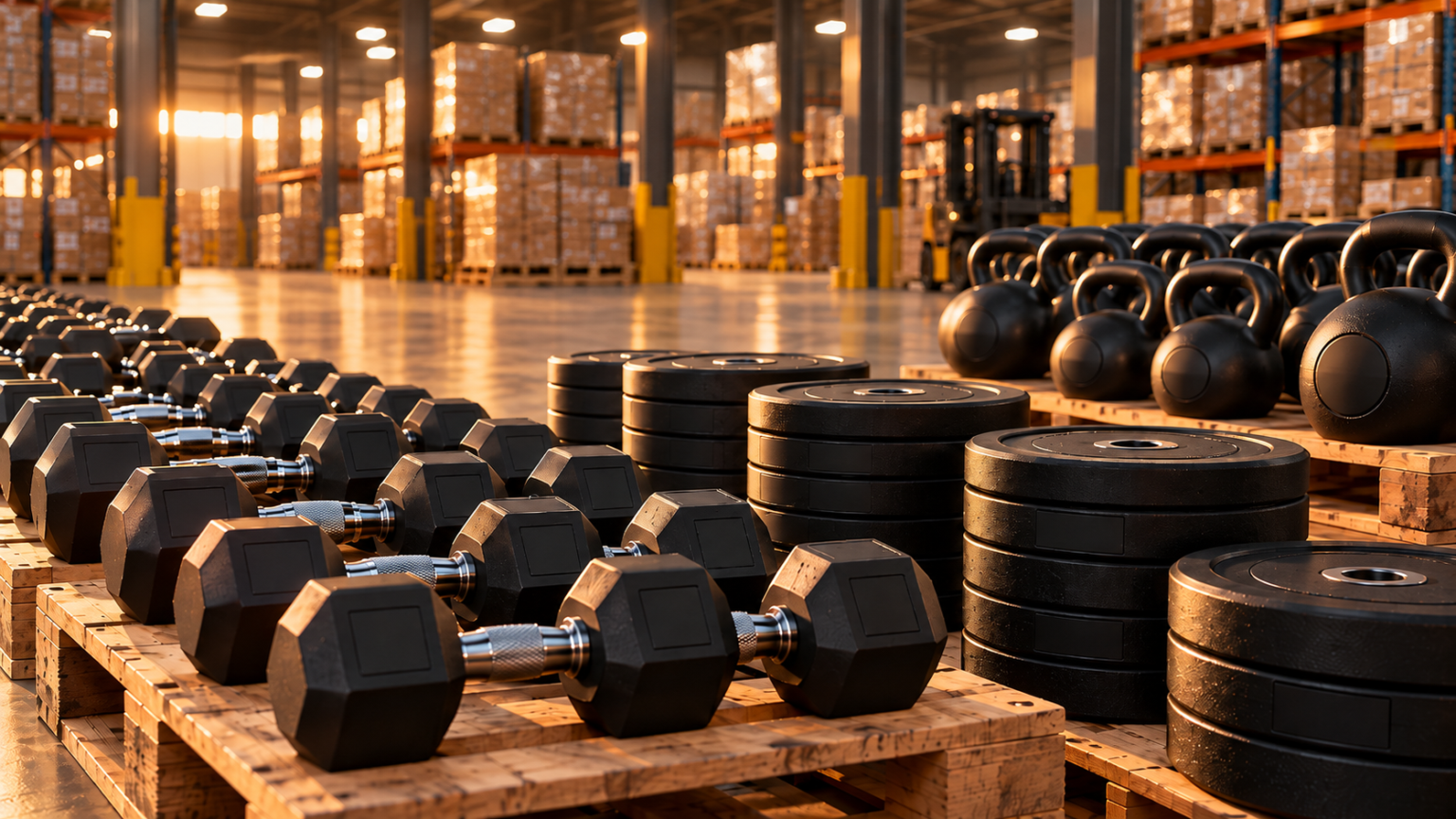
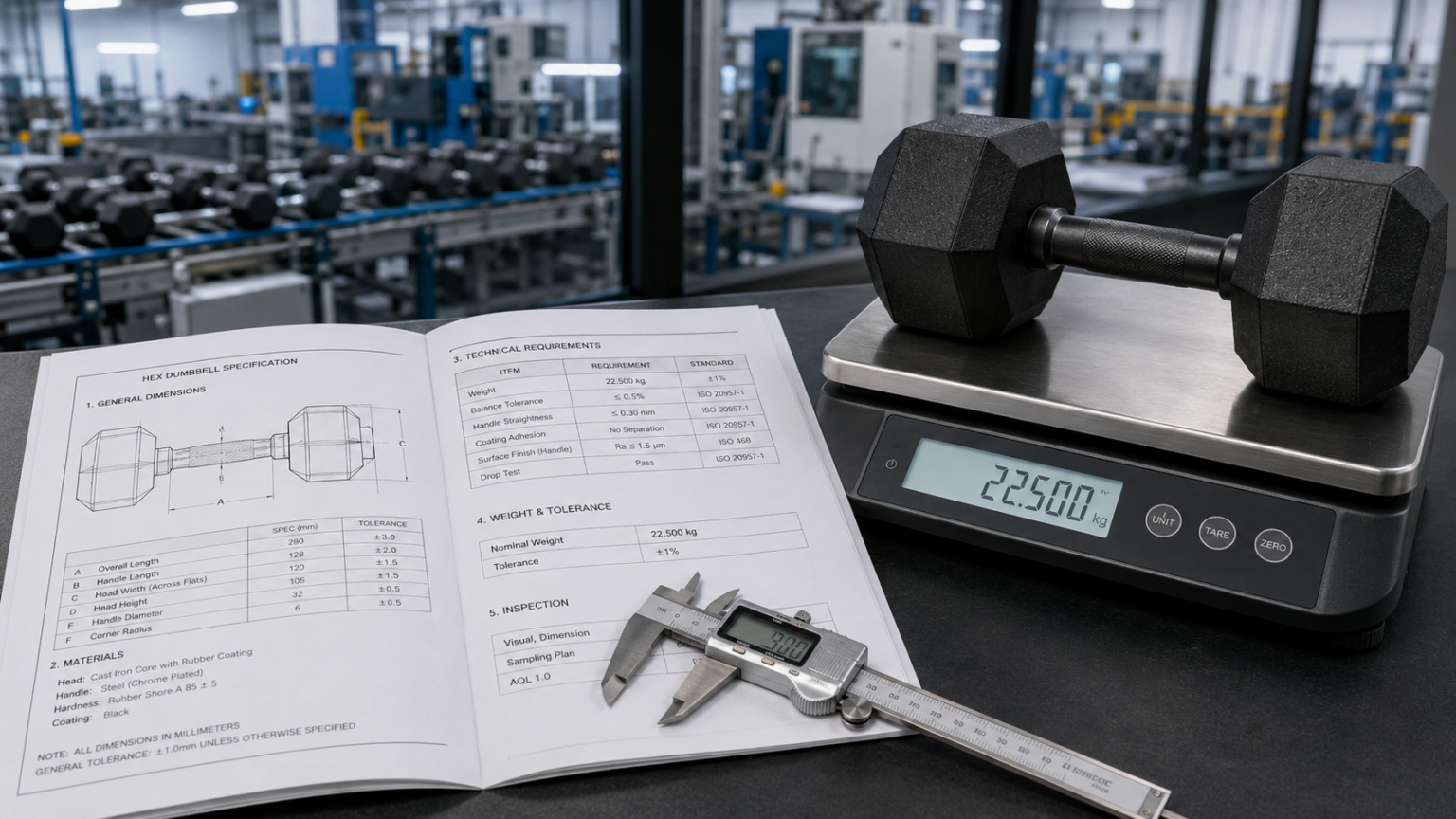
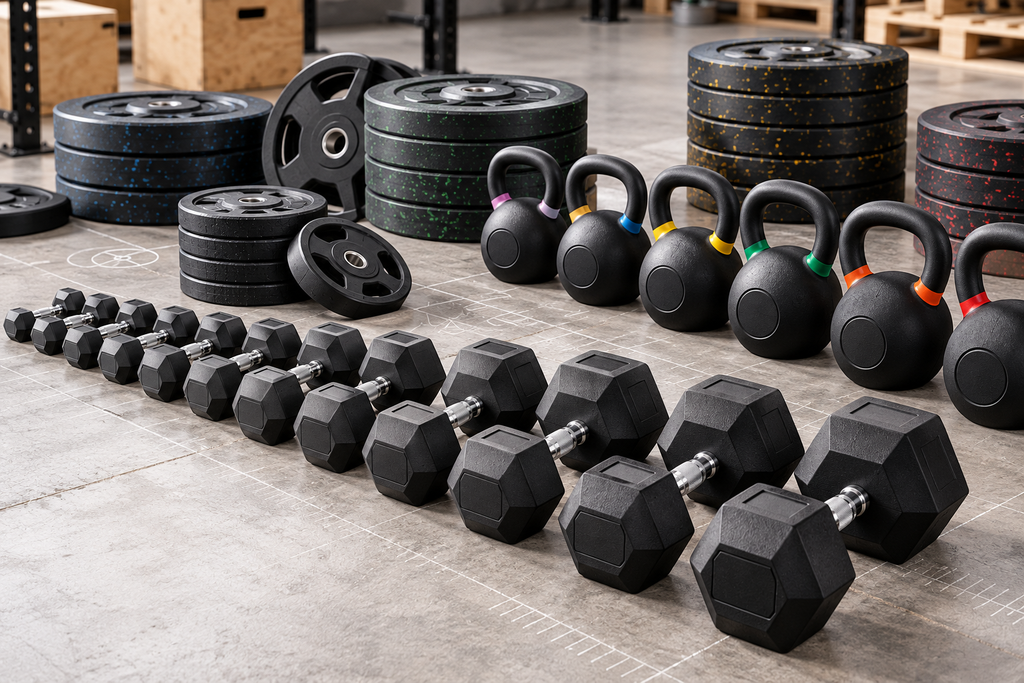
Virtually every successful free-weight line we have manufactured began with some combination of the same three families: rubber hex dumbbells, weight plates, and kettlebells. The reasons are structural rather than fashionable. These are the highest-velocity items in the category — every gym, studio, school and garage buys them, repeatedly — so they turn inventory fast enough to teach you your own demand curve. They are also the most standardized: buyers evaluate them on weight accuracy, coating quality and price, which a disciplined specification controls, rather than on patented features a newcomer cannot offer. And they brand well: a cast-in logo on a hex head or a custom color band on a kettlebell delivers brand visibility on every rep at near-zero marginal cost. Within the trio, launch depth beats breadth: a hex dumbbell run from 2.5 to 50 kilograms in standard increments, one plate system (choose bumper or iron based on your channel, not both at once), and a kettlebell run covering 8 to 32 kilograms will outperform a shallower version of five families in every metric that matters at launch. Specification discipline is what separates a credible core from a commodity one, and it costs little: define handle diameters by weight band, coating thickness and material, and the tolerance class you will hold, in writing, before quotation. Our guides to writing a dumbbell spec sheet and weight tolerance standards exist precisely because these documents, more than any logo, are what your customers will experience as quality. The core trio also teaches the factory relationship itself at low stakes: color matching, packaging approval, inspection rhythm and claims handling all get rehearsed on forgiving products before any proprietary tooling raises the cost of a misunderstanding.
Phase Two: Differentiation and the Second Wave
Once the core trio is reordering predictably — our rule of thumb is two clean reorder cycles, typically six to twelve months in — the line has earned a second wave, and the selection logic changes from velocity to differentiation. Phase two is where tooling investment starts to make sense, because now it rides on proven distribution. Candidates fall into three groups. The first is completions: the products your existing customers ask for next — bumper plates if you launched iron, fixed barbells, a bench — where the sale is already half made; the specification homework for the bumper route is covered in our bumper plate sourcing guide. The second group is margin builders: specialty finishes and competition-spec versions — calibrated plates to a defined tolerance class, competition kettlebells with regulation color codes — which sell in lower volume but reposition the whole brand upward; the reference standards for calibrated discs used in sanctioned sport, such as the International Powerlifting Federation’s technical specifications, give a private line an objective quality language to borrow even when selling to gyms that will never host a meet. The third group is proprietary differentiators: an OEM handle geometry, an inclusive feature such as braille weight markings, a storage-friendly head profile — the one or two items where your line stops being interchangeable. Our candid advice, against our own short-term interest as a tooling vendor: fund at most one proprietary project in phase two. Differentiation concentrated in a single hero product markets the entire line; differentiation scattered across five projects buys five tooling bills and no story. Choose the hero where your channel’s feedback is loudest — the complaint your customers repeat about everyone’s product is a tooling brief already written for you.
SKU Depth, Weight Runs and the Arithmetic of Minimums
Product-mix strategy ultimately succeeds or fails at the level of SKU arithmetic, so run the numbers before falling in love with any catalog. A hex dumbbell line from 2.5 to 50 kilograms in 2.5-kilogram steps is twenty SKUs; at a plausible per-SKU minimum, the founding dumbbell order alone can approach a container, which is precisely why factories and experienced buyers both prefer mixed-container programs — minimums applied across a balanced assortment rather than per item in isolation. Three practical rules keep the arithmetic survivable. First, weight the order toward the middle of each run: demand for dumbbells concentrates between 5 and 25 kilograms and for kettlebells between 8 and 24, so order depth there and minimum quantities at the extremes, however complete a full run looks in a catalog. Second, let packaging carry assortment: retail-channel lines sell pairs and sets — a 5-to-25-kilogram dumbbell set is one SKU to forecast instead of nine — while commercial channels buy open stock; decide which game you are playing per channel before the order, not after. Third, reserve 10 to 15 percent of founding-order budget for reorder flexibility rather than spending it all on launch breadth: the fastest-selling SKU in every new line sells out first and teaches you more than any forecast, and the brands that look competent at month six are the ones holding cash to chase that signal while their launch-heavy competitors wait for a factory slot with empty best-seller racking. How minimums, tooling amortization and these mix decisions interact with per-unit cost is quantified in our kettlebell tooling and MOQ guide, whose logic extends to the rest of the category.
| Launch Phase | Product Families | Selection Logic | Tooling Exposure | Typical Timing |
| Phase 1 — Core | Rubber hex dumbbells (2.5–50 kg), one plate system (bumper or iron), kettlebells (8–32 kg) | Velocity and standardization; brand via cast logos and color, not tooling | None to minimal | Founding order |
| Phase 2 — Completion | Second plate system, fixed barbells, bench, storage racks | Existing customers’ next purchase; attach to installed base | Low | After 2 clean reorder cycles (~6–12 mo) |
| Phase 2 — Margin builders | Calibrated plates, competition kettlebells, premium finishes | Reposition brand upward; borrow objective standards language | Low to moderate | With completion wave |
| Phase 2/3 — Proprietary | One OEM differentiator (handle geometry, inclusive features, storage profile) | Single hero product that markets the whole line | High (own tooling, own design) | Only on proven distribution |
| Ongoing | Reorder depth in mid-run weights | Chase sell-through signal; hold 10–15% budget back at launch | None | Every cycle |
Sourcing Strategy: Choosing the Factory That Will Wear Your Name
Every claim your brand makes, a factory has to keep. That sentence should govern the entire sourcing process, because in a private-label structure the market never sees the factory — your label absorbs every variance in weight accuracy, coating durability and delivery reliability as if you had cast the iron yourself. The three subsections below cover evaluation, specification and commercial structure in turn; the checklist table that follows is the one-page version to carry into supplier meetings. Two realities frame everything in them. First, sourcing is a longer decision than buying: a trading purchase is settled when the goods clear inspection, but a private-label factory relationship compounds — the second order inherits the first order’s tooling, the fifth inherits four cycles of accumulated process knowledge, and switching suppliers mid-line means re-qualifying every specification and often re-cutting every mold, so the evaluation deserves the diligence of hiring a business partner rather than comparing three quotes. Second, geography is a strategy input, not a footnote: labor cost, tariff exposure, lead time, intellectual-property enforcement and engineering depth vary by manufacturing country in ways that outlast any single quotation, and the right answer depends on whether your line competes on price, on consistency or on differentiation. One framing disclosure before the detail: we are a factory soliciting exactly these evaluations, so read this section as our answer key — the standards we believe any serious supplier should meet, published where our own prospects can hold us to them, and useful to you precisely because they are checkable claims rather than marketing.
Evaluating Manufacturers: Systems Over Samples
A golden sample proves a factory can make one excellent unit; a private label needs the ten-thousandth unit to match it, which is a property of systems, not samples. Evaluation should therefore weight process evidence over showroom impressions. Start with the quality management system: certification to ISO 9001 is the baseline signal that a factory documents its processes, controls nonconformances and audits itself — not a guarantee of excellence, but the difference between quality as a system and quality as a promise. Ask next for process depth in your category: does the factory cast, machine and coat in-house, or assemble traded components? In-house process control matters disproportionately in free weights because weight accuracy is set at casting and corrected at machining, and a factory that outsources either step is reselling someone else’s tolerance. Then test traceability: can the supplier tie a finished bell back to a casting batch and a material certificate? When a customer reports a cracked head two years in, batch traceability is what separates a contained recall from a line-wide credibility crisis. Probe engineering support — whether the factory can review your drawings, flag manufacturability problems and propose cost-downs — because a supplier who only quotes what you send will also only catch mistakes after they are molded. Finally, verify export maturity: references in your market, familiarity with its labeling and liability rules, and financial stability visible in audited accounts. The broader version of this diligence, including factory-visit checklists, is in our guide to assessing OEM manufacturer reliability. One further test costs nothing and predicts much: ask the factory to describe a quality failure it has had and what changed afterward. A supplier with a real quality system answers specifically — the batch, the root cause, the corrective action — while a supplier who claims to have none is describing either a very new factory or a very selective memory, and your brand should not be the customer that finds out which. Score every candidate on the same written rubric, because sequential factory visits blur quickly and the best salesman is rarely attached to the best plant.

Specification, Tolerance and Branding Control
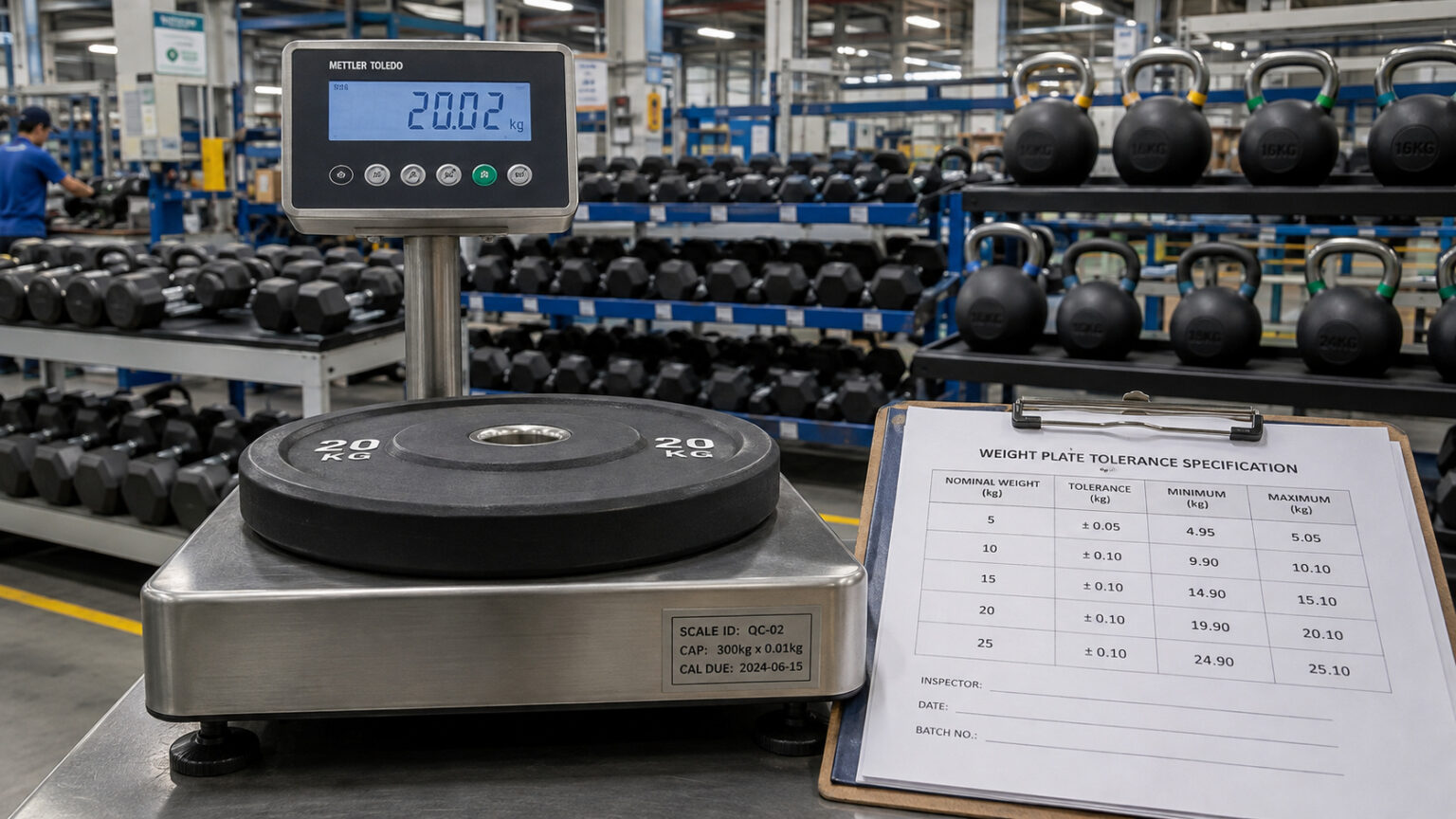
The specification pack is the constitution of a private-label relationship: everything not written there is a factory’s reasonable discretion, and reasonable discretion is where reorders drift. A complete pack for a free-weight line covers five layers. Dimensional and weight tolerance: state the class you will hold per product — general training equipment commonly runs ±1 to 2 percent on cast items, tighter on machined or calibrated product, and the grading logic of calibrated weights in metrology standards such as OIML R 111 provides the vocabulary even where you deliberately choose looser commercial classes. Materials and construction: iron grade, handle steel, rubber or urethane compound, insert design — by specification, not by adjective. Finish durability: coating type and thickness, adhesion requirements, and corrosion performance verified by salt-spray testing to ASTM B117 for plated components. Safety conformity: where products fall under the scope of stationary-equipment standards, design documentation against ISO 20957-1; for free weights generally, drop-test protocols and maximum-load declarations you can defend. And branding execution: logo application method (cast-in outlasts pad printing by the life of the product), color standards by Pantone reference, packaging artwork ownership, and — critically — a contractual statement that your tooling, your artwork and your trademarks remain yours, with the factory barred from supplying your configuration to others in your markets. Every item in this paragraph costs almost nothing at contract stage and a great deal eighteen months later; the asymmetry is the entire argument. Version the pack formally — revision numbers, change approvals in writing, one controlled copy on each side — so that when a reorder arrives different from memory, the dispute is settled by a document instead of by whoever kept better emails.
MOQ, Tooling Economics and Logistics Reality
Commercial structure is where sourcing strategy meets the balance sheet, and three numbers dominate it. Minimum order quantities in this category are driven by production economics — casting runs, coating batches, container mathematics — and are more negotiable in structure than in total: a factory that cannot halve its minimum can often spread it across an assortment, accept a two-delivery schedule against one order, or step it down after a proven first cycle; buyers who arrive with a mixed-container plan already drawn get materially better answers than buyers who ask “what is your MOQ?” item by item. Tooling cost applies only where you commission proprietary molds or fixtures, and its governing questions are amortization and ownership: whether the quote embeds tooling in unit price or bills it separately, at what volume it amortizes to irrelevance, and — non-negotiably — that paid-for tooling is contractually yours, documented, and retrievable. Logistics, finally, is the quiet margin killer in free weights because the product is nearly pure mass: freight can run 15 to 25 percent of landed cost, container utilization is a design input (plate dimensions and carton engineering determine whether you ship iron or air), and Incoterm choice allocates risk you should price rather than ignore. Model landed cost — ex-works price plus freight, duty, insurance and inland delivery — per SKU before signing anything, under current tariff conditions for your import market rather than last year’s — trade policy has repriced this category more than once in recent years, and a line whose margin assumed yesterday’s duty schedule is a line one customs notice away from repricing itself. A fuller worked treatment of consolidated free-weight purchasing sits in our complete free-weight package sourcing guide.

| Sourcing Checkpoint | What to Require | Evidence to Request |
| Quality management | Certified, audited QMS | ISO 9001 certificate, recent audit summary |
| Process depth | Casting, machining and coating controlled in-house (or disclosed) | Process flow chart, plant tour or video audit |
| Weight and dimensional tolerance | Written tolerance class per product family | Batch inspection reports; calibrated reference method (cf. OIML R 111) |
| Finish durability | Coating spec with corrosion verification | ASTM B117 salt-spray test reports |
| Safety conformity | Design documentation against applicable standards | ISO 20957-1 documentation, drop-test protocols, load declarations |
| Traceability | Batch-to-material linkage on finished goods | Material certificates, batch coding scheme |
| Branding control | Exclusivity of your configuration; IP ownership | Contract clauses: tooling ownership, artwork ownership, market exclusivity |
| Commercial structure | Assortment-based MOQ, transparent tooling amortization | Mixed-container quotation, tooling invoice and ownership letter |
| Export maturity | Experience in your import market | References, labeling compliance examples, Incoterm options |
Quality, Compliance and Protecting the Brand You Are Building
A private label concentrates risk as efficiently as it concentrates margin: every unit that leaves the factory now carries your name into strangers’ homes and businesses, and the compliance work that feels bureaucratic at launch is what keeps that concentration survivable. Four disciplines cover most of it. Incoming acceptance: attach a one-page acceptance protocol to every purchase order — weight sampling against the stated tolerance, coating inspection, logo and color verification against the standard, carton drop checks — and apply it to the first units of every batch, because specification drift across reorders, not first-article failure, is where private-label quality incidents actually originate. Market compliance: product liability rules differ by import market, and heavy goods attract attention; confirm labeling requirements, warning content and, where applicable, general product-safety obligations in each territory before the first container, not after the first incident letter. Insurance and recall readiness: carry product liability cover sized to your channel, and maintain the batch-traceability thread from the sourcing section — a recall you can scope to a batch is a bounded expense with a defined customer list, while a recall you cannot scope is an existential event that forces you to treat every unit ever sold as suspect. Claims discipline: resist the temptation to decorate the line with performance promises the specification does not support; “commercial grade” means a load rating and a test behind it, or it means a lawsuit’s exhibit A. None of this is exotic, and a factory partner with mature export customers will have templates for most of it; what cannot be delegated is the decision to take it seriously while the program is still small enough that nothing has gone wrong yet — compliance retrofitted after an incident costs multiples of compliance designed in, and regulators and plaintiffs both read the difference clearly. The same logic applies to durable commercial positioning generally — strength training’s consistent, guideline-backed demand base, summarized in resources such as the Mayo Clinic’s strength-training overview, is exactly why the category rewards brands built to last rather than lines built to flip.
Honest Risks, Failure Modes and Alternatives
An E-E-A-T-grade sourcing guide owes you the case against its own thesis, so here it is, from a factory that profits when you proceed. The dominant risk is inventory concentration: private labeling converts flexible trading capital into committed stock, and the standard failure sequence is a founding order sized by optimism, a slow first season, cash trapped in steel, and a distressed clearance that damages the brand it was meant to build. The mitigation is everything the product-mix section argued — narrow, deep, phased, with reorder budget held back. The second risk is price-war exposure: a young private label with thin marketing meets established brands and factory-direct marketplace sellers in the same search results, and if your only pitch is “the same, cheaper,” better-capitalized players can hold their breath longer; survivable positioning needs a channel advantage (your gyms, your dealer base, your audience) rather than a price advantage alone. The third is partner concentration: one factory making your whole line is one fire, strike or geopolitical disruption away from your whole catalog; dual-sourcing the core trio once volume justifies it, or at minimum qualifying a second source’s samples and holding its quotation current, is cheap insurance against the week you will otherwise spend explaining force majeure to your largest account. As for alternatives, three are legitimate and we recommend them regularly. Pure white labeling tests brand demand with near-zero tooling commitment, at the cost of exclusivity. Hybrid assortment — carrying national brands alongside a small private core — lets the known names pull traffic while your label takes the margin on commodity SKUs, and it is how many of the strongest programs we supply actually operate. And staying a distributor is an honorable answer: if your channel’s value is service and selection rather than product, a private label adds balance-sheet risk without adding what your customers buy from you. The decision is not whether private labeling is good — it demonstrably is, for the right operator — but whether you are the operator the model was built for, and the cheapest moment to answer that question honestly is before the first deposit wire, not after the first slow season.
Frequently Asked Questions
What does private label mean for free weights?
Private label free weights are dumbbells, plates, kettlebells and related products manufactured by a third-party factory to your agreed specification and sold exclusively under your brand name. You control the logo, colors, packaging, warranty and pricing, while the factory remains invisible to the end customer. It sits between white labeling (relabeled catalog product) and full OEM (your own design and tooling).
Are private label free weights profitable?
They can be — capturing distributor and brand margin typically improves unit economics by double-digit percentage points, and brand-controlled pricing avoids direct price comparison. Profitability depends less on margin math than on balance-sheet discipline: minimum order quantities concentrate cash in inventory, and slow sell-through erodes the gains. Operators with existing distribution — dealers, gym groups, established e-commerce channels — capture the economics most reliably.
Which products should a new free-weight line launch first?
Start with a deep core trio: rubber hex dumbbells (roughly 2.5–50 kg), one plate system, and kettlebells (8–32 kg). These are the highest-velocity, most standardized products in the category, they brand well through cast-in logos and color, and they require little or no tooling investment. Expand to benches, bars, bumper plates and proprietary differentiators only after the core has completed clean reorder cycles.
What is a typical MOQ for private label gym equipment?
Minimums vary by factory and product, but they are driven by casting runs, coating batches and container economics rather than arbitrary policy. Expect meaningful per-SKU minimums on cast items, with better structures available when quantities are spread across a mixed-container assortment. Factories also commonly step minimums down after a proven first cycle. Negotiate the structure — assortment, delivery schedule, step-downs — rather than just the headline number.
How do I choose a manufacturer for my own brand?
Evaluate systems, not samples. Require a certified quality management system (ISO 9001), in-house control of casting, machining and coating, written tolerance classes, salt-spray-verified finishes, batch traceability to material certificates, and contractual ownership of your tooling, artwork and trademarks with market exclusivity for your configuration. Then verify export maturity in your market through references. A factory that resists these questions has answered them.
Conclusion: Own the Line, Respect the Arithmetic
Strip the subject to its load-bearing walls and building a private-label free-weight line is two disciplined decisions executed in the right order. The first is a product-mix decision: launch narrow and deep — hex dumbbells, one plate system, kettlebells, weighted toward the middle of each run — and let two clean reorder cycles earn every subsequent expansion, with tooling money spent on a single proprietary hero only after distribution is proven. The second is a sourcing decision: choose a factory on systems rather than samples, write the specification pack as if the relationship will someday be tested in a dispute, structure minimums across assortments, own your tooling on paper, and model landed cost before celebrating ex-works price. Around both decisions runs the same perimeter fence: acceptance protocols on every batch, compliance homework per market, liability cover, traceability, and claims your tests can defend. The economics that attract everyone to private label free weights are real — margin capture, pricing control, assortment freedom — but they are paid out only to operators who treat the model as an inventory-owning manufacturer-brand business, not as reselling with better margins. If your channel is real and your arithmetic is honest, the iron aisle remains one of the most durable places in fitness to build a name; our own four decades of casting other people’s brands is, we suppose, both our credential and our bias. Start narrow, specify everything, and let the reorders — not the launch deck — tell you how big the line deserves to become. The brands that dominate this category in ten years are being founded on exactly that patience now; there is no structural reason yours cannot be one of them, and no shortcut that has ever substituted for it.
References
[1] World Health Organization. (2024, June 26). Physical activity [Fact sheet]. Retrieved October 16, 2026, from https://www.who.int/news-room/fact-sheets/detail/physical-activity
[2] International Organization for Standardization. (n.d.). ISO 9001 quality management systems. Retrieved October 16, 2026, from https://www.iso.org/iso-9001-quality-management.html
[3] International Organization of Legal Metrology. (2004). OIML R 111-1: Weights of classes E1 to M3 — Metrological and technical requirements. Retrieved October 16, 2026, from https://www.oiml.org/en/files/pdf_r/r111-1-e04.pdf
[4] ASTM International. (2019). Standard practice for operating salt spray (fog) apparatus (ASTM B117-19). Retrieved October 16, 2026, from https://store.astm.org/b0117-19.html
[5] International Organization for Standardization. (2024). Stationary training equipment — Part 1: General safety requirements and test methods (ISO 20957-1:2024). Retrieved October 16, 2026, from https://www.iso.org/standard/81908.html
[6] Mayo Clinic. (2026, June 5). Strength training: Get stronger, leaner, healthier. Retrieved October 16, 2026, from https://www.mayoclinic.org/healthy-lifestyle/fitness/in-depth/strength-training/art-20046670